Fewer than 650,000 international visitors set foot in Angola in a typical year, which means the country you’re planning to explore still feels genuinely undiscovered. That’s the good news. The less-good news: information is scattered, distances are huge, and a bad plan can turn a dream trip into a slog on unpaved roads. This guide fixes that.
Quick Answer: Your Angola Itinerary in 60 Seconds
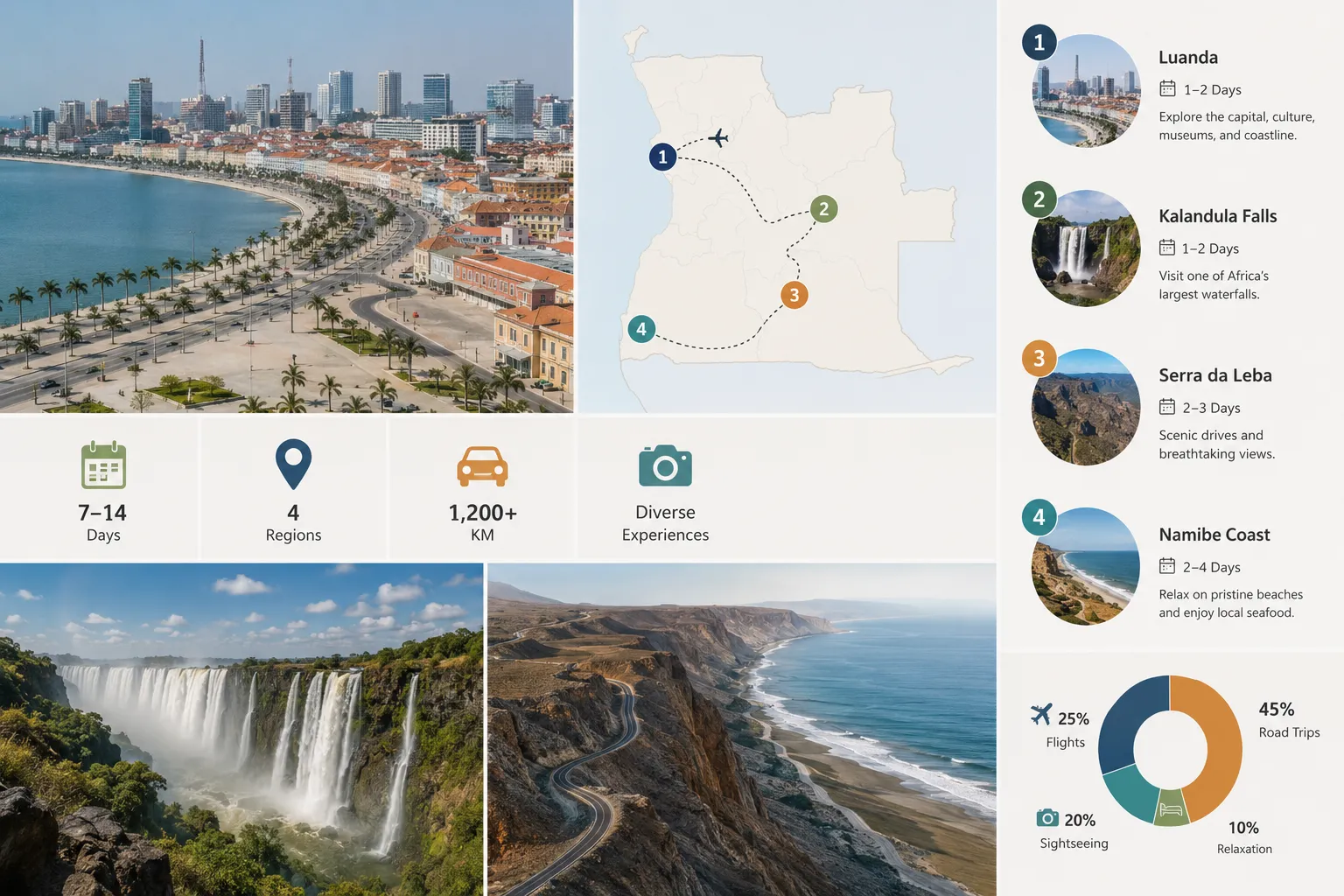
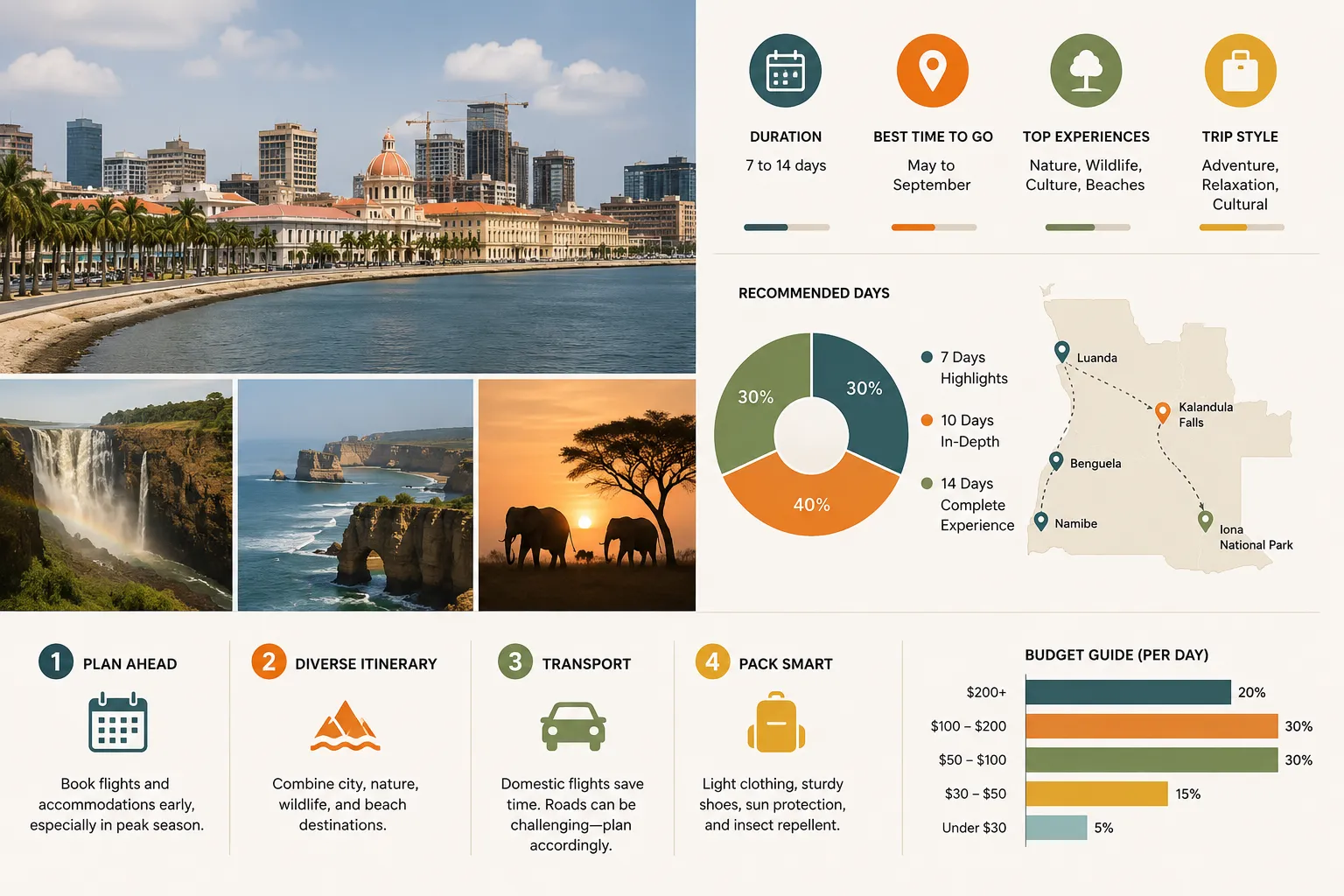
For most first-time visitors, the ideal angola itinerary is 7 to 14 days: one week covers Luanda plus either Kalandula Falls or the southern coast/highlands, while two weeks lets you combine Luanda, Malanje (Kalandula), Benguela/Lobito, Lubango (Serra da Leba, Tundavala), and Namibe. Fly domestically to save time, rent a 4x4 for the interior, and travel in the dry season (May to October) [1][5][8].
Key Takeaways
- Minimum 7 days to combine Luanda with either the north (Kalandula) or the south (Benguela, Lubango) [8].
- 14 days is the sweet spot for a full loop covering coast, highlands, and waterfalls.
- Dry season (May, October) is the best time to visit, with cooler temperatures and passable roads.
- Domestic flights (TAAG) save you 6-9 hours per leg versus driving.
- 4x4 is essential for the coastal EN-100 and most inland routes [5].
- Visa rules changed favourably for many EU passports; always verify before booking.
- Budget roughly €120,€250 per person per day mid-range, more in Luanda.
- Yellow fever vaccination is generally required for entry; malaria prophylaxis is recommended.
How Many Days Do You Need in Angola?
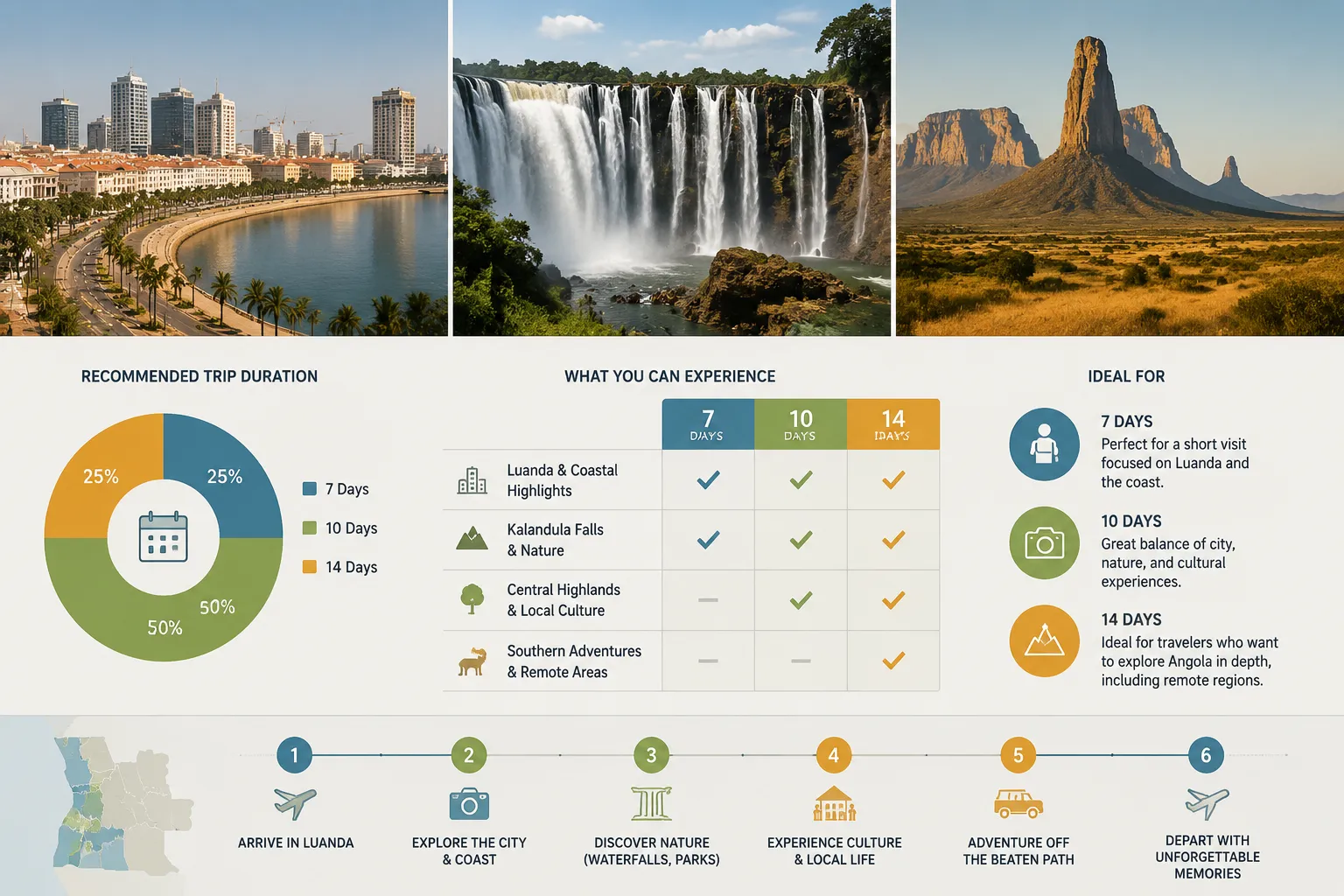
You need at least 7 days to see Angola properly, and 10-14 days to do it without feeling rushed. Anything shorter than a week means you’ll only scratch Luanda and one nearby excursion.
Here’s a rough guide by traveller type:
| Trip length | What fits | Best for |
|---|---|---|
| 3-4 days | Luanda + Mussulo or Cabo Ledo | Business extension |
| 7 days | Luanda + Kalandula or Benguela/Lubango | First-timers [1][8] |
| 10 days | Luanda + Malanje + coast or highlands | Balanced first trip [2] |
| 14 days | Full loop: Luanda, Malanje, Benguela, Lubango, Namibe | Comprehensive |
| 21+ days | Add Cabinda, Iona National Park, M’banza Kongo | Deep explorers [3] |
Common mistake: trying to do everything in a week. Distances in Angola are deceptive. Luanda to M’banza Kongo is about 468 km but takes 7-9 hours by road [3]. Build in buffer days.
What’s the Best Time to Visit Angola?
The best time to visit Angola is May to October, during the dry, cooler season. Roads are passable, humidity drops, and the interior is easier to explore. November to April brings heavy rains that can wash out dirt roads, especially in Malanje and the north.
- May, August: coolest and driest, ideal for Lubango’s highlands (1,800 m elevation, chilly nights) [5].
- September, October: warmer, still dry, great for Kalandula Falls which is fed by the wet-season runoff.
- November, April: lush but muddy; waterfalls at peak, but overland travel gets tricky.
For a deeper breakdown, see our guide on the best time to visit Angola.
Angola Itinerary 7 Days vs 14 Days
A 7-day angola itinerary forces you to choose between north (Kalandula) and south (Lubango). A 14-day trip lets you do both without racing. Here’s how the two compare in practice.
One-Week Itinerary: The Classic First-Timer Route
This is the itinerary I recommend if it’s your first time in Angola and you want a mix of city, nature, and one wow moment.
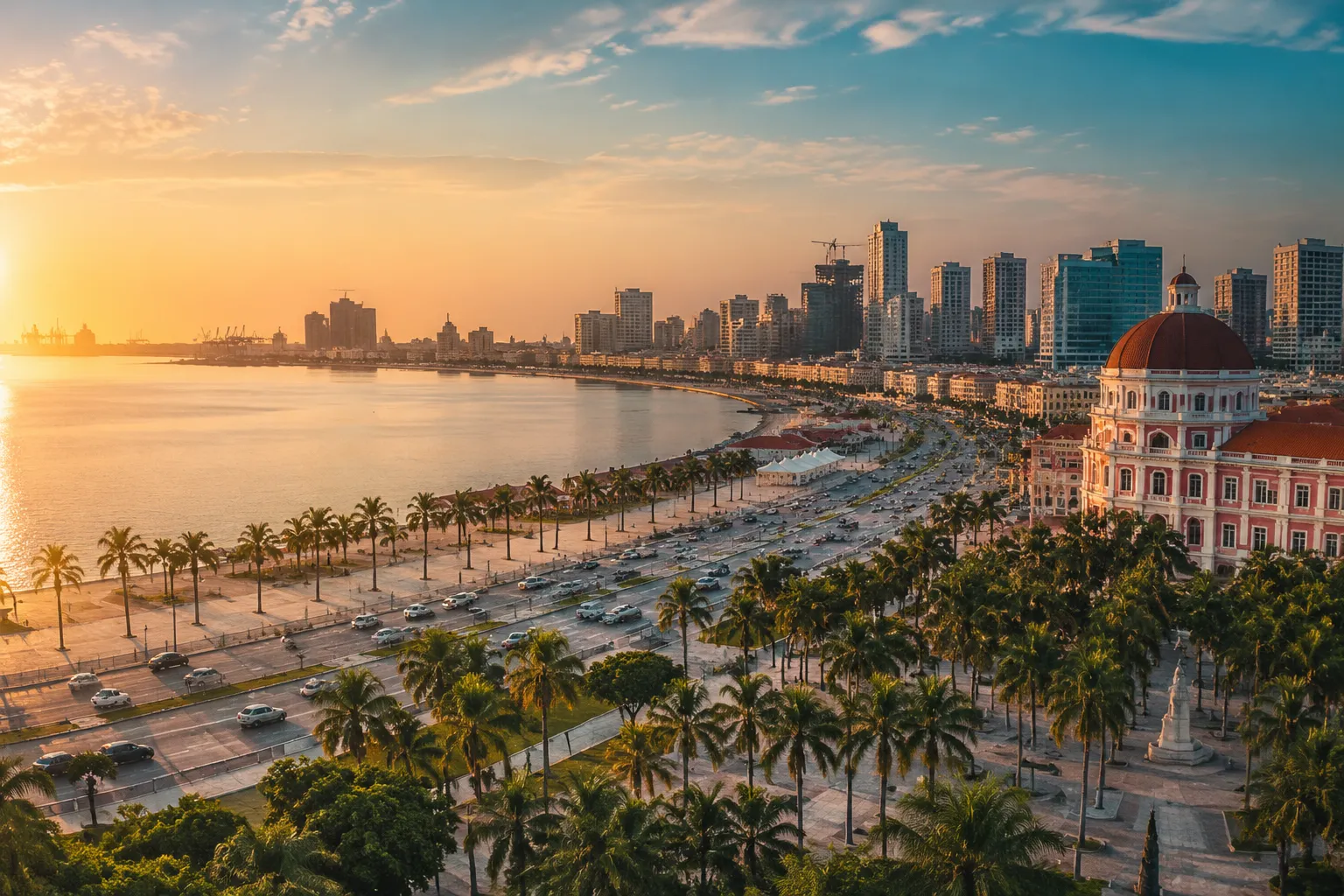
Day 1, Luanda arrival. Land at the new Dr. António Agostinho Neto International Airport (NBJ), about 40 km southeast of the centre. Check into Ilha, Miramar, or Talatona. Walk the Marginal at sunset [1].
Day 2, Luanda highlights. Fortaleza de São Miguel, National Museum of Slavery, seafood lunch on Ilha do Cabo. For more, see our full Luanda travel guide.
Day 3, Drive to Malanje. About 380 km, 6-7 hours. Overnight near Kalandula.
Day 4, Kalandula Falls + Pungo Andongo. One of Africa’s widest waterfalls, plus the surreal Black Rocks [8][9].
Day 5, Return to Luanda, then evening flight or drive south to Cabo Ledo (about 2 hours) to decompress at the beach [2].
Day 6, Miradouro da Lua + Mussulo boat trip. The “moon viewpoint” and the lagoon peninsula [8].
Day 7, Departure or an extra beach day.
Pro tip: If you want highlands instead of Malanje, swap days 3-5 for a domestic flight to Catumbela (about 1 hour), then drive up to Lubango via Baía Azul [5].
Two-Week Itinerary: The Full Loop
Fourteen days is where Angola opens up. This route combines coast, highlands, and inland waterfalls.
- Days 1-2: Luanda (arrival, city, Ilha).
- Day 3: Fly or drive to Benguela/Lobito. Praia Morena, Baía Azul.
- Day 4: Coastal drive to Lubango via EN-100 (4x4 required) [5].
- Days 5-6: Lubango, Cristo Rei, Tundavala Gap (1,000 m escarpment), Serra da Leba switchbacks [5][8].
- Day 7: Descend to Namibe. Optional day-trip toward Iona National Park (welwitschia, dunes).
- Day 8: Fly Namibe, Luanda.
- Day 9: Drive to Malanje.
- Days 10-11: Kalandula Falls, Pungo Andongo, Cangandala (palanca negra habitat).
- Day 12: Return to Luanda.
- Day 13: Kissama National Park safari day (herbivores reintroduced via Operação Arca de Noé) [3].
- Day 14: Mussulo or Cabo Ledo, then departure.
Best Places to Visit in Angola
The core anchors for any angola itinerary are Luanda, Kalandula Falls, Lubango (Serra da Leba + Tundavala), Benguela/Lobito, Mussulo, and Cabo Ledo [8]. Add M’banza Kongo (UNESCO) and Iona National Park if you have more than 10 days.
Quick hits:
- Luanda: Fortaleza de São Miguel, Marginal, Ilha do Cabo.
- Kalandula Falls (Malanje): one of Africa’s widest waterfalls [8].
- Pungo Andongo: the Black Rocks near Kalandula.
- Lubango: Cristo Rei, Tundavala Gap, Serra da Leba pass [5].
- Benguela/Lobito: colonial architecture, Praia Morena, Baía Azul.
- Mussulo: lagoon peninsula, boat day-trip from Luanda.
- Cabo Ledo: surf and beach, about 2 hours south of Luanda [8].
- M’banza Kongo: UNESCO-listed former capital of the Kongo kingdom [3].
- Cangandala National Park: habitat of the giant sable antelope (palanca negra).
More options in our overview of the top things to do in Angola.
Luanda Things to Do
Give Luanda at least 2 full days. It’s expensive, chaotic, and captivating, and it’s your acclimatisation window before heading into the interior.
Must-do list:
- Walk the Marginal at sunset.
- Fortaleza de São Miguel for history and views over the bay.
- National Museum of Slavery just south of the city.
- Ilha do Cabo for seafood and beach clubs.
- Mercado do Benfica for crafts.
- Miradouro da Lua as a half-day trip south.
- Mussulo boat day from Luanda marina.
Choose Ilha if you want beachfront. Choose Miramar if you want walkable neighbourhoods with restaurants. Choose Talatona if you’re business-first or want newer hotels [1].
How to Get Around Angola: Transportation Options
Combine domestic flights (TAAG) for long north-south hops with a rented 4x4 for regional exploration. Public transport exists but is slow and not tourist-friendly.
- Domestic flights: TAAG connects Luanda with Catumbela (Benguela), Lubango, Namibe, and M’banza Kongo. Roughly 1 hour vs 6-9 hours by road [5].
- 4x4 rental: essential for EN-100 coastal road and most inland routes. Book with a company that includes a driver if you’re not confident. Fuel is cheap by European standards.
- Taxis and ride-hailing: in Luanda, use hotel taxis or app-based services.
- Long-distance buses: possible but not recommended for first-timers.
- Trains: the historic Benguela railway (Lobito Corridor) runs, but schedules are unpredictable for tourists.
Common mistake: underestimating drive times. Angola’s roads range from excellent (Luanda, Malanje highway) to potholed dirt (much of EN-100). Always add 20-30% to Google Maps estimates.
Angola Visa Requirements (Including for Americans)
Angola has significantly loosened its visa policy in recent years. Since Presidential Decree 189/23 of September 2023, citizens of 98 countries can enter Angola visa-free for tourism stays of up to 30 days, including Dutch passports and US citizens (check the official list on evisa.ao for other nationalities). Business, work, study or longer stays still need a visa arranged in advance. Always verify the current rules with the Serviço de Migração e Estrangeiros (SME) and the official e-visa portal before you book, the situation changes.
General points (verify for 2026):
- EU nationals: many, including Dutch, French, German, Portuguese and Italian passports, are visa-free for tourism stays of up to 30 days.
- US citizens: visa-free for tourism stays of up to 30 days since September 2023; business, work or longer stays still need a visa.
- Passport validity: minimum 6 months.
- Yellow fever certificate: generally required at entry.
- Onward ticket and accommodation proof often requested.
For the full breakdown, see our guide on the Angola visa guide and check your government’s official travel advisory (for example the UK FCDO or the US State Department).
How Much Does a Trip to Angola Cost?
Angola is one of Africa’s more expensive destinations, especially in Luanda. Budget roughly €120,€250 per person per day mid-range, and €300+ in the capital.
Rough daily estimates (mid-range, per person, verify current rates):
| Category | Daily estimate |
|---|---|
| Mid-range hotel (Luanda) | €120,€200 |
| Mid-range hotel (province) | €60,€120 |
| Meals (mix local + restaurant) | €25,€50 |
| 4x4 rental with driver | €150,€250/day (shared) |
| Domestic flight one-way | €120,€250 |
| Guided day tour | €80,€180 |
Ways to save: travel as a pair or small group to share the 4x4, mix flights with driving, eat local funge and grilled fish, and stay in guesthouses outside Luanda. Note: I’m not quoting fixed prices because AOA exchange rates fluctuate; always confirm with the Banco Nacional de Angola.
Booking tip (affiliate): for tours, 4x4 packages, and hotels I usually compare a local operator like AngolaExpert with international platforms. Disclosure: some links on this site are affiliate links marked with rel="sponsored nofollow". We never invent prices or availability.
Is Angola Safe for Tourists?
Angola is generally safe for tourists who take normal precautions, but petty crime (pickpocketing, opportunistic theft) is common in Luanda. Cabinda often carries stricter travel advisories, and residual landmine risk exists in some rural areas, stay on marked paths.
Practical safety notes:
- Avoid displaying valuables in Luanda.
- Use hotel or app taxis at night.
- Don’t drive at night outside cities (unlit roads, livestock).
- Carry a copy of your passport, keep the original in the hotel safe.
- Check your government’s official travel advisory (for example the UK FCDO or the US State Department) before departure.
More detail in our post is Angola safe?.
Angola Itinerary With Kids
Angola is doable with kids over 8 who can handle long car days and warm weather, but it’s not a typical family destination. Long distances, malaria risk, and limited “kid infrastructure” mean you’ll need to plan carefully.
- Stick to coast-focused itineraries: Luanda, Mussulo, Cabo Ledo, Benguela.
- Skip long inland drives (Malanje) unless you fly.
- Choose hotels with pools.
- Bring child-appropriate malaria prophylaxis after consulting a tropical medicine centre (in Belgium: ITG Antwerp; in NL: LCR).
Can You Visit Angola on a Budget?
Yes, but “budget” in Angola still means €60,€100 per person per day. True backpacker travel is possible if you speak Portuguese, stay in guesthouses (residenciais), take shared transport, and eat street food.
Budget tips:
- Skip Luanda hotels; use short-stay apartments.
- Eat at local quitandas and grill spots.
- Use TAAG promotional fares booked well in advance.
- Group up: 4 people in a shared 4x4 changes the maths completely.
- Travel edges of the dry season (May or October) for lower rates.
What Do I Need to Know Before Visiting Angola?
Angola rewards prepared travellers. Learn a few Portuguese phrases, carry cash (kwanza), don’t drink tap water, and pack for both tropical heat and highland chill (Lubango nights can drop below 10°C).
Pre-departure checklist:
- Vaccinations: yellow fever certificate; consult ITG Antwerp or LCR for others (typhoid, hepatitis A/B, tetanus). See vaccinations in Angola.
- Malaria prophylaxis recommended countrywide.
- Cash: kwanza (AOA); cards accepted in big hotels only.
- Language: basic Portuguese goes a long way; English is limited.
- Power: 220V, plug types C and F (European).
- eSIM: buy before arrival for reliable data.
- Travel insurance: essential, with medical evacuation coverage.
More on preparing your trip: travelling to Angola.
Angola Itinerary Without a Tour Guide
Self-guided travel in Angola is possible but demanding. You’ll need reasonable Portuguese, comfort driving a 4x4 on mixed roads, and patience with bureaucracy. Most first-timers do a hybrid: guided for Malanje/Lubango, independent for Luanda and the coast.
Self-drive works well for:
- Luanda, Cabo Ledo, Mussulo (coastal, paved).
- Luanda, Benguela (with domestic flight).
Guide strongly recommended for:
- Northern loop (M’banza Kongo, Uíge) [3].
- Lubango, Namibe via Serra da Leba.
- Iona National Park.
Best Hotels and Accommodation in Angola
In Luanda, stay in Ilha, Miramar, or Talatona. Outside the capital, options are more limited: mid-range hotels in Benguela, Lobito, and Lubango, plus lodges near Kalandula and Kissama.
- Luanda: international chains in Talatona; boutique options in Miramar; beach hotels on Ilha [1].
- Benguela/Lobito: colonial-era hotels and modern beach resorts.
- Lubango: business hotels and one or two mountain lodges.
- Malanje: a handful of hotels near Kalandula Falls, book ahead.
- Cabo Ledo: surf lodges and eco-camps.
Book flexibility if possible; internal flights and road conditions can force changes. See our full guide to accommodation in Angola.
Building Your Own Angola Itinerary: A Simple Framework
Use this decision flow to design your trip:
- Pick season: dry (May, October) for most travellers.
- Pick duration: 7, 10, or 14 days.
- Pick anchor 1 (mandatory): Luanda + one coastal day.
- Pick anchor 2: Kalandula (north) or Lubango (south).
- Pick anchor 3 (if 14 days): the other one, plus Namibe or M’banza Kongo.
- Insert transit days (add 1 day per major move).
- Reserve 1 buffer day for weather, delays, or a rest.
Conclusion: Your Next Steps
Angola isn’t a country you stumble into, it rewards planners. Pick your window in the dry season, choose 7, 10, or 14 days, and lock in your two or three anchor regions before booking flights. Then verify your visa, vaccinations, and current safety advice with official sources.
Your action list:
- Confirm dates in the May, October window.
- Check visa rules on the official Angolan e-visa portal.
- Book flights (TAAG or a European carrier via Lisbon).
- Reserve your 4x4 or guided tour early, inventory is limited.
- Get yellow fever + malaria consultation at ITG Antwerp or LCR.
- Read our Angola travel tips before you fly.
Angola is one of the last great uncrowded destinations in Africa. Plan it well and it will surprise you.
Free help from our team in Angola
Want an Angola itinerary made for you?
Tell us how many days you have and what you want to see. We send a day-by-day plan that fits your dates and budget, with transport, guides and hotels arranged by our team.
- Local team in Angola
- No obligation, nothing to pay
- Reply by email or WhatsApp
Want to keep this guide? We email you the key points with a link to every section.
Frequently asked questions
How many days do you need in Angola?
At least 7 days for a meaningful first trip, and 10-14 days if you want to combine Luanda with both Kalandula Falls and the Lubango highlands without exhausting yourself.
What's a good one-week Angola itinerary?
Two days Luanda, drive to Malanje for Kalandula Falls and Pungo Andongo, back via Cabo Ledo for the beach, ending with Mussulo or Miradouro da Lua.
Can you do a two-week Angola road trip?
Yes. A 14-day loop covers Luanda, Benguela/Lobito, Lubango (Serra da Leba, Tundavala), Namibe, Malanje (Kalandula), and Kissama. Use one or two domestic flights to skip the longest legs.
Is it easy to travel independently in Angola?
It's doable but not easy. Bring basic Portuguese, be comfortable driving a 4x4, and expect logistical friction. Many travellers do a hybrid: guided in the interior, independent in Luanda.
What's the best route for first-time visitors?
Luanda + Kalandula + Cabo Ledo for 7 days; add Lubango and Benguela for 14 days. This mixes city, waterfall, coast, and highlands with manageable transit.
Do I need a guide for a self-drive angola itinerary?
Not legally, but strongly recommended for northern provinces, remote parks, and the Lubango, Namibe descent. For Luanda, Cabo Ledo, and Mussulo you can go it alone.