
Quick Answer
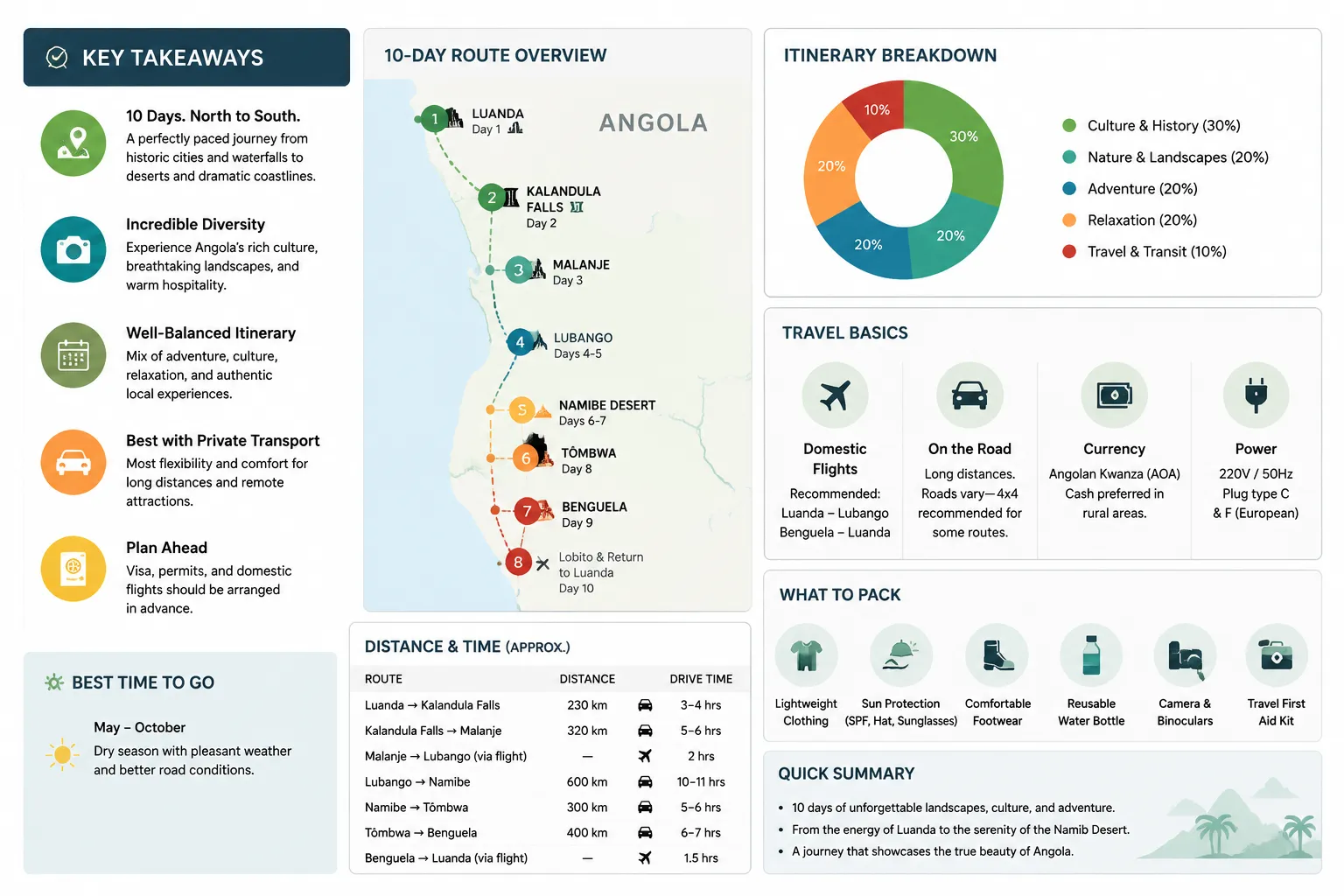
A realistic 10 day Angola itinerary from north to south starts in Luanda, loops inland to Malanje for the Kalandula Falls, then heads south along the coast to Benguela and Lobito, climbs to Lubango for Serra da Leba and Tundavala, and finishes in the Namibe desert. You’ll need one internal flight (usually Luanda to Lubango or Namibe) to make it work without exhausting long drives. Budget roughly €2,200 to €3,800 per person excluding international flights [1][2].
Key Takeaways
- Ten days is enough for the “grand” north-to-south loop, but only with at least one domestic flight to skip a 1,200+ km drive.
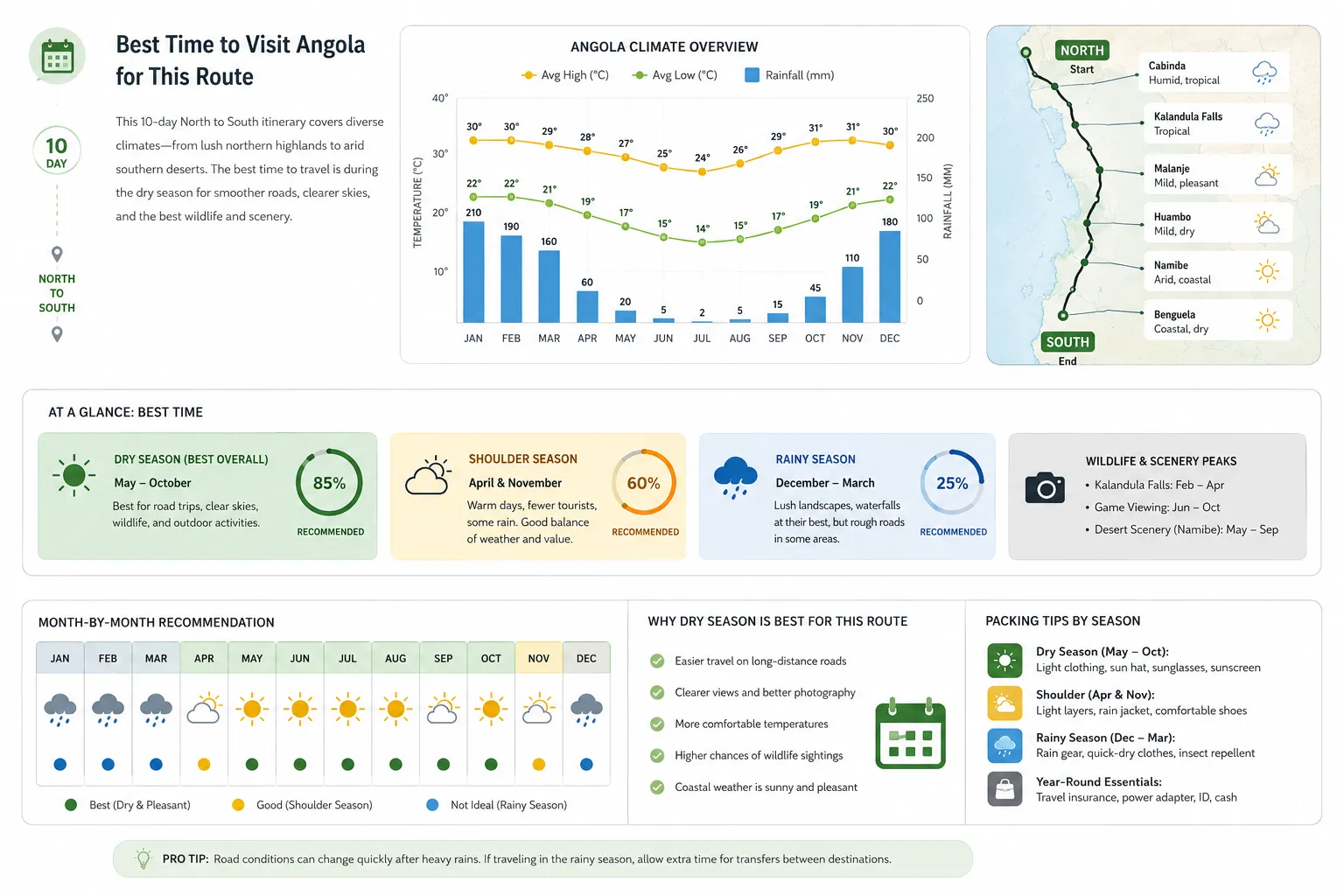
- The best months are May through October (dry season), with June to September the sweet spot for waterfalls, wildlife and cool coastal weather.
- Most EU, UK, US, Canadian and Australian travellers can now enter Angola visa-free or via a quick e-visa; verify the current rules before booking.
- Yellow fever vaccination is standard for entry, and malaria prophylaxis is strongly recommended country-wide.
- Kalandula Falls, Serra da Leba, Tundavala and the Namibe desert coast are the four unmissable natural highlights.
- English is barely spoken outside hotels; learn basic Portuguese phrases or travel with a guide.
- Expect Luanda prices closer to Paris than to neighbouring African capitals; the interior is cheaper.
- Independent travel is possible but demanding; most first-time visitors use a local operator for logistics.
What’s the best time to visit Angola for this route?
The dry season, roughly May to October, is by far the best time for a 10 day Angola itinerary. Roads to Malanje and Kalandula are passable, the Namibe desert is comfortable rather than scorching, and waterfalls still carry serious volume from the previous rains.
- May to June: Waterfalls at peak flow, landscapes still green.
- July to September: Classic dry-season weather, cooler nights in Lubango (bring a fleece).
- October: Warmer, drier, last window before the rains return.
- November to April: Rainy season, dramatic skies but muddy inland roads and higher malaria risk.
If you can only travel in the shoulder months, weight your itinerary toward the coast (Luanda, Benguela, Namibe) rather than long inland drives. For more detail, see our guide on the best time to visit Angola.
Do I need a visa to visit Angola?
For most Western travellers, no traditional visa is required. Since 2023 Angola has opened up to visa-free tourism for many nationalities (including most EU countries, the UK and several others), while others use a simple online e-visa. This has been a genuine game-shift for tourism [10].
That said, rules change often. Always verify:
- Your specific nationality on the official Serviço de Migração e Estrangeiros (SME) portal or the Angolan embassy site.
- Passport validity (usually 6+ months) and blank pages.
- Yellow fever certificate, which is checked on arrival.
Our up-to-date breakdown lives at Angola visa. Never rely on a blog (including this one) as your final source, government portals win.
Do I need vaccinations before traveling to Angola?
Yes. Yellow fever vaccination is effectively mandatory (border officials check the certificate), and several others are strongly recommended. Consult a travel clinic 6 to 8 weeks before departure.
Standard recommendations from tropical medicine institutes include:
- Yellow fever (required for entry)
- Hepatitis A and B
- Typhoid
- Tetanus/diphtheria/polio (DTP) booster
- Rabies for longer or rural trips
- Malaria prophylaxis for the entire country, year-round
Consult the WHO country page and your national travel-health service before you go. Full detail at Angola vaccinations.
The 10 day Angola itinerary day by day
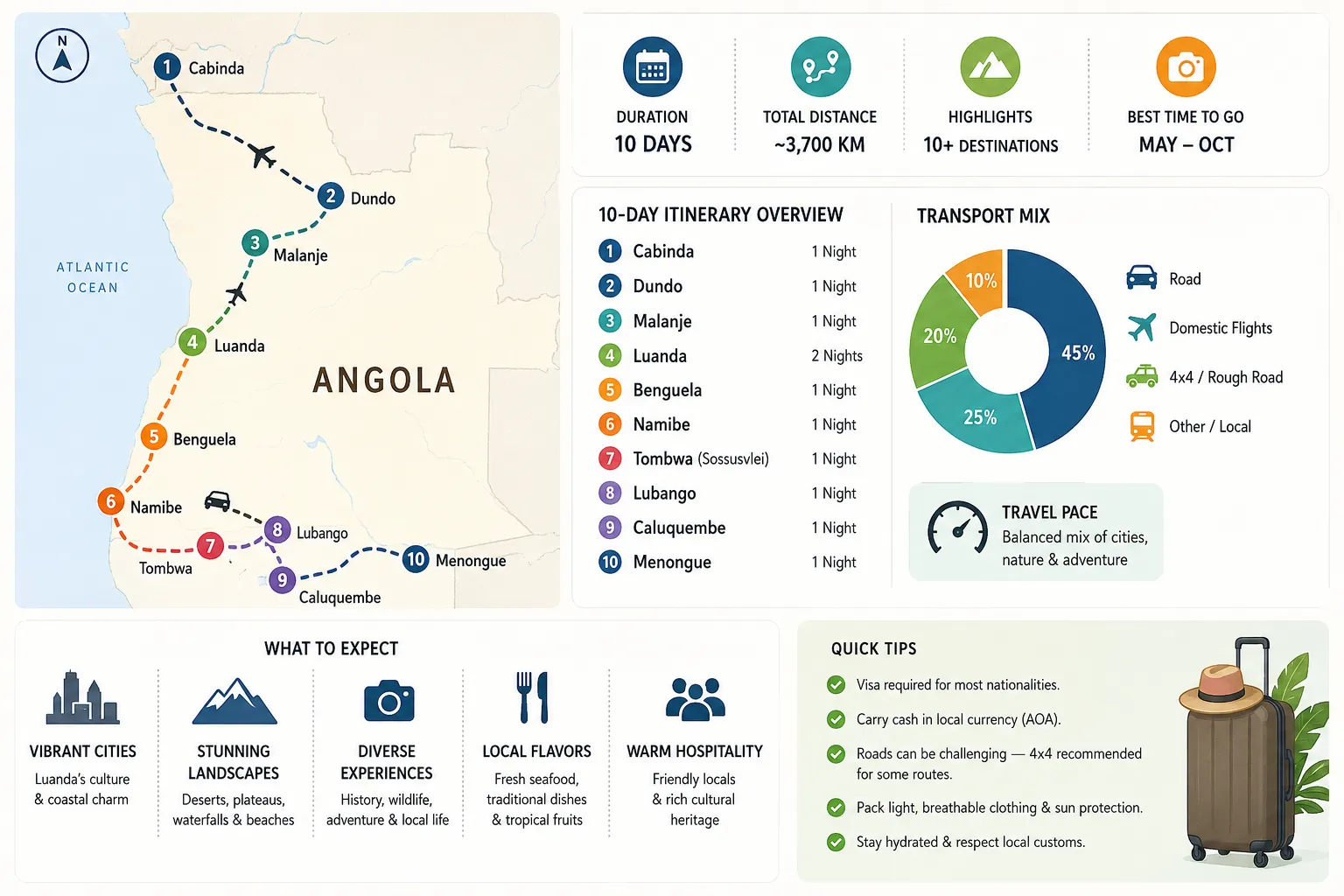
Here’s the honest, tested version of the grand north-to-south loop. It uses one internal flight to keep drives manageable [1][2][4].
Day 1: Arrive in Luanda
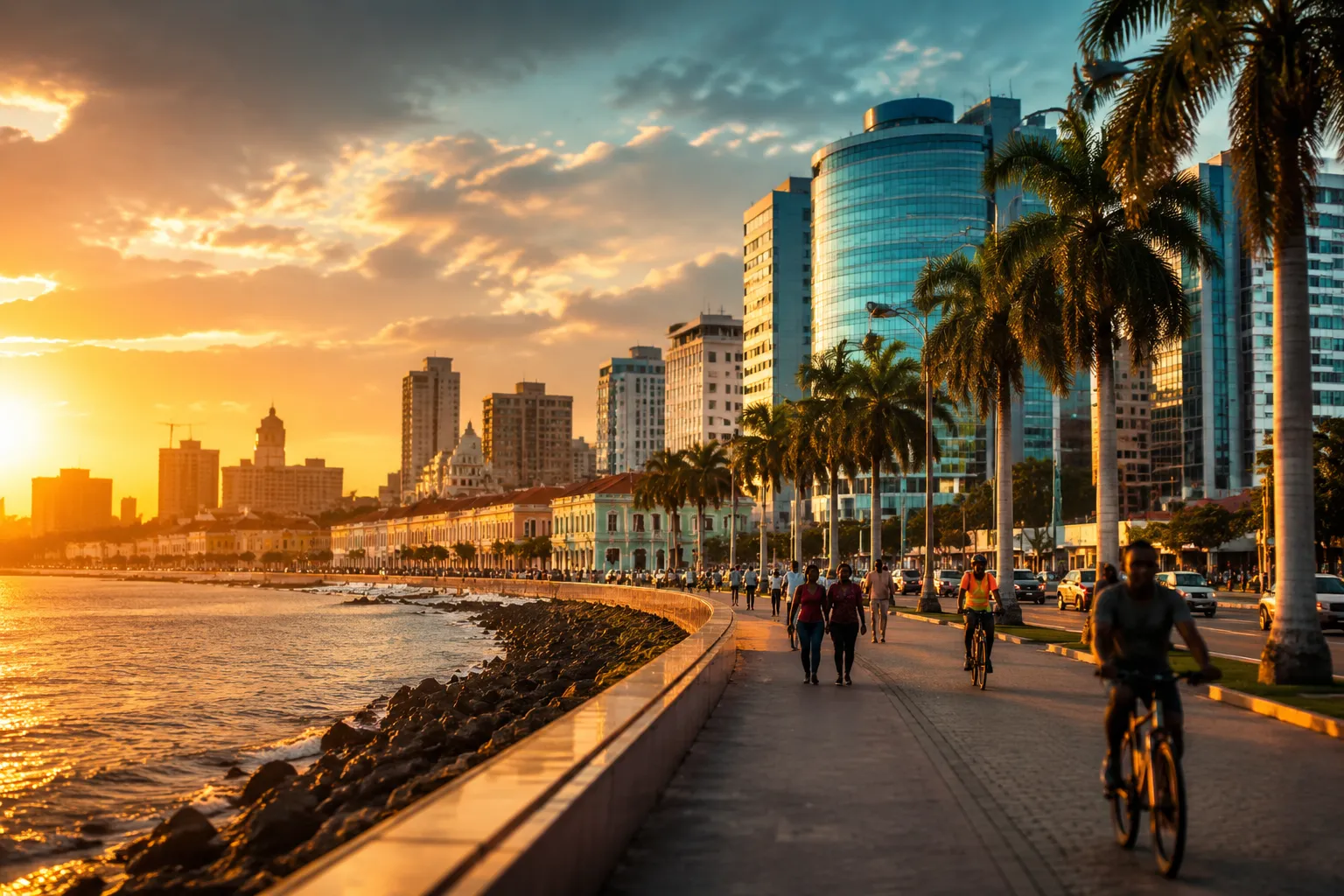
Fly into Luanda’s new Dr. António Agostinho Neto International Airport. Transfer to your hotel, walk the Marginal promenade at sunset, and eat grilled fish on the Ilha de Luanda. Recover from the flight; Luanda is intense.
Day 2: Luanda city day
Fortaleza de São Miguel, the National Museum of Slavery, the Iron Palace (Palácio de Ferro) and the colonial old town. Late afternoon coffee at a Marginal café. See our dedicated Luanda guide for neighbourhood tips.
Day 3: Kissama National Park
Drive 2 to 3 hours south along the coast. Half-day safari in Kissama (Quiçama) National Park, famous for its Operação Arca de Noé wildlife reintroduction. Overnight in a lodge inside the park or return to Luanda.
Day 4: Luanda to Malanje
Long drive east (roughly 380 km, 6 to 7 hours) to Malanje. Break the drive with a stop at Pungo Andongo (Pedras Negras), the huge black rock formations tied to Queen Nzinga’s legend [1][4].
Day 5: Kalandula Falls
The pay-off. Kalandula Falls is one of Africa’s largest waterfalls by volume. Do a sunrise viewpoint visit, then hike down to the base for the wall-of-water view. Overnight nearby. More background at Kalandula Falls.
Day 6: Fly south to Lubango
Return to Luanda (either drive back or catch a regional flight if schedules allow), then fly to Lubango in Huíla province. This flight is what saves the itinerary; the alternative is a 15+ hour drive. Evening: Cristo Rei statue at sunset over the city.
Day 7: Serra da Leba and Tundavala
Morning at the legendary Serra da Leba pass, the switchback road every Angolan puts on their postcards. Afternoon at the Tundavala Gap, a 1,000-metre escarpment with jaw-dropping views. Both are within an hour of Lubango [2][6].
Day 8: Lubango to Namibe
Descend from the highlands to the coast (roughly 3 hours). Namibe town has faded Portuguese architecture, Atlantic seafood, and access to the desert. Sunset on the beach.
Day 9: Namibe desert and coast
Half or full-day trip into Iona National Park territory or the closer desert dunes. Look for the ancient welwitschia plants and, near the coast, dramatic dunes meeting cold Atlantic surf. Optional visit to Arco, a natural rock arch with a small lagoon.
Day 10: Fly back to Luanda and depart
Morning flight Namibe to Luanda, then connect to your international flight home. If you have a long layover, squeeze in the Miradouro da Lua (“moon viewpoint”) south of Luanda on the way to the airport.
For a shorter version, see the 7-day Angola itinerary. For a deeper south, our southern Angola road trip guide adds Iona and remote coastal stretches.
Can I really do Angola in 10 days or do I need more time?
You can do a satisfying grand loop in 10 days, but only if you accept trade-offs: one flight instead of a marathon drive, and no time for Cabinda or the deep east. Fourteen days is more comfortable and lets you add Benguela/Lobito properly. Three weeks unlocks Iona National Park expeditions and Cabinda’s Mayombe rainforest [3][10].
Choose 10 days if: you have limited leave, want the “greatest hits”, and are okay flying one leg. Choose 14+ days if: you want to drive the full coast, add wildlife time in Kissama, or visit remoter regions.
How do you get around in Angola?
Realistically, you’ll combine three modes:
- Private driver with 4x4: The standard for inland routes to Malanje/Kalandula and mountain roads around Lubango. Non-negotiable in the rainy season.
- Domestic flights: TAAG Angola Airlines and a couple of smaller carriers connect Luanda with Lubango, Namibe, Catumbela (Benguela) and others. Book early.
- Taxis and ride apps in cities: Yango and Heetch work in Luanda. Outside Luanda, arrange transport through your hotel.
Self-driving is legal but not recommended for first-timers: signage is inconsistent, fuel logistics are tricky, and police checkpoints are frequent.
What’s the safest route through Angola from north to south?
The coastal-and-inland loop described above is the standard safe route: Luanda, Malanje, back to Luanda, fly south, then coast to Namibe. It stays on well-travelled roads and away from areas with residual landmine risk or restricted access [2][6].
Safety notes:
- Cabinda exclave: many Western governments advise extra caution; not on this itinerary for that reason.
- Rural tracks: stick to marked roads and paths. Some areas still have unexploded ordnance from the civil war (1975 to 2002).
- Luanda petty crime: standard big-city rules; don’t flash phones or cash.
Check current advisories from your government’s travel advisory (for example the UK FCDO or the US State Department) before you go. See is Angola safe for more nuance.
How much does a 10 day trip to Angola cost?
Angola is not a cheap destination. Luanda regularly ranks among the world’s most expensive cities for expats, and while tourism is opening up, prices reflect that [2][6].
Realistic per-person estimates for the itinerary above (2026):
| Travel style | Daily budget | 10-day total (excl. int'l flights) |
|---|---|---|
| Budget (guesthouses, shared 4x4, local food) | €100 to €150 | €1,000 to €1,500 |
| Mid-range (3-4* hotels, private driver, one flight) | €220 to €380 | €2,200 to €3,800 |
| High-end (best lodges, private guide, all flights) | €450 to €700+ | €4,500 to €7,000+ |
Add international flights (typically €700 to €1,300 from Europe on TAAG or via Lisbon/Addis Ababa), travel insurance and vaccinations.
What language do they speak in Angola, will English work?
Portuguese is the official language and the one that actually gets you around. English is spoken only in top hotels, some tour companies and by younger urban Angolans. Outside those bubbles, expect Portuguese only, plus Bantu languages like Umbundu, Kimbundu and Kikongo regionally.
Learn these before you fly:
- Bom dia / Boa tarde (good morning/afternoon)
- Obrigado/a (thank you)
- Quanto custa? (how much?)
- A conta, por favor (the bill, please)
More at Angola language.
What are common mistakes people make planning an Angola trip?
Four mistakes I see over and over:
- Trying to drive Luanda to Lubango in one go. It’s 1,000+ km on variable roads. Fly it.
- Booking in the rainy season without adjusting. Kalandula is spectacular in December, but the roads to get there might not cooperate.
- Underestimating Luanda’s cost. A basic hotel can be €150 to €250 a night. Budget accordingly.
- Assuming English works. Bring an offline Portuguese translator or hire a bilingual guide.
Bonus mistake: forgetting cash. Card acceptance is patchy outside major hotels; ATMs work but have low withdrawal limits.
Is it better to book a tour or travel independently?
For a first Angola trip, most travellers do better with a local operator handling logistics: flights, drivers, park permits, hotel bookings. Independent travel is possible if you speak Portuguese, are experienced in off-grid Africa, and have plenty of buffer time [6][7].
Choose a tour if: this is your first sub-Saharan trip, you want to fit the grand loop into 10 days, or you don’t speak Portuguese. Choose independent if: you’ve travelled overland in Africa before, speak decent Portuguese, and have 14+ days flexibility.
Luanda vs other cities, which should I prioritize?
Prioritize Luanda for 2 nights (culture, food, history), then move on. Benguela and Lobito are the most rewarding secondary cities: colonial architecture, better beaches, easier pace. Lubango is essential for the surrounding landscapes rather than the city itself. Namibe is a base for the desert, not a destination on its own.
If you had to cut one, cut Benguela/Lobito, brutal but true on a 10-day timeline. Add them back on a 14-day version.
Conclusion and next steps
A 10 day Angola itinerary from north to south is one of Africa’s most rewarding under-the-radar trips: Kalandula’s thunder, Serra da Leba’s switchbacks, Tundavala’s cliffs, and the Namibe desert meeting the Atlantic. It’s not cheap and not effortless, but that’s the point.
Your next steps:
- Check current visa and vaccination rules on official portals.
- Pick your dates in the May to October window.
- Decide: tour operator or independent (with driver).
- Book international flights early, then domestic legs.
- Read our things to do in Angola roundup to fine-tune your day-by-day.
Boa viagem.
Free help from our team in Angola
Want this north-to-south route arranged?
This route combines long drives with a domestic flight to Lubango. Tell us your dates and we plan the connections, a guide from our own team and the hotels, with a quote.
- Local team in Angola
- No obligation, nothing to pay
- Reply by email or WhatsApp
Want to keep this guide? We email you the key points with a link to every section.
Frequently asked questions
Is Angola safe for tourists in 2026?
Generally yes, in the areas covered by this itinerary. Petty crime happens in Luanda; violent crime against tourists is rare. Avoid Cabinda unless you have specific reasons and check your government's current advisory.
What currency do I use and can I pay with cards?
The Angolan kwanza (AOA). Cards work in Luanda hotels and some restaurants; carry cash for everything else. Exchange at banks or official bureaux, never on the street.
Do I need travel insurance?
Yes, and specifically one covering medical evacuation. Healthcare outside Luanda is limited.
Can I drink the tap water?
No. Bottled or filtered water only, everywhere in Angola.
What plug type does Angola use?
Type C and F (standard European two-pin), 220V/50Hz. No adapter needed from most of continental Europe.
How far in advance should I book?
Two to four months for dry-season travel (June to September). Domestic flights and the better lodges fill up.