Quick Answer
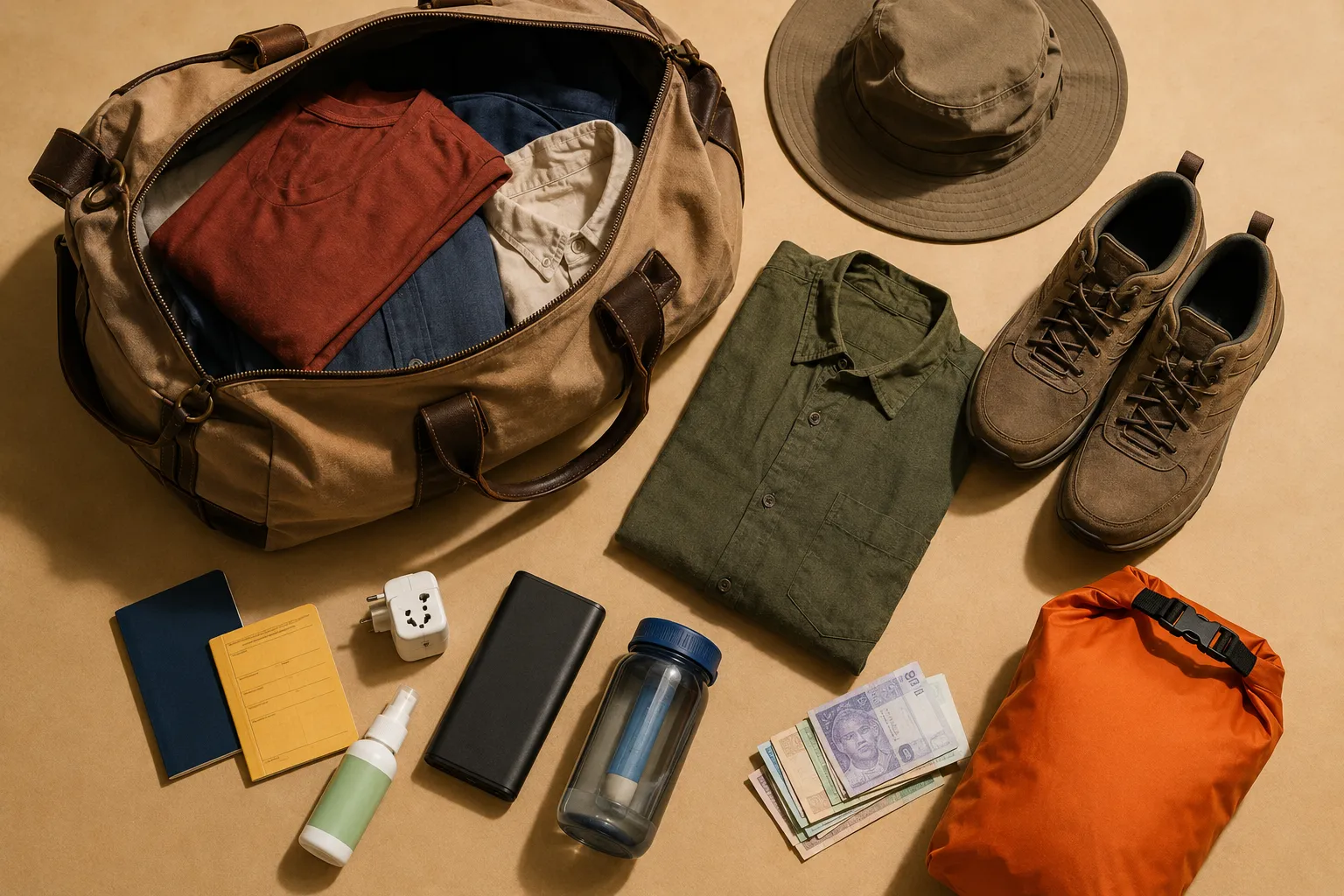
For an Angola packing list, what to pack comes down to five things most travellers underestimate: your yellow fever vaccination certificate (a standard entry requirement), a Type C/F plug adapter for Angola’s 220V sockets, cash because card acceptance is limited outside big cities and hotels, serious mosquito protection because malaria is present across much of the country, and modest clothing for cities and villages where beachwear stays on the beach. Everything else is climate-driven: light and breathable for coastal Luanda, warm layers for Lubango and the southern desert nights.
Key Takeaways
- Documents first: passport with at least six months’ validity and blank pages, printed visa or e-visa approval, insurance papers, and your yellow fever certificate.
- Cash is not optional. Bring some US dollars plus a modest amount of kwanza for arrival, and expect to pay cash outside Luanda and major hotels.
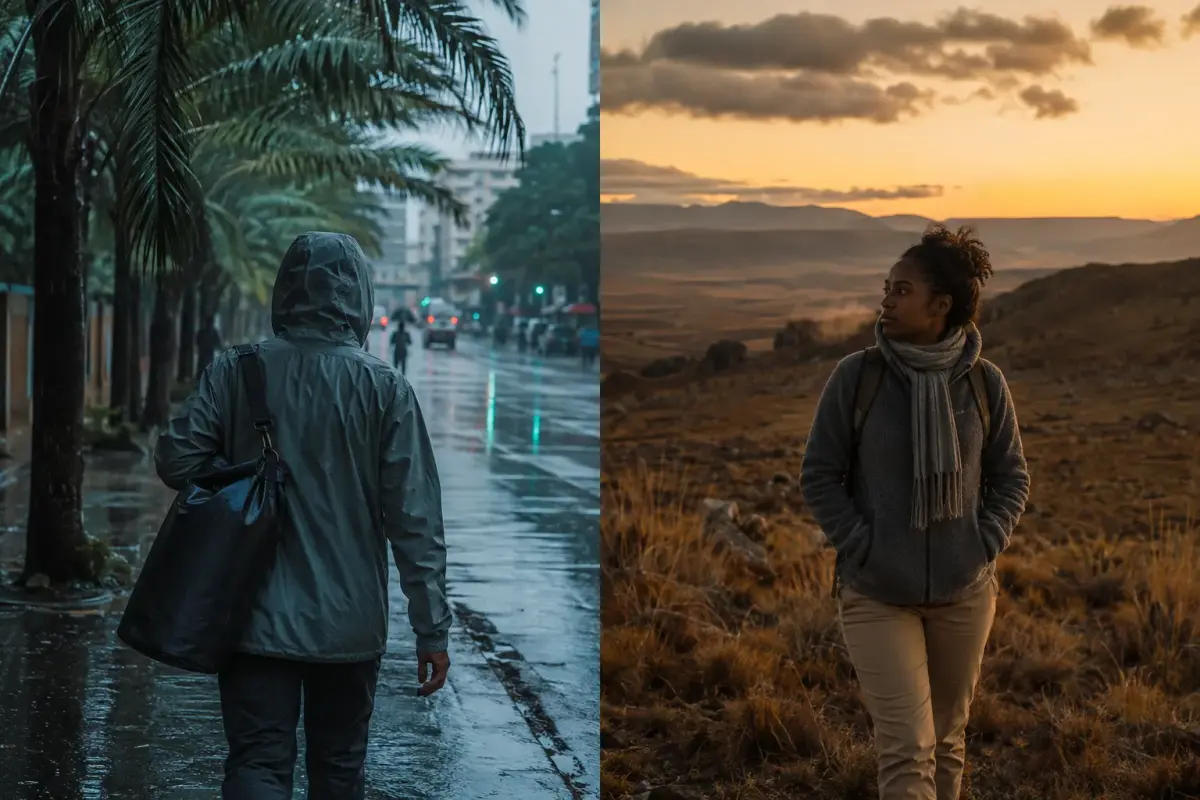
- Two climates, one suitcase. Coastal Angola is warm and humid; the Huíla highlands and far-southern desert nights are genuinely cold.
- Adapter, not just a converter. Angola uses European Type C and Type F plugs at 220V. UK, US, Irish and Australian visitors need an adapter, and US travellers should confirm their devices are dual voltage.
- Repellent with a high DEET concentration plus long sleeves at dusk does more for you than any single product in your bag.
- Dress conservatively in towns, markets and rural areas. Smart casual gets you further than resort wear.
- Soft-sided luggage plus a daypack handles Angola’s mixed roads and small aircraft better than a rigid hard-shell case.
- Leave behind: drone kits without permits, camouflage clothing, unlabelled loose medication, and anything you would be upset to lose.
What’s the weather like in Angola by season?
Angola has two seasons, not four. The dry, cooler season runs roughly May to October and is the most comfortable window for travel. The wet season runs roughly November to April, with the heaviest, most sudden rain in that same window. Coastal Luanda stays warm and humid year round, cooled slightly by the Benguela current, while the highlands around Lubango and Huambo are noticeably milder and the far-southern desert drops sharply at night.
That is the short version. For month-by-month temperatures and rainfall patterns, see the Angola weather and climate guide, and if you are still choosing dates, the best time to visit Angola breaks down the trade-offs.
Decision rule: if you are travelling between November and April, treat rain gear as core kit rather than an afterthought. Between May and October, redirect that space toward a warm layer and sun protection.
What should I pack for Angola’s rainy season vs dry season?
Rainy season packing is about staying dry and protecting electronics; dry season packing is about sun, dust and cold nights.
Wet season (roughly November to April):
- A lightweight, packable rain shell with a hood. Umbrellas are near-useless in a tropical downpour with wind.
- A dry bag or two (5 to 10 litres) for camera gear, passport and phone. Roads flood and boat transfers to places like Mussulo get spray.
- Quick-drying trousers and shirts in synthetic or light merino. Cotton stays wet for hours in high humidity.
- Sandals or water shoes for flooded streets, plus a second pair of closed shoes so you always have something dry.
- Extra ziplock bags or packing cubes to separate damp clothing.
Dry season (roughly May to October):
- Warm layers. A fleece or light insulated jacket, long trousers and a beanie or scarf are genuinely useful in Lubango, Huambo and the Namibe desert after dark.
- Broad-spectrum sunscreen, wide-brim hat and sunglasses. Highland sun is deceptive because the air feels cool.
- A buff or light scarf for dust on gravel roads.
- Lip balm and moisturiser, since the interior air is dry.
Common mistake: packing only for equatorial heat. Travellers arriving in Lubango in July with nothing but shorts and t-shirts spend the evenings shivering, and there is no reliable outdoor-shop network to fix it.
What documents do I need to travel to Angola?
Bring a passport valid for at least six months beyond arrival with two or more blank pages, your visa or printed e-visa approval, proof of onward travel, accommodation details, travel insurance documents and a yellow fever vaccination certificate, which is a standard entry requirement.
Practical handling tips:
- Print everything. Do not rely on airport wifi or a phone battery at the immigration desk.
- Keep two photocopies of your passport data page and visa: one in your main bag, one in your daypack.
- Store digital copies in cloud storage and in your email as an offline-accessible attachment.
- Bring two or three passport-sized photos. They are occasionally requested for permits and registrations.
- If you drive, bring your licence plus an International Driving Permit, arranged before you leave home.
Entry rules for Angola have changed several times in recent years, so confirm the current position for your nationality shortly before departure using the Angola visa guide and your own government’s travel advisory. Never assume a rule that applied last year still applies in 2026.
What clothes to wear in Luanda and the rest of Angola
Dress in Angola is fairly conservative in cities and rural areas, and Angolans generally dress well. Aim for neat, covered and breathable: light trousers, knee-length or longer skirts and dresses, and short or long-sleeved shirts. Beachwear belongs on the beach and nowhere else.
A workable core wardrobe for one to two weeks:
- 4 to 6 breathable tops, mixing short and long sleeves
- 2 pairs of light trousers or chinos, plus 1 pair of shorts for the coast
- 1 or 2 modest dresses or skirts
- 1 long-sleeved shirt specifically for dusk, when mosquitoes are most active
- 1 warm layer (fleece or light jacket)
- Swimwear plus a cover-up or sarong for walking between beach and car
- Underwear and socks for roughly a week, then wash
Dark or neutral colours hide dust better. Avoid camouflage patterns entirely, which can attract unwanted official attention in countries with a military past.
What’s the dress code for Angola social events?
Smart and put-together. For restaurants, church, weddings and nightlife in Luanda, men do well with a collared shirt, dark trousers and closed shoes; women with a dress or blouse and skirt at or below the knee. Angolan social life, including live semba and kizomba nights, skews dressier than most European casual norms, and turning up in flip-flops and a vest will feel out of place.
Pack one smart outfit you can wear twice, in a fabric that survives being rolled in a bag.
What to pack for business travel in Angola
For business travel, pack a lightweight suit or blazer in a breathable fabric, two or three pressed shirts, closed leather shoes and business cards. Meetings in Luanda are formal, and offices are usually air-conditioned to the point of being cold, so a jacket does double duty.
Add: a laptop with a universal charger, a hard-shell folder for printed documents, a power bank for long transfer days, and small gifts if you are visiting partners. Because clothes crease in humidity, choose wrinkle-resistant fabrics or budget for hotel pressing.
Footwear: what actually works in Angola
Bring three pairs at most: closed walking shoes, sandals, and one smart pair. That covers 95% of trips without eating your luggage allowance.
- Closed, broken-in walking shoes or light trail shoes. Streets can be uneven, and paths at Kalandula Falls or in Kissama get muddy and rutted.
- Sturdy sandals for beaches, boats and hot city days. Flip-flops are fine for the sand and the hotel, not for city walking.
- One smart pair of loafers or flats for restaurants and evenings out.
- Wool or synthetic socks rather than cotton, which blisters when damp.
Edge case: if your trip includes desert or long game-drive days in Iona or Kissama, add gaiter-height socks and consider a shoe you can rinse. Skip heavy hiking boots unless you have a specific multi-day trek planned.
Do I need vaccinations and malaria medication for Angola?
Yellow fever vaccination is a standard entry requirement for Angola, and malaria is present across much of the country, so antimalarial medication and effective repellent both matter. Which antimalarial suits you depends on your health, your itinerary and the season, which is a conversation for a travel clinic or your doctor, ideally six to eight weeks before departure, not something to self-prescribe from a blog.
Take the same approach with routine and recommended vaccines (typhoid, hepatitis, tetanus, rabies for some itineraries). Our Angola vaccinations and health overview summarises what is usually discussed, and requirements do get revised, so verify current rules with an official health authority before you fly.
What to physically pack in the medical kit:
- All prescription medicines for the full trip in their original, labelled containers, plus a few spare days’ worth
- Your antimalarial course as prescribed, kept in hand luggage
- Insect repellent with a high DEET concentration, enough for the whole trip
- Oral rehydration salts, general painkillers, antihistamines, plasters, antiseptic wipes and blister care
- Treatment for traveller’s diarrhoea as advised by your clinician
- A small hand sanitiser and a water bottle with a built-in filter, since tap water is not for drinking
- A permethrin-treated mosquito net if you plan to stay in budget or rural accommodation
Do not drink tap water anywhere in Angola, including for teeth brushing in rural areas.
Can I bring certain medications into Angola?
Generally yes, for personal use, if the medication is in its original labelled packaging and you carry documentation. Bring a doctor’s letter or a copy of the prescription listing the generic drug names and the condition treated, and keep everything in hand luggage.
Where care is needed: strong painkillers, sedatives, ADHD stimulants and some psychiatric medicines are controlled in many countries, and rules differ from those at home. Check the current position with an Angolan embassy or consulate before travelling if you carry anything in those categories. Loose pills in an unlabelled organiser are the single easiest way to create a problem at customs.
Do I need power adapters for Angola?
Yes. Angola uses Type C and Type F plugs on a 220V, 50Hz supply, the standard European configuration. Travellers from the UK, Ireland, the US and Australia need a plug adapter, and US visitors should check each device is rated dual voltage (100 to 240V) before plugging in. Continental European travellers can plug in directly.
What to bring:
- A universal travel adapter covering Type C and F, ideally with two or three USB outputs so one socket serves the whole group
- A multi-plug power strip from home, which turns a single hotel socket into four
- A power bank of 10,000 mAh or more, because power cuts and long road transfers are both realistic
- A head torch or small torch for outages
- A voltage converter only if you insist on bringing a single-voltage 110V appliance, and honestly, leave it at home instead
For data, an eSIM bought before departure means you have maps and messaging from the moment you land. Compare options in the Angola SIM card and eSIM guide.
How much cash should I bring to Angola?
Bring more cash than you would for a European trip. Card acceptance is limited outside Luanda and major hotels, so plan to pay cash for taxis, markets, small restaurants, fuel, park fees and rural guesthouses. A common approach is to arrive with US dollars in good condition (clean, recent notes) plus a small amount of kwanza for your first day, then top up locally.
Sensible mechanics:
- Set travel notifications on your bank cards and carry two cards from different networks
- Split cash across your daypack, main luggage and a money belt rather than one wallet
- Keep small notes for tips and taxis; breaking large notes is often difficult
- ATMs exist in cities but can be offline or cash-empty, so never run to zero
Exchange rates and withdrawal realities shift, so read the Angola currency and money guide for current practice before setting your budget. Avoid publishing-day precision on rates in your head: check the day you travel.
Best luggage for Angola travel: backpack vs suitcase
Choose a soft-sided wheeled duffel or a 50 to 65 litre travel backpack, plus a 20 to 30 litre daypack. Angola mixes smooth city tarmac with gravel roads, sandy beach access, small domestic aircraft and hotels without lifts. Soft luggage compresses into vehicles; rigid hard-shell cases crack on rough handling and are awkward on unpaved ground.
| Your trip style | Best main bag | Why |
|---|---|---|
| Luanda business trip | Soft-sided carry-on with wheels | Smooth surfaces, formal clothing needs structure |
| Coastal route (Benguela, Lobito, Namibe) | Wheeled duffel or hybrid backpack | Sand and kerbs defeat small wheels |
| Southern road trip and parks | Travel backpack | Loading into 4x4s, no wheels to break |
| Multi-region two-week loop | Hybrid wheeled backpack | Handles both cities and gravel |
| Any trip at all | 20 to 30 litre daypack | Documents, water, camera, rain shell |
Add packing cubes (they double as a sorting system in shared rooms), a small padlock, a laundry bag, and a luggage tag on the inside as well as the outside.
What’s not allowed in Angola luggage, and what not to bring
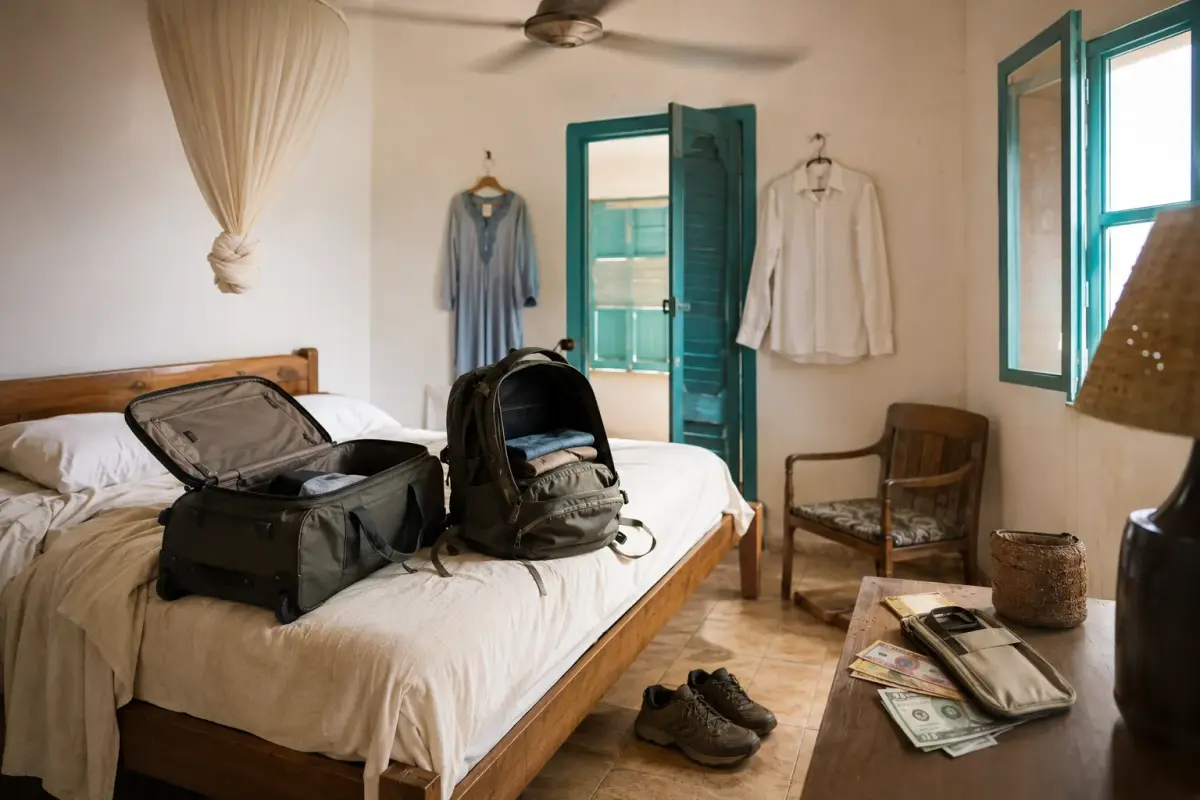
Leave out anything that invites scrutiny or loss. Rules on imports and equipment change, so check current customs guidance and your own government’s travel advisory before departure rather than trusting a list you found online.
Do not pack:
- Drones without written permission arranged in advance. Confiscation is a real risk.
- Camouflage or military-style clothing, including for children.
- Unlabelled loose medication or large quantities of anything prescription-only.
- Expensive jewellery and designer watches. Petty crime in Luanda is opportunistic, and flashy items raise your profile. The Angola safety guide covers the practical picture.
- Illegal drugs, obviously, where penalties are severe.
- Bulky hiking boots, a hairdryer, or a full-size towel. Most accommodation covers the last two.
- A heavy hard-shell suitcase, for the reasons above.
Also be careful with photography. Avoid photographing military installations, government buildings, ports and airports, and ask before photographing people.
Things worth bringing that people forget
The small items separate a smooth trip from an irritating one.
- A reusable water bottle with a filter, which saves money and plastic where tap water is unsafe
- Wet wipes and tissue packets, since public washrooms often lack both
- A quick-dry travel towel for beaches and boat trips
- Offline maps downloaded before departure, plus a downloaded Portuguese phrasebook or translation pack, since English is barely spoken outside tourism
- A photocopy of your yellow fever certificate, kept separately from the original
- Sunglasses with a strap for boats to Mussulo
- Rehydration sachets, which pack flat and matter in coastal humidity
- A universal sink plug and a small tube of travel detergent for washing in the sink
- A door wedge or small padlock if you are staying in budget guesthouses
- Snacks you actually like for long transfers between provinces
Conclusion: build the list, then cut it
The Angola packing list what to pack question really has three answers: the documents you cannot enter without, the health and power kit you cannot easily buy locally, and the clothing that respects both the climate and local norms. Everything else is negotiable.
Next steps, in order:
- Six to eight weeks out: book a travel clinic appointment and confirm your yellow fever certificate and antimalarial plan.
- Four weeks out: verify entry requirements for your nationality and check your own government’s travel advisory.
- Two weeks out: buy the adapter, repellent, power bank and any eSIM; order cash in clean US dollar notes.
- One week out: print documents in duplicate, set bank travel alerts, download offline maps.
- Packing day: lay everything out, then remove the heavy suitcase, the hairdryer and half the clothes.
Pack light, pack modestly, and keep cash and copies in more than one place. Angola rewards travellers who arrive prepared rather than over-equipped.
Related reading: Angola weather and climate · Best time to visit Angola · Angola vaccinations and health · Angola visa guide · Is Angola safe? · SIM cards and eSIM · Currency and money
References Angola Packing List - https://angolatourism.org/guides/angola-packing-list/ Packing List - https://wwwnc.cdc.gov/travel/destinations/angola/traveler/packing-list What To Pack For Angola The Ultimate Packing List - https://www.mustseespots.com/angola/articles/what-to-pack-for-angola-the-ultimate-packing-list/ Planning - https://www.atlas-guide.com/africa/angola-guide/planning Travel Advisory Angola Level 2 Exercise Increased Caution - https://ao.usembassy.gov/travel-advisory-angola-level-2-exercise-increased-caution/ Packing List For Angola Climate Outlets Mosquito Protection - https://viza.se/en/blog/packing-list-for-angola-climate-outlets-mosquito-protection Angola - https://www.gov.uk/foreign-travel-advice/angola
Plug & adapter check
Angola uses plug types C and F at 220 volts / 50 Hz. Choose your country of departure.
This is a general indication. If you are unsure about your specific device, check the voltage label (almost all EU devices are 100-240V). More on what to pack in ourAngola packing list.
Travel gear advisor
Three choices, and you see which gear suits your trip.
- eSIM with data for Angola (arrange before departure)View →
- Universal travel adapter (type C/F, 220V)
- Insect repellent (DEET) and light long clothing for the evening
- High-factor sun cream and a hat
- Reusable water bottle (for bought or filtered water)
- Copies of your documents (physical and digital)
- Basic first-aid kit (ORS, painkillers, plasters)
- Power bank for on the go
- Light rain jacket or poncho
- Waterproof cover or dry bag for your electronics
- A warm layer for cool evenings (cacimbo, highlands)
- A smart outfit for restaurants and going out
- Sturdy walking shoes
- Binoculars for safari and birdwatching
- Head torch or flashlight
- Duffel or backpack (handier than a suitcase on rough roads)
- Quick-drying clothing to wash on the go
- Travel pillow for long journeys
- Entertainment for the children (games, a tablet with downloads)
- Children's sun cream and child-friendly insect repellent
- Familiar snacks for on the go
This is a general guideline, not a complete packing list and not medical advice (ask your travel clinic about malaria prevention among other things). Read the full guide inwhat to bring to Angola.
Free help from our team in Angola
Not sure what to bring?
Tell us where and when you are going. We tell you what you really need for that region and season.
- Local team in Angola
- No obligation, nothing to pay
- Reply by email or WhatsApp
Want to keep this guide? We email you the key points with a link to every section.
Frequently asked questions
Do I need a mosquito net for Angola?
Bring one if you plan to stay in budget guesthouses, camp, or travel in rural areas during the wet season. Mid-range and upper hotels usually have screens and air conditioning. A lightweight permethrin-treated net weighs little and costs less than a bad night.
Is one suitcase enough for a two-week Angola trip?
Yes, if you pack layers rather than outfits. One soft-sided bag plus a daypack covers a two-week route from coastal Luanda to the Lubango highlands, because laundry is widely available and clothes dry fast.
Can I buy toiletries and repellent in Angola?
Basics like shampoo, soap and bottled water are available in city supermarkets and pharmacies, but specialist items such as high-DEET repellent, specific sunscreens, contact lens solution and reliable antimalarials are much harder to find. Bring those from home.
What should I wear at Angolan beaches?
Standard swimwear is fine on the sand at places like Cabo Ledo, Mussulo or Baía Azul, but cover up the moment you leave the beach. Walking through a town in swimwear reads as disrespectful.
Do I need travel insurance documents in my luggage?
Carry a printed copy of your policy with the emergency assistance number and policy reference. Medical facilities are limited outside Luanda, and evacuation cover is the part of the policy that actually matters here.
Should I pack for cold weather in Angola?
Pack one warm layer, always. The far south's desert nights and the highland evenings around Lubango, Huambo and Tundavala get genuinely cold, especially in the dry season between May and October.