Quick answer
Angola’s currency is the Angolan kwanza (AOA), and it’s what you’ll need for almost every transaction outside major Luanda hotels. On July 20, 2026, 1 USD equaled roughly 912.6 AOA, but the rate moves often, so always check the Banco Nacional de Angola before you travel. Bring US dollars or euros to exchange on arrival, carry cash for anything outside big cities, and expect Visa and Mastercard to work only at upscale hotels, restaurants, and supermarkets in Luanda.
Key takeaways
- The Angolan kwanza (AOA) is the only legal tender; banknotes run from 50 to 10,000 AOA [2].
- The kwanza has depreciated steadily against the dollar; on July 20, 2026, 1 USD ≈ 912.6 AOA [1].
- US dollars and euros are accepted informally in upscale Luanda venues but not in most of the country [3].
- ATMs (Multicaixa) exist in Luanda and provincial capitals with daily limits often around USD 100 to 200 [2].
- Cards work in high-end hotels, restaurants, and supermarkets; always carry cash as backup [2].
- Exchange money only at banks, licensed bureaus, or your hotel. Never use the street market.
- Budget travelers should plan around USD 60 to 100 per day; luxury travelers, USD 400+ [2].
- The kwanza is not freely convertible outside Angola, so change leftover cash before you leave.
What is the currency of Angola?
The currency of Angola is the Angolan kwanza, currency code AOA, symbol Kz. It’s issued by the Banco Nacional de Angola and is the only legal tender for goods and services within the country.
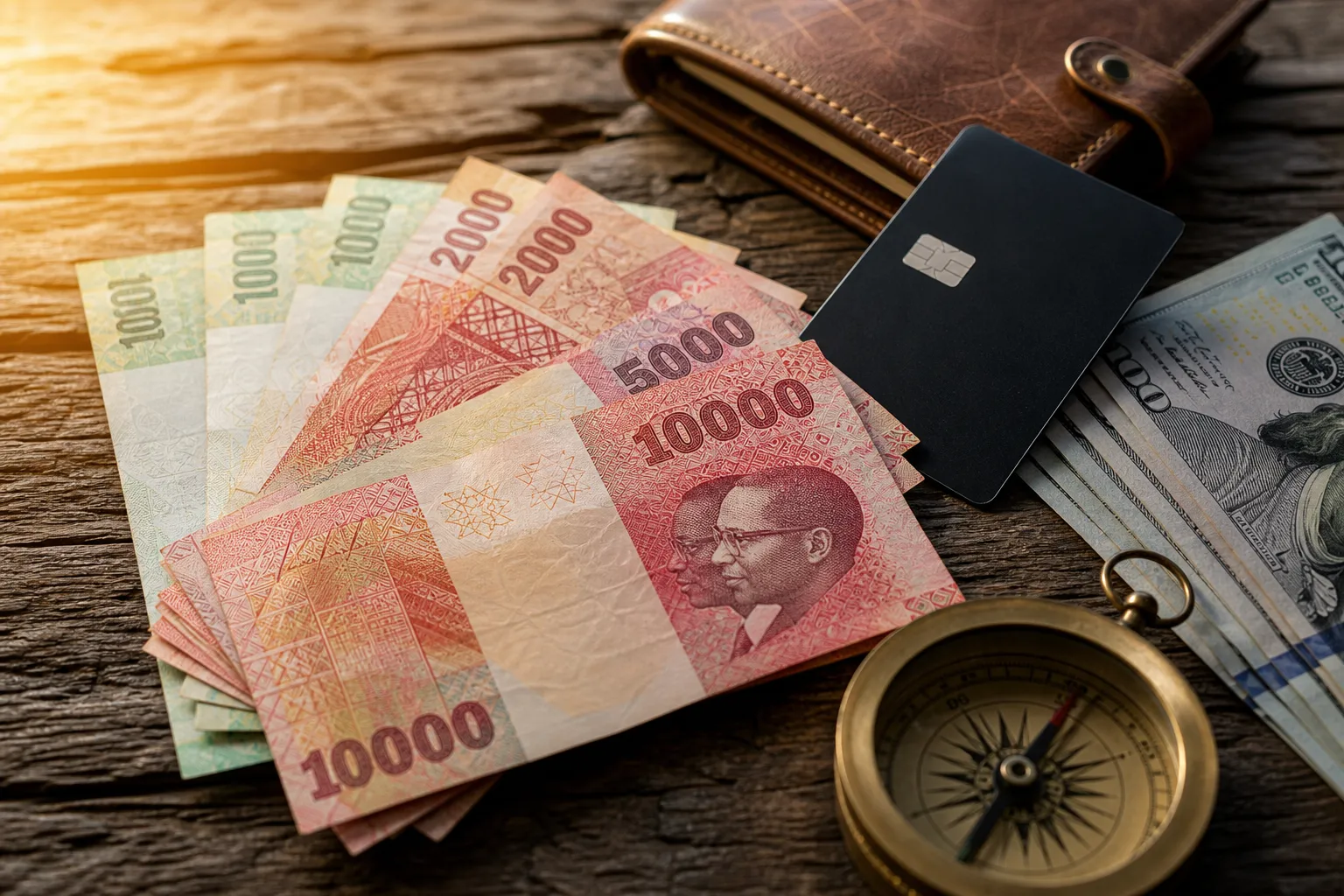
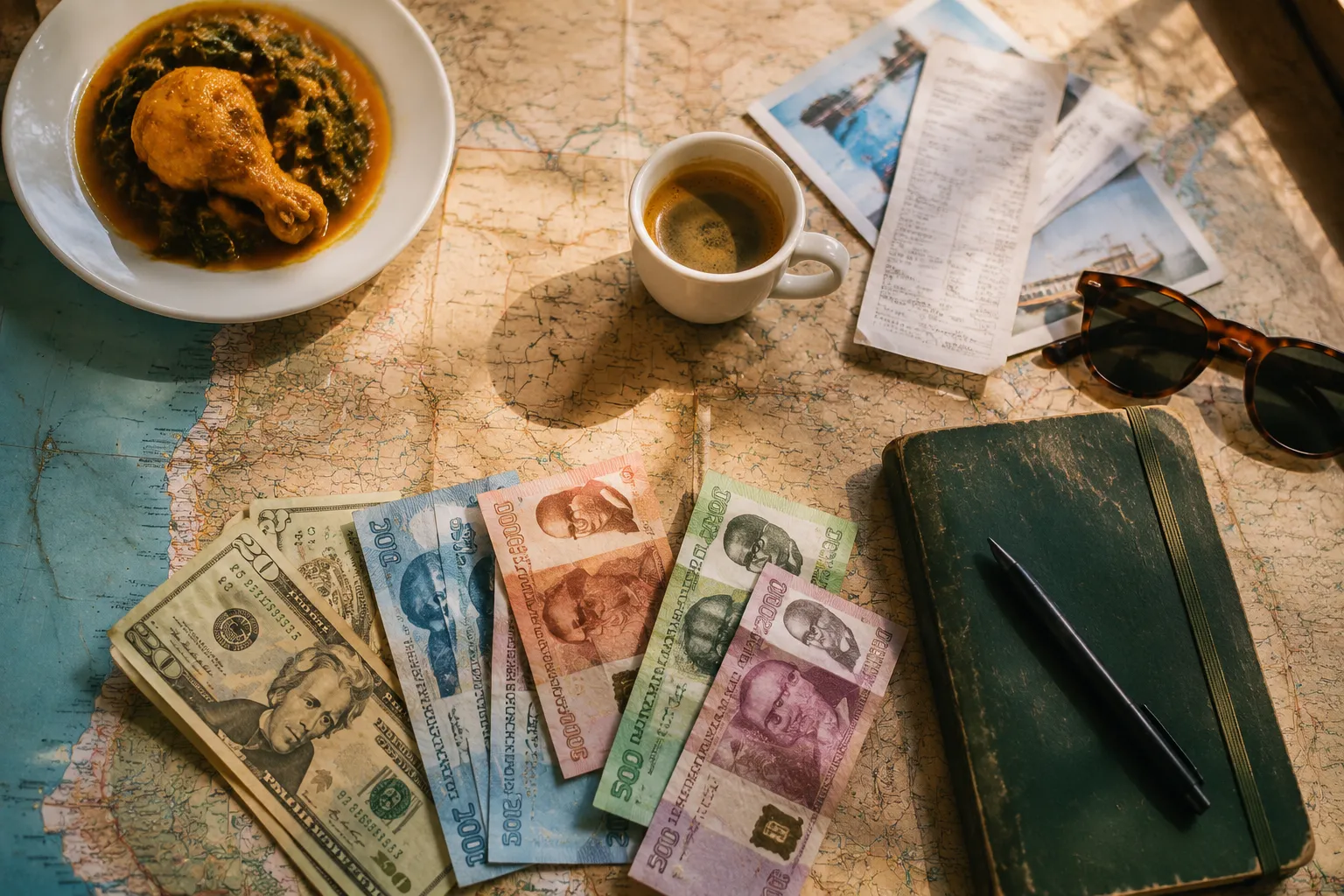
Banknotes come in denominations of 50, 100, 200, 500, 1,000, 2,000, 5,000, and 10,000 kwanza [2]. Coins exist but you’ll rarely see them in daily use because inflation has made small change largely irrelevant. The current series features Angolan presidents and cultural imagery, and the notes are polymer-based, which handles Angola’s humidity better than paper.
The name “kwanza” comes from the Kwanza River, one of the country’s most important waterways. The modern kwanza (AOA) has been in circulation since 1999 after several rounds of monetary reform.
Good to know: the kwanza is a closed currency. You can’t buy it easily abroad, and you can’t spend it once you leave Angola. Plan to exchange on arrival and again before departure.
The kwanza explained: is the angolan kwanza stable?
Short answer: no, the kwanza has been one of Africa’s more volatile currencies over the past decade. It has lost significant value against the US dollar since 2015, driven by oil price swings (Angola’s economy leans heavily on crude exports) and periodic foreign-exchange shortages.
For travelers this matters in two ways:
- Prices in kwanza change often. A restaurant menu printed six months ago may quote outdated prices.
- The dollar or euro rate you get today may not match tomorrow’s. Exchange smaller amounts more frequently rather than converting your entire trip budget on day one.
For the official rate, check the Banco Nacional de Angola daily reference rate. For the market rate you’ll actually receive, ask your hotel or the exchange desk on arrival. There is often a gap between the two.
If you’re planning a longer trip, our guide on travelling to Angola covers broader budgeting and preparation.
Angolan kwanza to USD exchange rate
On July 20, 2026, 1 USD ≈ 912.6 AOA [1]. But this figure moves daily, sometimes noticeably within a single week. Do not budget your trip based on a rate you saw months ago.
Rough reference points for planning (verify before you go):
| Amount in USD | Approx. AOA (July 2026) |
|---|---|
| 1 USD | ~913 AOA |
| 10 USD | ~9,130 AOA |
| 50 USD | ~45,600 AOA |
| 100 USD | ~91,300 AOA |
For EUR to AOA, expect a rate roughly 8 to 10% higher than the dollar rate, tracking the EUR/USD cross. Always confirm at the counter before handing over cash.
Where to check the real rate:
- Banco Nacional de Angola (official reference)
- XE.com or currency.world (indicative market rate)
- Your hotel front desk on arrival
Does Angola use the US dollar? Can I use dollars in Angola?
US dollars are widely accepted in Luanda’s upscale economy but not legal tender. Major hotels, international restaurants, some tour operators, and expat-oriented businesses will take dollars (and often euros), typically at a rate slightly worse than the bank rate [3].
Outside Luanda, assume dollars will not be accepted. Small restaurants, taxis, markets, provincial hotels, and rural areas run entirely on kwanza. Even in Luanda, taxi drivers, street vendors, and small cafés expect local currency.
Practical rules:
- Bring crisp, newer US dollar notes (2013 or later, no tears, no marks). Damaged bills are often refused.
- Carry a mix of denominations. Small bills (5s, 10s, 20s) are more useful than 100s.
- Never assume a place takes dollars without asking first.
- Change enough kwanza on day one to cover taxis, tips, small meals, and any excursions outside the city.
Cash vs card: what’s the best way to pay in Angola?
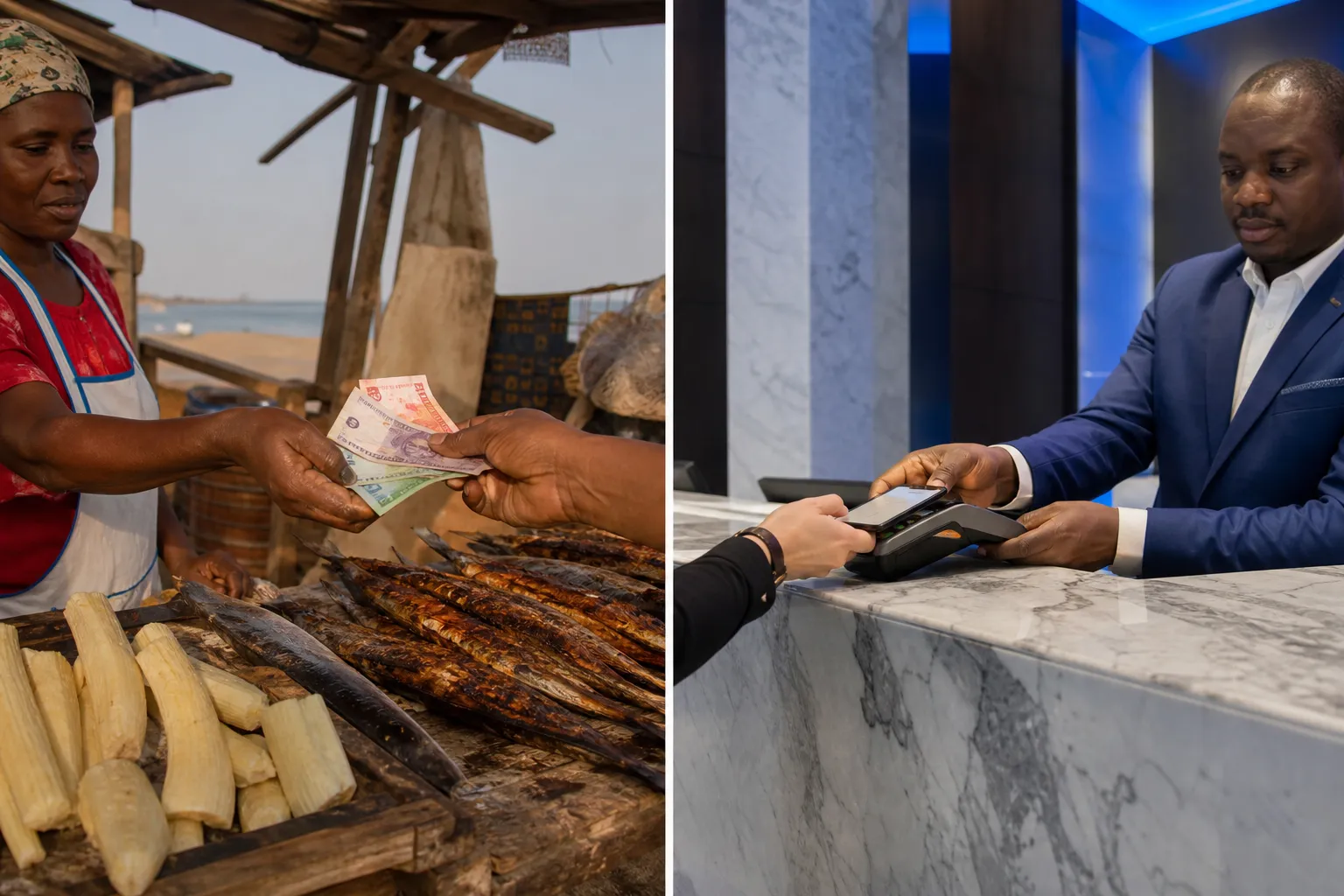
Cash wins in Angola for most transactions. The country operates primarily as a cash-based society [3]. Cards are useful as a backup and for large purchases at established venues, but they are not the primary payment method for travelers.
Use cards for:
- Upscale hotels (Epic Sana, InterContinental, Talatona Convention)
- International-brand supermarkets (Kero, Shoprite in some locations)
- Larger restaurants in central Luanda and Talatona
- Fuel stations in Luanda (sometimes)
Use cash for:
- Taxis, ride-hailing, and Kupapata motos
- Local restaurants and cafés
- Markets (Benfica, Roque Santeiro area, Mercado do Kikolo)
- Anywhere outside Luanda, Lobito, Benguela, or Lubango
- Tips, small services, and entrance fees at things to do in Angola
What’s cheaper: cash or card in Angola?
Cash is usually cheaper if you exchange at a bank or licensed bureau, because card transactions add a foreign-exchange margin plus your home bank’s international fee (often 2 to 3%). However, if your card offers no foreign-transaction fee, paying by card at a big hotel can be competitive and safer than carrying large sums.
Rule of thumb: exchange enough cash to cover 60 to 70% of your expected spend, and keep a card for backup, big-ticket items, and emergencies.
Do credit cards work in Angola?
Visa and Mastercard work at major hotels, upscale restaurants, and larger supermarkets in Luanda and other big cities. American Express acceptance is very limited [2]. Contactless payment is spreading in newer POS terminals but not universal.
Before you travel:
- Notify your bank you’ll be using the card in Angola or it will likely be blocked on the first swipe.
- Bring at least two cards from different networks (one Visa, one Mastercard is ideal).
- Ask your bank about foreign-transaction fees. A no-FX card saves 2 to 3% per purchase.
- Enable transaction alerts so you spot suspicious activity fast.
Skimming and card cloning happen, especially at ATMs in less-secure locations [2]. Cover the keypad, use ATMs inside bank branches or hotels, and check your statement often during and after your trip.
Where can I exchange money in Angola?
Exchange money only at banks, licensed exchange bureaus (casas de câmbio), authorized hotel desks, or the airport counter on arrival. Never exchange with individuals on the street, even if the rate sounds better [3].
Best options in Luanda:
- Dr. António Agostinho Neto International Airport (NBJ) exchange counters in Luanda (convenient on arrival, rate is decent but not the best)
- Major banks: BFA (Banco de Fomento Angola), BAI, BIC, Banco Millennium Atlântico
- Licensed câmbios in central Luanda and shopping malls like Belas Shopping
- Hotel front desks at upmarket hotels (worst rate but safest and easiest)
Bring your passport (required for all exchanges) and be prepared to sign a small form. Keep receipts because you may need them if you want to convert leftover kwanza back before departure.
Black market warning
Street changers may offer better rates, but the risks are real: counterfeit notes, short-counting, theft, and legal trouble. It’s not worth it. Stick to official channels [3].
ATMs and withdrawal limits: atm fees in Angola
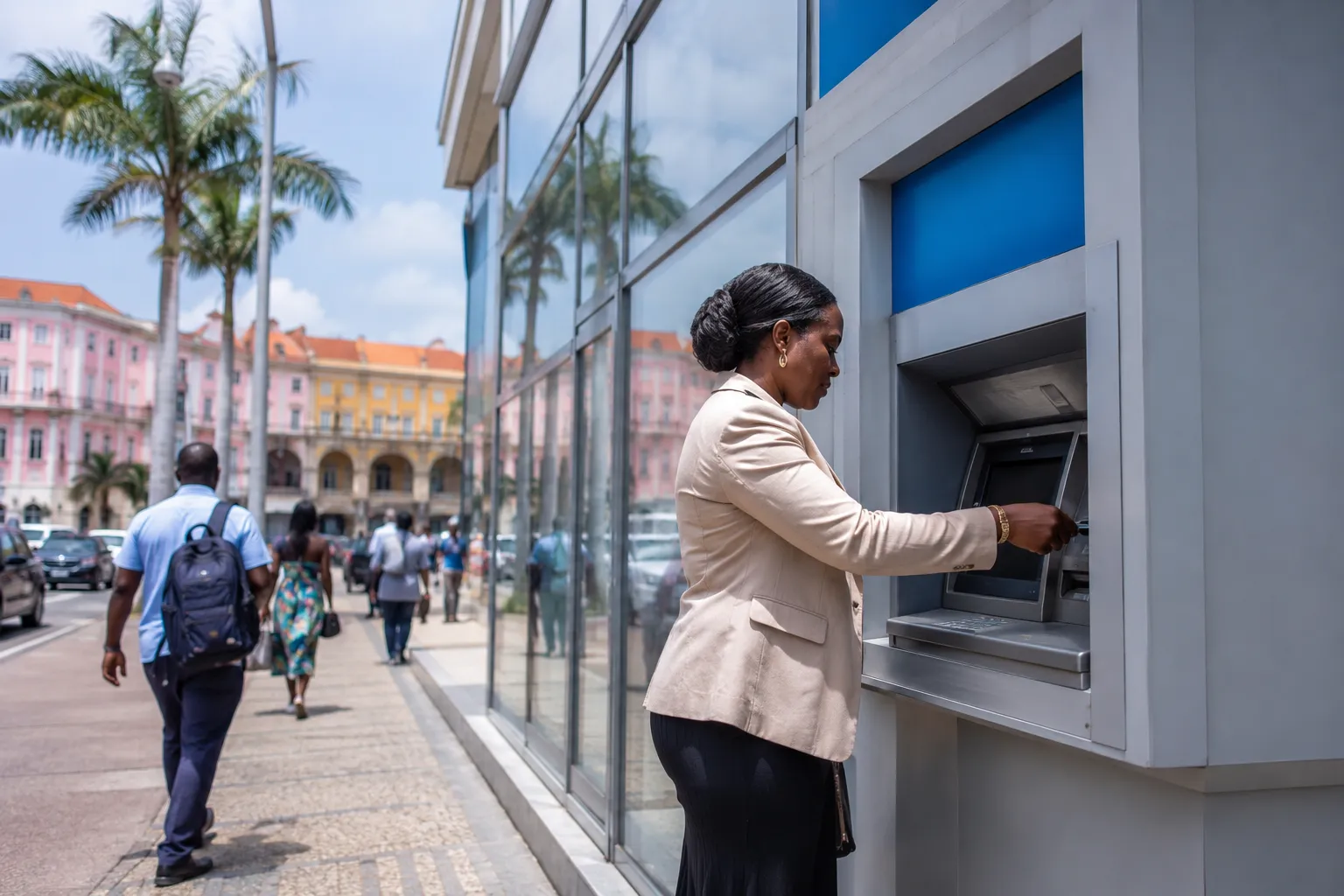
ATMs (locally called Multicaixa) are common in Luanda and provincial capitals, but virtually absent in rural areas. Daily withdrawal limits are typically the equivalent of USD 100 to 200 [2].
What to expect:
- Kwanza only. ATMs do not dispense dollars or euros.
- Foreign-card acceptance is inconsistent. Even Visa/Mastercard cards can be refused by some machines. Try a different bank’s ATM if one rejects your card.
- Fees: Your home bank’s international ATM fee (often USD 3 to 5) plus a possible local fee. Some machines don’t clearly disclose the local charge.
- Weekends: ATMs sometimes run out of cash on Saturdays and Sundays. Withdraw on Fridays if you can [4].
- Reliability: Multicaixa machines are known to malfunction or be offline. Have a backup plan (cash reserve, second card).
Safety tip: Use ATMs inside bank branches or major hotel lobbies during daylight hours. Avoid isolated street-side machines, especially after dark.
More on staying safe in general: is Angola safe.
Typical daily budget: how much do things cost in Angola?
Angola is more expensive than most African destinations because so much is imported and Luanda is consistently ranked among the world’s costliest cities for expats. Rough daily budgets [2]:
| Traveler type | USD per day | What it covers |
|---|---|---|
| Budget | 60 to 100 | Guesthouse, local food, shared transport |
| Mid-range | 150 to 300 | 3-star hotel, mix of restaurants, some tours |
| Luxury | 400+ | 4/5-star hotel, private guide, fine dining |
Sample prices to expect (verify current rates):
- Bottle of water (500 ml): ~200 to 500 AOA
- Local restaurant meal: 3,000 to 8,000 AOA
- Upscale restaurant main: 15,000 to 40,000 AOA
- Taxi across central Luanda: 3,000 to 8,000 AOA
- Domestic TAAG flight (Luanda to Lubango): varies widely; check TAAG directly
- Entrance fee to Kissama National Park: verify with park authority
For deeper cost planning, see our full Angola trip cost breakdown and Angola itinerary guides.
Tipping basics
Tipping in Angola is appreciated but not obligatory [2]. General guidelines:
- Restaurants: 10% if service charge isn’t included. Check the bill first.
- Hotel porters: USD 1 to 2 per bag (or equivalent in kwanza).
- Housekeeping: USD 1 to 2 per day.
- Tour guides: USD 10 to 20 per day for full-day tours.
- Drivers: 10% of the fare or a small rounded-up amount for taxis.
Tips in kwanza are always welcome. Small dollar bills also work at hotels and with tour guides.
What currency should I bring to Angola?
Bring US dollars as your primary foreign currency, with euros as a solid second option. Both convert easily at banks, bureaus, and hotels. Other currencies (GBP, CHF, ZAR) are harder to exchange outside a few Luanda banks and get worse rates.
Practical packing tips:
- Newer, crisp notes only. Older or worn US bills are often rejected.
- Mix of denominations. 20s and 50s are the sweet spot. Keep some 5s and 10s for small exchanges and tips.
- Split your cash between your wallet, a money belt, and your hotel safe.
- Estimate 60 to 70% of budget in cash, the rest on card.
How to get angolan kwanza before traveling
In most cases, you cannot get kwanza before you arrive. The AOA is not stocked by banks or exchange offices in Europe, North America, or most of Africa because it’s a closed currency with limited convertibility.
Plan to exchange on arrival at:
- The airport counter (convenient, decent rate)
- Your hotel (easy, slightly worse rate)
- A bank or bureau the next day (best rate, requires a short trip)
If a rare service in your country claims to sell kwanza, verify the rate carefully. The margin is often steep enough that you’d do better waiting until arrival.
Do tourists need to declare currency in Angola?
Yes, if you’re carrying large sums. Angolan customs generally requires travelers to declare foreign currency amounts above roughly USD 10,000 (or equivalent) on entry and exit. Rules can change, so check the latest with the Serviço de Migração e Estrangeiros or your embassy before you fly.
Practical tips:
- Keep exchange receipts. They help if customs asks how you got your kwanza.
- Do not try to leave Angola with large amounts of kwanza. Convert leftover cash back to USD or EUR at the airport before departure.
- If you’re moving significant funds, use a bank transfer, not cash.
Is it safe to carry cash in Angola?
It’s manageable if you’re sensible. Petty theft happens in Luanda, especially in crowded markets, on public transport, and near ATMs. Violent robbery is less common but not unheard of.
Sensible habits:
- Carry only what you need for the day. Leave the rest in the hotel safe.
- Use a money belt or hidden pouch for larger sums.
- Split cash across two or three locations on your person.
- Don’t count money in public.
- Take official taxis or ride-hailing (Yango, Heetch) rather than flagging cars on the street.
- Be extra careful at ATMs at night. Use ones inside banks or hotels when possible.
Full safety context in our is Angola safe guide.
Money at a glance
- Currency: Angolan kwanza (AOA / Kz)
- Rate (Jul 2026): ~912.6 AOA per USD, verify daily
- Bring: Crisp USD or EUR, mix of denominations
- Exchange: Airport, banks, licensed câmbios, hotel
- Cards: Visa/Mastercard at upscale venues in cities
- ATMs: Multicaixa, ~USD 100-200 daily limit
- Avoid: Black-market exchange, worn USD notes, unfamiliar ATMs at night
Conclusion: quick action plan
Getting Angola’s money situation right isn’t complicated once you know the pattern: cash-first, kwanza-primary, card-as-backup. Before you fly:
- Notify your bank and pack two cards on different networks.
- Bring crisp USD or EUR in mixed denominations (target 60 to 70% of your budget in cash).
- Check the latest AOA rate on the Banco Nacional de Angola site.
- Exchange on arrival at the airport or your hotel, then top up at a bank the next day.
- Keep a cash reserve for anywhere outside major cities.
- Convert leftover kwanza back before you leave, since AOA is a closed currency.
Do those six things and you’ll avoid the money headaches that catch most first-time visitors. For the bigger picture of your trip, browse our guides on Luanda and the best things to do in Angola.
Kwanza currency converter
Convert between the Angolan kwanza (AOA) and the currency of your country.
Exchange rates for guidance only, last updated on 25 July 2026. Rates for the kwanza move a lot, so always check the current rate before you leave atWise (live rate), and read more about paying in our guide to money in Angola.
Free help from our team in Angola
A question about money in Angola?
Cards, cash and exchange work differently here. Tell us where you are going and what you want to know, and our team answers from experience.
- Local team in Angola
- No obligation, nothing to pay
- Reply by email or WhatsApp
Want to keep this guide? We email you the key points with a link to every section.
Frequently asked questions
What is the currency of Angola?
The Angolan kwanza (AOA, symbol Kz), issued by the Banco Nacional de Angola. Banknotes run from 50 to 10,000 AOA.
Does Angola use the US dollar?
No, but dollars are informally accepted at major hotels and upscale venues in Luanda. Outside the capital, kwanza is essential.
Can I pay by card in Angola?
Yes, at major hotels, larger restaurants, and international supermarkets in Luanda and other cities. Cards are refused most other places, so always carry cash.
Where do I exchange money?
At the airport on arrival, at banks (BFA, BAI, BIC), at licensed câmbios, or at your hotel. Avoid street changers.
Are there ATMs in Angola?
Yes, Multicaixa ATMs are widespread in Luanda and provincial capitals, but rare in rural areas. Daily limits are around USD 100 to 200, and reliability varies.
Is Angola expensive to visit?
Yes, relative to most African countries. Budget travelers should plan for USD 60 to 100 per day, mid-range USD 150 to 300, and luxury USD 400+.
Can I take kwanza out of Angola?
Technically no, the kwanza is not freely convertible outside the country. Exchange leftover cash back to USD or EUR at the airport before you fly out.