Quick answer: do UK citizens need a visa for Angola?
Short version: as of mid-2026, the UK Foreign, Commonwealth & Development Office states that British nationals do not need a visa for tourist trips to Angola up to a limited number of days, thanks to a visa-waiver introduced by Angolan authorities [1][9]. For longer stays, business, work or study, you’ll still need a visa, usually the Angola e-visa applied for online before travel [3]. Rules change often, so always verify with the official Angola e-visa portal and the FCDO before booking.
Disclosure: This article contains occasional affiliate links to visa-processing services. If you use them we may earn a small commission at no extra cost to you. We only recommend services we consider legitimate. Always cross-check with the official Angolan government portal.
Key takeaways
- British passport holders currently benefit from visa-free tourist entry to Angola for short stays, according to the UK FCDO [1].
- For stays beyond the visa-waiver window, or non-tourism purposes, a pre-arranged e-visa is required [3].
- Applications are made online via the official Angolan Migration Service (SME) e-visa portal, not on arrival [3][4].
- Your passport must be valid for at least six months beyond your date of entry, with blank pages available.
- Yellow fever vaccination is generally required to enter Angola. Verify with the WHO and your travel clinic.
- Children travelling on a UK passport follow the same rules as adults and need their own entry authorisation.
- Visa on arrival is not a reliable option for tourism; do not fly without confirming your entry route first.
Do UK citizens need a visa for Angola?
For most British tourists in 2026: no visa is required for short leisure trips, but yes for anything longer or non-tourist. Angola introduced a visa-waiver programme for many nationalities (including the UK) to boost tourism, and the FCDO confirms British nationals can currently enter for tourism without a pre-arranged visa for a limited stay [1][9].
However, “visa-free” doesn’t mean “no paperwork”. You still need:
- A valid British passport (six months’ validity, blank pages).
- Proof of onward or return travel.
- Proof of accommodation.
- Yellow fever vaccination certificate.
- Sufficient funds for your stay.
If you’re travelling for business, journalism, volunteering, study, work, or to visit family for longer periods, the visa-waiver doesn’t apply. You’ll need to apply for the appropriate Angola e-visa in advance. For a broader picture of entry rules and general planning, see our guides on traveling to Angola and the Angola visa overview.
Visa-free entry or e-visa: what applies now

Here’s the honest answer: it depends on your trip purpose and length. The visa landscape for Angola has changed significantly since 2023, and the government has actively simplified access for European visitors [2][6].
You likely qualify for visa-free entry if:
- You hold a full British citizen passport.
- Your trip is purely for tourism.
- Your stay is within the permitted short-stay window (verify current limit on the FCDO page [1]).
- You can prove return travel, accommodation and funds.
You need an e-visa (or another visa type) if:
- You’re travelling for business meetings, conferences or paid work.
- You’re a journalist, researcher or on official duty.
- You want to stay longer than the tourist-waiver allows.
- You’re transiting in a way that requires entry.
- You hold an emergency or temporary UK travel document.
“Angola’s e-visa system has made independent travel realistic for the first time in decades, but the rules are still a moving target. Check twice, apply once.”
Because the exact number of days permitted, fees and processing times shift, I deliberately won’t quote them here. Always confirm on the official Angolan e-visa portal run by the Serviço de Migração e Estrangeiros [3] and the UK government’s travel advice page [9].
How to apply for the Angola e-visa step by step
If you need an e-visa, the process is done online before you fly. There is no reliable visa-on-arrival system for standard tourism in 2026 [1][3].
Step-by-step:
- Go to the official Angolan e-visa portal. Use the government link from the FCDO page [9] or the SME portal directly [3]. Avoid look-alike sites.
- Create an account with your email and a secure password.
- Choose the correct visa type (ordinary tourist, business, transit, etc.). Selecting the wrong type is the number-one cause of rejection.
- Fill in the application form with personal details, passport info, travel dates, accommodation address, and purpose of visit.
- Upload supporting documents (see the next section for the full list). Files must be clear, legible and in the accepted format.
- Pay the visa fee online using an accepted card. Keep the payment receipt.
- Submit and wait for the decision by email. You may be asked for additional documents.
- Print your approved e-visa and carry it (paper + digital copy) alongside your passport when flying.
Prefer to outsource the paperwork?
If forms and uploads make you nervous, a reputable visa agency can prepare and submit your application for you. Services like iVisa Angola e-visa service handle the process for a fee on top of the government charge. Handy if you’re short on time, but not required. Disclosure: affiliate link.
For related travel prep, our overview on Angola vaccinations and is Angola safe covers the health and safety side.
Required documents
Regardless of whether you’re travelling under the visa-waiver or applying for an e-visa, prepare the following:
- Passport: valid at least six months beyond your planned entry date, with at least two blank pages.
- Recent passport-style photo: white background, taken within the last six months.
- Return or onward ticket: confirmed booking, not a placeholder.
- Accommodation proof: hotel reservation, tour booking, or a formal invitation letter from a host in Angola.
- Yellow fever certificate: the international vaccination card (ICVP).
- Travel insurance: covering medical evacuation is strongly recommended, and sometimes requested.
- Proof of funds: recent bank statement or credit-card statement.
- For business visas: an invitation letter from the Angolan company, plus a letter from your UK employer.
- For minors: birth certificate, parental consent letter (if travelling with one parent or unaccompanied), and both parents’ passport copies.
Keep both digital and printed copies. Angolan immigration officers may check any of these on arrival.
Cost and processing time
I won’t quote exact figures because fees and turnaround are adjusted periodically by the SME. What I can tell you [3][4][5]:
- The e-visa fee is paid online in the local currency equivalent, by card.
- Processing is generally handled within a short business-day window, but backlogs happen, especially around holidays and peak travel seasons.
- Business visas typically cost more than tourist visas.
- Expedited processing is not always advertised. If you need to travel urgently, a paid visa agency may be the fastest legitimate route.
Rule of thumb: apply at least three to four weeks before travel. That gives buffer time for corrections, additional document requests, or courier issues if a physical visa sticker is needed.
Comparison: visa-free tourist entry vs Angola e-visa
| Feature | Visa-free tourist entry | Angola e-visa |
|---|---|---|
| Who it's for | UK tourists, short stay | Business, longer stays, work, study |
| Applied in advance? | No visa, but documents needed | Yes, online before travel |
| Cost | Free (verify) | Government fee (verify) |
| Length of stay | Short window (verify current) | Longer, depending on visa type |
| Extension possible? | Limited, via SME | Yes, via SME in Angola |
| Yellow fever proof | Required | Required |
Can UK citizens get a visa on arrival for Angola?
Generally no, and I’d strongly advise against relying on it. Angola offered limited airport-issued visas in the past, but the current system channels almost everyone into either the visa-waiver route or the online e-visa [1][3][6]. Turning up at Luanda without the correct entry paperwork risks being refused boarding in the UK or denied entry on arrival.
The only real exception is a narrow “border visa” for specific business travellers with prior authorisation, which is not something a tourist should count on.
What’s the difference between a tourist and business visa?
- Tourist visa (or visa-free tourist entry): leisure travel, family visits, sightseeing. No paid work allowed.
- Business visa: attending meetings, conferences, negotiations, site visits. Requires an invitation letter from an Angolan entity. Does not permit long-term employment.
- Work visa: for taking up employment in Angola. Requires employer sponsorship and separate residence steps.
- Transit visa: for short layovers where you need to leave the airside area.
Choosing the wrong category is the fastest way to get a rejection or hassle at immigration.
What if my Angola visa application gets rejected?
A refusal isn’t the end of the road, but it needs a calm response:
- Read the reason carefully. Common issues include unclear passport scans, mismatched dates, missing yellow fever proof, or wrong visa category.
- Fix the issue and reapply. You can submit a fresh application through the portal.
- Contact the Angolan Embassy in London for complex cases or if you believe there was an error.
- Consider a professional visa agency if you’ve been refused twice; they know the common triggers.
Do not book non-refundable flights until your visa (or visa-waiver eligibility) is confirmed.
Can I get an Angola visa faster if I’m travelling soon?
Sometimes. Options:
- Priority processing via the portal if offered at that time.
- A licensed visa agency that can escalate through the SME.
- The Angolan Embassy in London for exceptional cases.
There is no guaranteed same-day route. If you’re within a week of travel and still without a visa, be honest with yourself about postponing.
Do UK children need their own visa for Angola?
Yes. Every traveller needs their own passport and entry authorisation, regardless of age. Children benefit from the same visa-waiver as adults if they hold a full British passport. For minors travelling without both parents, carry:
- The child’s full birth certificate.
- A notarised parental consent letter.
- Copies of both parents’ passports.
Angolan border officials do check these, especially at Luanda’s international airport.
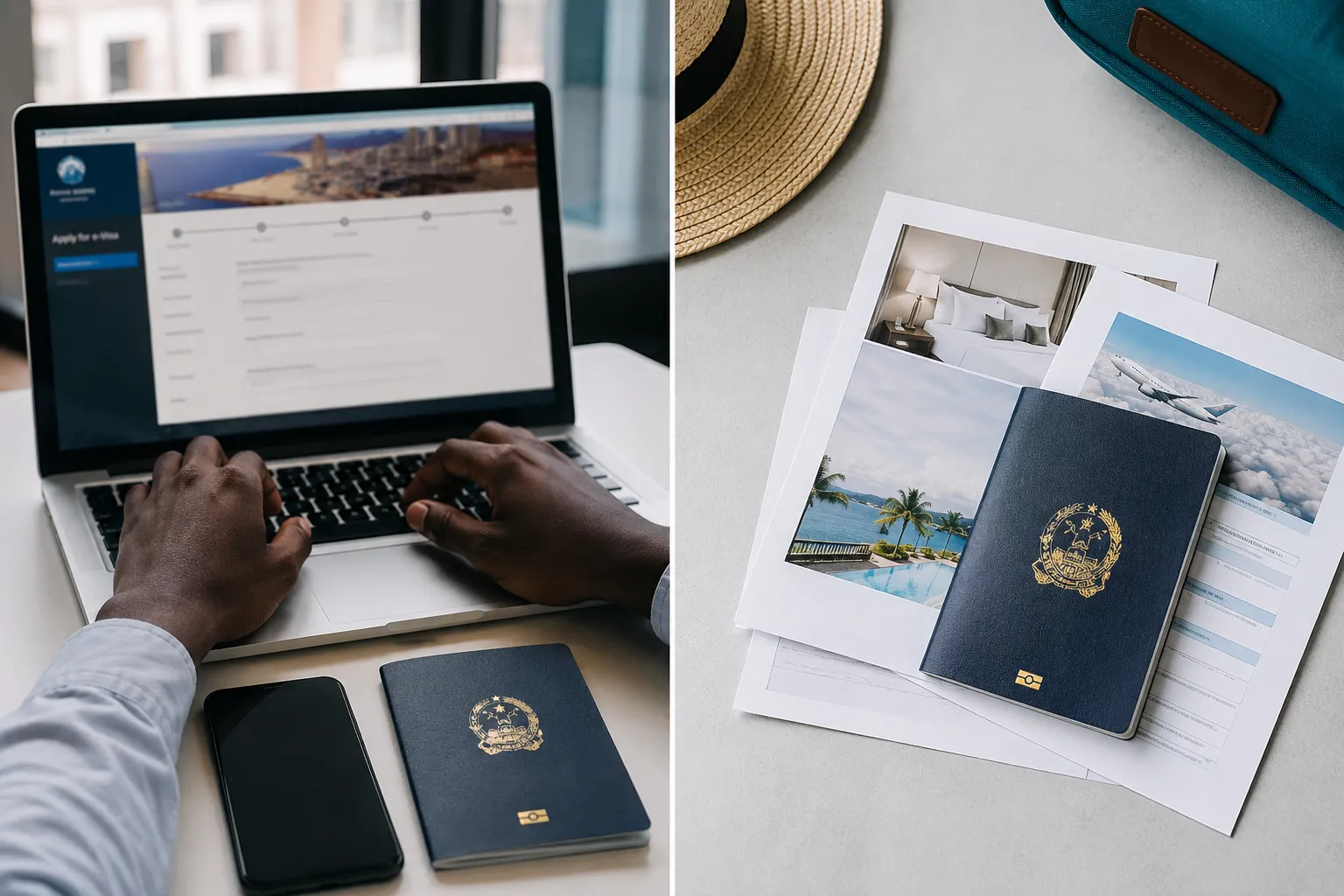
Common mistakes when applying for an Angola visa
- Using an unofficial website that mimics the government portal.
- Applying for the wrong visa category (e.g. tourist when you’re attending a business event).
- Uploading a blurry passport scan.
- Forgetting the yellow fever certificate.
- Booking non-refundable flights before approval.
- Assuming visa on arrival is available.
- Letting your passport slip under six months’ validity.
How do I renew or extend an Angola visa in the country?
Extensions and renewals are handled by the Serviço de Migração e Estrangeiros (SME) offices inside Angola. You’ll typically need:
- Your current passport and visa.
- A written request explaining why.
- Proof of address in Angola.
- Payment of the extension fee.
Start the process well before your current stay expires. Overstaying leads to fines and can affect future entry. If you’re planning a longer trip, check our travel guide to Angola and read up on Luanda as your likely base.
Arriving in Luanda: what to expect
Most UK travellers arrive at Luanda’s international airport. Expect:
- Immigration officers checking passport, entry authorisation, yellow fever card, and sometimes return ticket and hotel booking.
- Baggage collection followed by a customs check.
- Taxis and hotel pick-ups outside the terminal. Arrange transfer in advance, especially if arriving late.
- Portuguese is the working language. Basic phrases help.
For onward planning, browse Angola attractions to shape your itinerary before you land.
Conclusion and next steps
Angola is more accessible to British travellers than at any point in recent history, and that’s genuinely exciting news for anyone eyeing Luanda’s Atlantic promenade, the Kalandula waterfalls or the desert coast of Namibe. The visa story in 2026 is simple in principle (short tourist trips: no visa; everything else: e-visa) but the details drift, so treat every rule quoted online, including in this guide, as a starting point rather than gospel.
Your next steps:
- Check the current entry rules on the FCDO travel advice page [1][9].
- Confirm on the official Angolan e-visa portal whether you need to apply [3].
- Get your yellow fever jab and travel insurance sorted.
- Book flexible flights and refundable accommodation until your entry route is confirmed.
- Start planning the fun part: browse our Angola attractions, Luanda and travel guides to build your itinerary.
Boa viagem.
Free help from our team in Angola
A visa question as a UK citizen?
Tell us your nationality, why you travel and when. We answer from the official rules on evisa.ao and tell you what applies to you. The Angolan embassy or the migration service (SME) always has the final say.
- Local team in Angola
- No obligation, nothing to pay
- Reply by email or WhatsApp
Want to keep this guide? We email you the key points with a link to every section.
Frequently asked questions
Do UK citizens need a visa for Angola?
For short tourist trips in 2026, no visa is required for British nationals under Angola's visa-waiver programme, according to the UK FCDO. Longer stays and non-tourism travel still need an e-visa.
Is there visa-free entry for British travellers?
Yes, for tourism up to a short stay limit set by Angolan authorities. You still need a valid passport, return ticket, accommodation proof and yellow fever certificate.
How do I apply for the Angola e-visa?
Online through the official Angolan Migration Service e-visa portal. Create an account, choose the visa type, upload documents, pay the fee and wait for email approval.
What documents do I need?
Passport valid six months beyond entry, passport photo, return ticket, hotel booking or invitation letter, yellow fever certificate, travel insurance and proof of funds.
How much does it cost and how long does it take?
Fees and processing times change. Check the current amounts on the official e-visa portal. Apply at least three to four weeks before travel.
Can I get a visa on arrival?
Not reliably. Standard tourists should either travel under the visa-waiver or apply for an e-visa in advance.