Quick answer
Internet in Angola is usable but uneven. In central Luanda and the bigger coastal cities you can expect 4G mobile data at roughly 15 to 45 Mbit/s, which is fine for email, messaging, maps and light cloud work. Outside urban areas coverage thins fast and disappears entirely in remote regions such as the far south-west desert. Mobile data, not hotel wifi or fixed broadband, is how almost everyone gets online, so plan around a local SIM or eSIM plus a power bank and offline backups.
Key takeaways
- Three operators matter: Unitel (widest national coverage), Africell (fastest measured speeds, limited provinces) and Movicel.
- Independent measurement across 2025 to 2026 put Africell’s average mobile download speed at about 19.7 Mbit/s, the best of the three nationally.
- National internet penetration sits around 44 to 45 percent of the population and keeps climbing.
- Fixed broadband is rare, so mobile data dominates almost completely.
- Public wifi exists in better hotels, malls, airports and some restaurants, but it is frequently slow or congested.
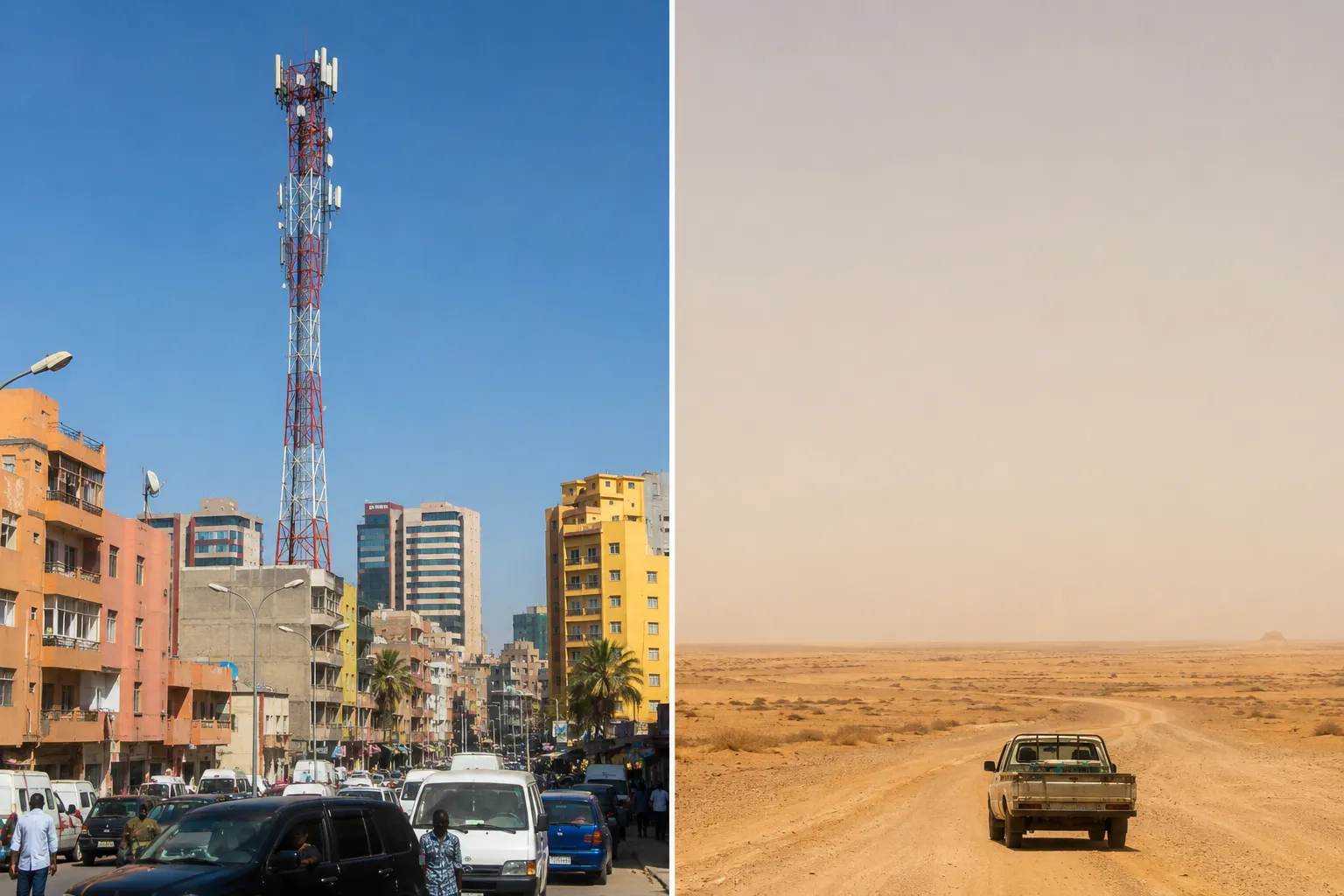
- Coverage falls off quickly beyond city limits and along long-distance roads.
- Power cuts affect connectivity, not just your battery. Redundancy is the whole strategy.
- Angola works for light remote work in Luanda, and is a poor bet if you need guaranteed video calls or big uploads.
What internet providers are available in Angola?
Angola has three mobile operators worth knowing and a small number of fixed-line providers. For travellers, the mobile operators are the only realistic choice.
Mobile operators:
- Unitel is the market leader and has the widest national footprint. If you are heading inland to Malanje, Huambo or the far south, Unitel is the safest single choice.
- Africell entered the market most recently and has recorded the fastest average mobile speeds in the country. The catch is reach: it operates in only a minority of Angola’s 21 provinces, concentrated in urban centres. Excellent in Luanda, useless in the bush.
- Movicel is the third player, still present but generally a secondary option.
Fixed providers: ZAP and a handful of other operators sell fixed connections in the cities. That matters if you are renting an apartment for a month. It does not matter for a two-week trip.
The sector regulator is INACOM (Instituto Angolano das Comunicações), which supervises electronic communications and runs a consumer complaints channel for billing and service-quality disputes.
Decision rule: if your itinerary stays in Luanda and the coast, Africell for speed. If you are travelling inland or on a road trip, Unitel for coverage. If your trip does both, carry two SIMs.
We cover the practical side of buying, registering and topping up separately in our Angola SIM card and eSIM guide, so this article stays focused on how the connection actually performs once you have it.
What is the average internet speed in Angola?
Realistically, expect mid-teens Mbit/s as a national average and 15 to 45 Mbit/s on 4G in central Luanda depending on operator, time of day and exactly where you are standing.
Independent measurement across the 2025 to 2026 period put Africell’s national average mobile download speed at roughly 19.7 Mbit/s, ahead of both Unitel and Movicel. Broader connectivity datasets place Angola’s real-world average speeds near 15 to 20 Mbit/s.
What those numbers mean in practice:
| What you want to do | Realistic in central Luanda? | Realistic upcountry? |
|---|---|---|
| WhatsApp, email, banking apps | Yes, reliably | Usually, when there is signal |
| Google Maps, ride-hailing | Yes | Patchy, download offline maps |
| Uploading photos to cloud storage | Yes, but slowly | No |
| One-to-one video call | Usually, with a backup plan | Do not count on it |
| Large team video call, screen share | Risky | No |
| Uploading video files, big datasets | Poor | No |
National broadband policy sets targets for raising both speeds and coverage over the coming years. Those are targets, not current conditions, and they tell you where the baseline sits today.
Does Angola have 4G or 5G coverage?
4G is the workhorse across Angola’s cities. 5G exists in limited form in parts of Luanda but should be treated as a bonus, not a plan.
- 4G covers Luanda, Benguela, Lobito, Huambo, Lubango and other provincial capitals.
- 3G fallback is common on the fringes of towns and along some corridors. Your phone will drop back without warning.
- 5G has been switched on in select urban locations, but availability is narrow and device and plan dependent. Do not build a work schedule around it.
- No coverage is the honest expectation in stretches of the far south-west desert, in parts of the eastern provinces, and on long empty road sections between towns.
Common mistake: assuming your phone showing “4G” means usable throughput. In congested Luanda cells during evening peak, a 4G icon can still deliver a crawl. Check actual load times before committing to a call.
Why is the internet slow in Angola?
Slowness in Angola usually comes from four causes: network congestion, limited backhaul capacity to inland areas, patchy electricity supply, and simple distance from a tower. Understanding which one you are facing changes the fix.
The structural picture. Urban internet penetration is far higher than rural penetration, a gap that reflects where infrastructure was actually built. Interior provinces have remained well below the national average. Backbone fibre is expanding and substantial investment has been committed across fibre, towers and data centres, so the direction is upward, but the interior is still catching up.
The everyday causes:
- Peak-hour congestion. Late afternoon and evening in Luanda are the worst windows. Early morning is noticeably better.
- Shared hotel wifi. One modest connection split across a full hotel produces exactly the result you would expect.
- Power interruptions. Cuts hit base stations and building routers, not just your laptop.
- Building interference. Thick concrete, basements and interior rooms kill signal. Moving near a window often doubles your speed.
- Weather. Heavy rain-season downpours can degrade both mobile and fixed links.
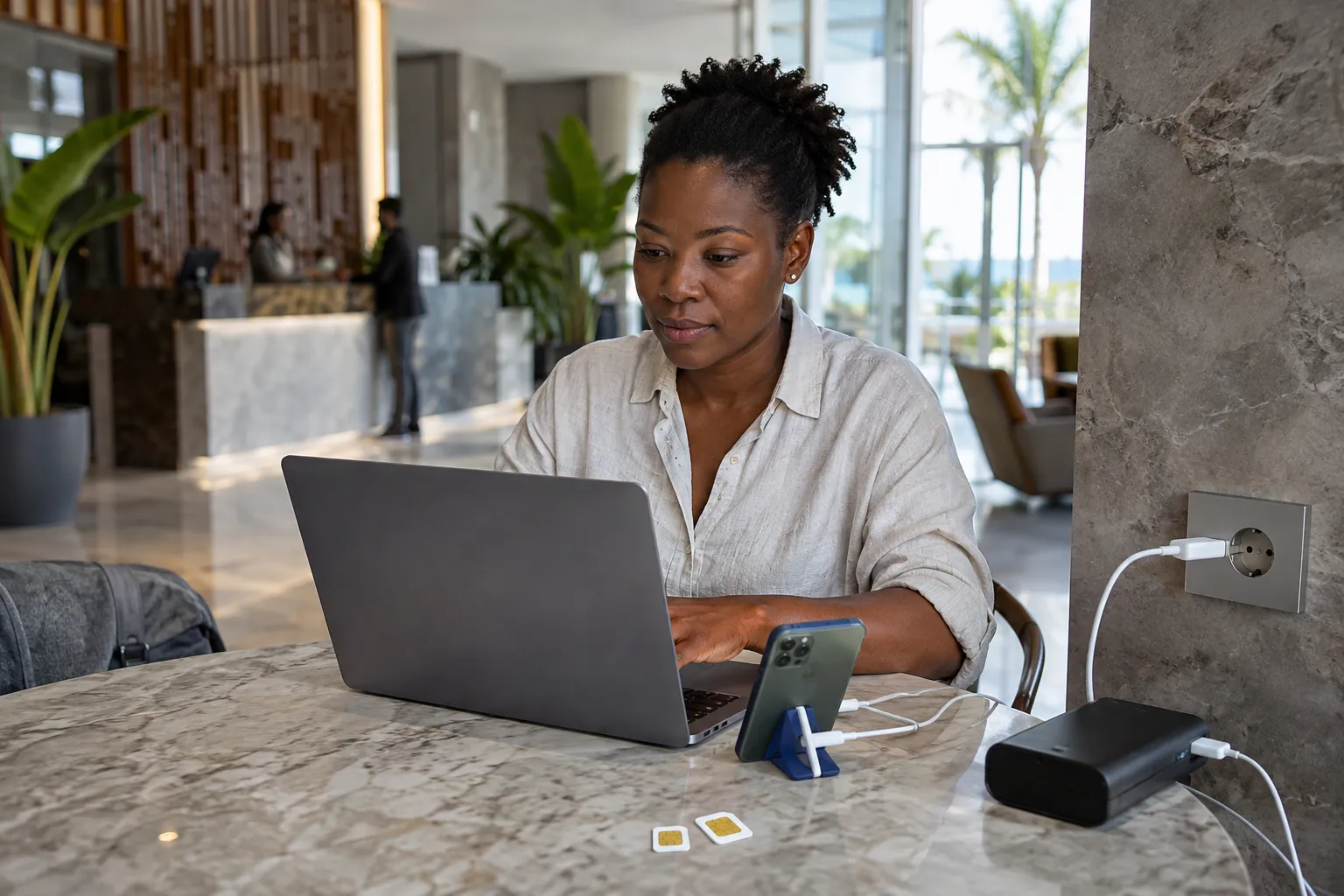
How to troubleshoot a bad connection
Work through the cheap fixes first. Most Angolan connectivity problems are solved by changing location, network mode or operator, not by buying more data.
- Move. Go to a window, balcony or street level. In concrete buildings this is the single biggest improvement available.
- Force network mode. Lock the phone to 4G only in settings. Constant 4G-to-3G handoffs cause more dropped sessions than low speed does.
- Toggle airplane mode for ten seconds to force a fresh cell attachment. Unglamorous, works often.
- Switch SIMs. If you carry two operators, test both. Coverage in Angola is genuinely operator-specific street by street.
- Abandon the hotel wifi. Tether to your phone instead. Mobile data usually beats congested property wifi.
- Check your balance and bundle status. Data bundles expire. A “broken” connection is sometimes an empty one.
- Restart the router if you are on a fixed line, and check whether the building is on generator power.
- Escalate. For persistent service-quality or billing disputes with an operator, INACOM operates a consumer help and complaints mechanism.
Edge case: if data works but a specific app does not, the problem is usually app-side or DNS-related rather than the network. Test a second app before blaming the operator.
What does internet cost in Angola?
Mobile data in Angola is sold as prepaid bundles, and it is generally cheap relative to European mobile roaming but not free. Exact tariffs change often, so check the operator’s current published rates rather than any figure quoted in a blog.
What to know about cost structure rather than specific prices:
- Prepaid bundles are the norm. You buy a volume of data valid for a set number of days.
- Bigger bundles cost less per gigabyte. If you are staying two weeks or more, a larger monthly bundle is usually the cheapest route.
- Night or off-peak bundles are commonly offered and can be the cheapest way to run large downloads and cloud syncs.
- Fixed broadband is dramatically more expensive per month than mobile data and involves installation, so it only makes sense for stays of several months.
- Hotel wifi is usually included in the room rate at mid-range and upmarket properties, which is convenient but not a substitute for your own data.
For how connectivity fits into a wider travel budget, including accommodation and transport, see our Angola trip cost breakdown. Bear in mind Luanda has ranked for years among the more expensive cities in the world for expatriates, and that shows up across the board.
Mobile data or fixed broadband?
For anyone staying under a month, mobile data wins outright. For a multi-month stay in Luanda, a fixed connection plus mobile backup is the stronger setup.
Choose mobile data if:
- You are in Angola for days or weeks
- You are moving between cities
- You need something working within an hour of landing
- Your work is email, messaging, documents and browsing
Choose fixed broadband, with mobile as backup, if:
- You are staying three months or more at one address
- You need more consistent latency for calls
- Someone else handles installation, which can take time
Fixed broadband penetration nationally is a tiny fraction of mobile broadband uptake. That imbalance is the whole story: the country runs on mobile.
Getting reliable wifi in Luanda
The most reliable wifi in Luanda is your own phone hotspot on a local SIM, supported by a good hotel connection as a secondary option. Treat public wifi as a convenience, never as your primary work connection.
Where public wifi is generally available:
- Better hotels and serviced apartments, often the most usable option after mobile data
- Shopping centres in Luanda, variable quality
- The airport, useful on arrival but frequently congested. See our Luanda airport arrival guide for what to expect on landing
- Cafes and restaurants in upmarket districts, hit and miss
Practical tips for Luanda specifically:
- Pick accommodation in central districts such as the Marginal area or Talatona, where infrastructure is denser. Our Luanda city guide covers the neighbourhoods.
- Ask the property two direct questions before booking: does the building have a generator, and is the wifi shared across all rooms?
- Schedule anything important for morning hours.
- Always have a phone hotspot ready as the fallback when the room wifi stalls.
Staying connected on the road
Get a local SIM or eSIM on arrival, download everything you need offline before leaving the city, and accept that some days you will simply be offline. That is the honest version.
Before you leave a city with good coverage:
- Download offline maps for your whole route
- Save documents, tickets and booking confirmations locally, not just in the cloud
- Download entertainment for long drives
- Send your itinerary to someone at home
- Charge everything, including the power bank
On the road. Coverage follows population, so signal appears in towns and vanishes between them. Long transfers in the interior and southern provinces mean hours without data. If you are self-driving or using long-distance transport, our guide to getting around Angola explains the distances involved.
Genuinely remote areas. In the far south-west desert and remote eastern regions, expect no data at all. Options are limited and none are casual purchases:
- Satellite messengers for short text and SOS, the most practical traveller option
- Satellite internet terminals, technically available in the region but subject to national licensing conditions, so verify current legal availability for Angola before relying on one
- Tour operator radio or satellite phones, which most serious desert operators carry
For current conditions, always check the Angola travel advice page alongside your own government’s official advisory.
Is Angola good for remote work?
Angola is workable for light remote work in Luanda and a poor choice if your job depends on guaranteed video calls or heavy uploads. Expats overwhelmingly rely on mobile data, often on two operators, and treat fixed lines as a supplement.
Angola is fine for:
- Email, messaging, project tools
- Editing documents and light cloud sync
- Occasional one-to-one calls, scheduled in the morning
- Reading, research, writing
Angola is a bad bet for:
- Client-facing video calls you cannot reschedule
- Live streaming or webinars
- Uploading large video or design files
- Anything needing stable low latency, including remote desktop into a server
The redundancy checklist that actually matters:
- Two networks. SIMs from two operators, ideally Unitel plus Africell, in one dual-SIM phone or an eSIM alongside a physical SIM.
- A high-capacity power bank, because power cuts affect both your devices and the network around you.
- A European plug adapter. Angola runs 220V on type C and F sockets, so most continental European plugs fit directly.
- Offline everything. Maps, documents, boarding passes, key contact numbers written down.
- Async-first communication with your team. Set the expectation before you fly, not after a call drops.
- A local backup workspace identified in advance, such as a hotel lobby with a generator.
The realistic verdict: Angola suits the remote worker who can work asynchronously for two weeks. It does not suit the one with a calendar full of unmovable video meetings.
Conclusion
Angola is a country where getting online is possible almost everywhere people live, and impossible in a lot of the places travellers most want to see. Around 45 percent of the population is connected, mobile data does nearly all the work, and city speeds in the 15 to 45 Mbit/s range are decent enough for ordinary tasks while falling short of what heavy remote work demands.
Your next steps:
- Sort out a local SIM or eSIM before you need it, using our SIM and eSIM guide for Angola.
- Plan two networks if your route mixes Luanda with the interior.
- Download offline maps and documents before every leg outside the cities.
- Pack a serious power bank and a type C or F adapter.
- If you are working remotely, tell your team now that you will be async for parts of the trip.
Set expectations low and Angola will surprise you. Assume it works like Lisbon and it will not.
Free help from our team in Angola
Need to stay connected in Angola?
Ask us about coverage where you are going, or about working remotely. We can also arrange a local SIM card on arrival.
- Local team in Angola
- No obligation, nothing to pay
- Reply by email or WhatsApp
Want to keep this guide? We email you the key points with a link to every section.
Frequently asked questions
Is there wifi in hotels in Angola?
Yes, most mid-range and upmarket hotels in Luanda and larger cities offer wifi, usually included in the room rate. Quality varies widely because bandwidth is shared across the property, so keep mobile data as a backup.
What is the fastest mobile network in Angola?
Africell has recorded the fastest average mobile download speeds nationally, around 19.7 Mbit/s over the 2025 to 2026 measurement period. However, it operates in only a minority of Angola's 21 provinces, mostly urban ones, so Unitel remains better for national coverage.
Can you make video calls from Angola?
One-to-one video calls generally work in central Luanda on a good 4G connection, especially outside evening peak hours. Group calls, screen sharing and calls from outside the main cities are unreliable, so always have a voice-call or messaging fallback.
Is satellite internet available in Angola?
Satellite services exist in the region, but availability depends on national licensing and regulatory approval, which changes. Verify current legal status and coverage for Angola with the provider and with the regulator INACOM before relying on a terminal, and do not assume a device bought elsewhere will work legally.
How much of Angola's population is online?
Internet penetration is around 44 to 45 percent of the population, with the great majority of those users connecting over mobile networks. Urban penetration is far higher than rural.
Do I need a local SIM, or will roaming work?
Roaming will work in covered areas but is usually far more expensive than a local prepaid bundle. For any stay longer than a couple of days, a local SIM or eSIM is the better value and gives access to local data bundles.
Are there power cuts that affect the internet in Angola?
Yes. Outages affect base stations, building routers and your own charging, so they hit connectivity from several directions at once. A high-capacity power bank and accommodation with a generator are the two most useful defences.