Quick Answer
As of mid-2026, most Western governments rate Angola as a “increased caution” or “high caution” destination rather than a no-go country. The US keeps Angola at Level 2 overall, with Level 3 (Reconsider Travel) for greater Luanda after a March 2026 update citing armed robbery and carjacking.[2] The UK advises against all but essential travel to Cabinda province (outside Cabinda city) and to a 1 km strip along the DRC border in Lunda Norte.[1] Canada tells travellers to exercise a high degree of caution nationwide.[11] Angola is very much visitable, but you need to prepare properly: valid e-visa or visa-free entry, yellow fever certificate, malaria protection, evacuation-grade insurance, and a plan for cash, driving, and photography rules.
Key Takeaways
- US Level 2 / Luanda Level 3, UK avoid all but essential travel to Cabinda and the 1 km DRC border strip, Canada high caution nationwide, Spain “extreme precaution” as of July 2026.[1][2][11][12]
- Yellow fever certificate is required for entry from most countries; get the shot at least 10 days before arrival.
- Malaria is present countrywide; take prophylaxis and bring repellent.
- Medical care is limited, so book travel insurance that includes medical evacuation, not just treatment.
- E-visa or visa-free entry for many nationalities; passport must be valid 6+ months with blank pages.
- Cash still rules outside big hotels in Luanda; cards work but with limits.
- Landmines and UXO remain a residual risk in some rural areas; stay on cleared roads.
- Photography of government, military, and port sites is restricted; drones need permits.
- Always check the live advisory from your own government before booking.
What Do the Official Angola Travel Advisories Actually Say Right Now?
Angola sits in the “yellow to orange” band on most Western advisory maps in 2026: elevated caution, but not off-limits. Each country phrases it slightly differently.
- United States (State Department): Level 2, Exercise Increased Caution. The advisory was updated on 5 March 2026 and specifically escalates the greater Luanda metropolitan area to Level 3, Reconsider Travel, citing armed robbery, assault, and carjacking. Contributing risks nationwide include crime, health infrastructure, civil unrest, and unexploded ordnance.[2][8]
- United Kingdom (FCDO): Advises against all but essential travel to Cabinda Province (excluding Cabinda city) because of separatist activity, targeted attacks on foreigners, and kidnap risk. Also advises against all but essential travel to within 1 km of the DRC border in Lunda Norte, except at official crossings.[1]
- Canada (Global Affairs): Exercise a high degree of caution nationwide due to crime, landmines, and unexploded ordnance. Avoid non-essential travel to Cabinda and Lunda Norte.[11]
- Spain (Exteriores, effective 6 July 2026): Recommends “extremar la precaución y evitar determinadas zonas” (exercise extreme precaution and avoid certain zones).[12]
- France (France Diplomatie): Publishes ongoing “dernières minutes” alerts covering seasonal flooding, protests, and border areas.[6]
For a fuller crime and street-safety breakdown, see our dedicated is Angola safe to visit guide. This article focuses on the advisories and what to do about them.
How Advisory Levels Work and How to Read Them Sensibly
Every government uses a slightly different scale, but they map roughly onto four tiers:
| Country | Overall Angola level | Specific “avoid” zones |
|---|---|---|
| USA | Level 2 (Exercise Increased Caution); Luanda metro Level 3 | Greater Luanda[2] |
| UK | See our travel advice | Cabinda (except city), 1 km DRC border in Lunda Norte[1] |
| Canada | High degree of caution | Cabinda, Lunda Norte[11] |
| Spain | Extreme precaution | Certain zones (Cabinda, borders)[12] |
| Australia | Exercise a high degree of caution (typical) | Cabinda, remote border areas |
Read the advisory as a risk profile, not a verdict. A Level 2 or “high caution” rating simply means you should prepare more than you would for, say, Portugal: better insurance, smarter transport choices, no flashy jewellery, no walking Luanda at night. It does not mean you cannot go.
Rule of thumb: if your government says “avoid non-essential travel” to a region (Cabinda, DRC border, Lunda Norte interior), don’t wing it there as a tourist. If it says “exercise increased caution” for the country, go, but read the whole page first.
Which Regions Carry Specific Warnings?
Three areas come up in almost every advisory. Treat them differently.
Cabinda Province (excluding Cabinda city). The exclave north of the Congo River has an active separatist movement (FLEC). The UK FCDO cites targeted attacks on foreigners and kidnap risk outside Cabinda city.[1] Canada echoes this.[11] Cabinda city itself and organised oil-sector visits are generally fine, but independent travel into the rural interior is not recommended. If you’re curious about the region, read background before you decide.
The DRC border strip in Lunda Norte. The UK specifically flags a 1 km strip along the DRC border, except at official crossings and their access roads.[1] This is diamond country with informal mining activity and unpredictable border dynamics.
Greater Luanda metropolitan area. The US bumped this to Level 3 in March 2026 over armed robbery, assault, and carjacking.[2] In practice this means: use hotel or app-based transport at night, keep car doors locked and windows up at intersections, don’t display phones or bags, and avoid the informal settlements (bairros) unless with a trusted local.
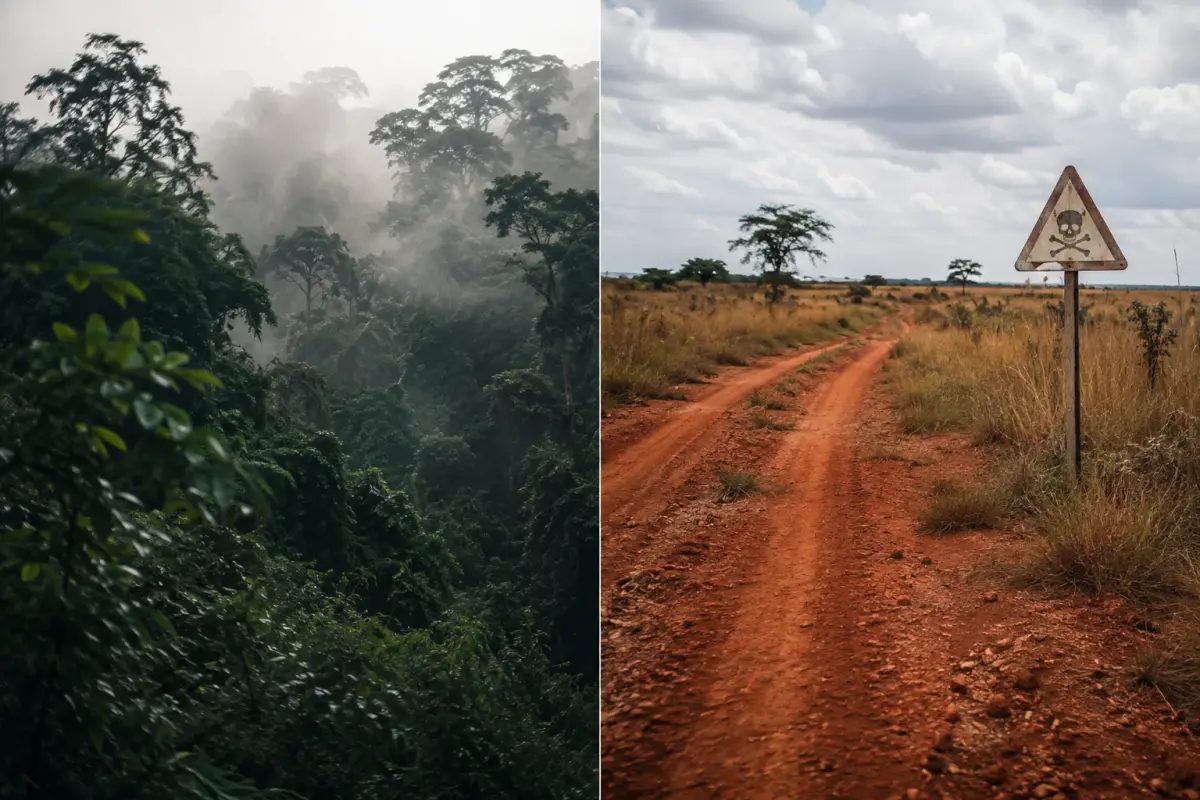
Landmines and UXO. Angola’s long civil war left mines in rural areas. Huge progress has been made through demining programs, but stay on cleared roads and tracks, don’t wander into empty fields, and heed local warnings.[11]
What Vaccines and Health Prep Do I Need for Angola?
Yellow fever vaccination is effectively mandatory for entry from most countries, and the certificate must be at least 10 days old on arrival. Beyond that, you’ll want malaria prophylaxis and standard travel updates.
Baseline vaccines and health steps for Angola, based on WHO and tropical medicine guidance:
- Yellow fever (required for entry, valid for life on the current certificate).
- Routine boosters: MMR, tetanus-diphtheria, polio.
- Recommended: hepatitis A and B, typhoid, rabies (if going rural or long-stay), meningitis, cholera in outbreak periods.
- Malaria: present countrywide, all year. Talk to a travel clinic about prophylaxis (options include atovaquone-proguanil, doxycycline, mefloquine).
- Water: don’t drink tap water; use bottled or filtered.
- Insects: DEET repellent, long sleeves at dawn/dusk, treated mosquito nets in budget accommodation.
Medical infrastructure outside private clinics in Luanda is limited. Trauma care and reliable ambulance response are not widely available, and serious cases usually mean medical evacuation at the traveller’s expense, which is why your insurance matters more here than in most destinations. For the full breakdown by disease and clinic, see our Angola vaccinations and health guide.
Do I Need Travel Insurance for Angola?
Yes, and specifically insurance that covers medical evacuation and repatriation, not just clinic visits. This is the single most important line item in your pre-departure prep for Angola.
Look for a policy that includes:
- Medical evacuation (air ambulance) with a limit of at least USD 250,000, ideally 500,000+.
- Repatriation of remains.
- Hospitalisation abroad with direct billing where possible.
- Trip cancellation and interruption if you’re booking flights and lodges in advance.
- Baggage and electronics cover with reasonable single-item limits.
- Adventure activities if you plan to surf, dive, or 4x4 remote areas.
What’s the Visa Process and Entry Requirements?
Many travellers now enter Angola visa-free for short tourism stays (up to 30 days) under Angola’s 2023 visa waiver, which covers 98 countries including the US, UK and most EU passport holders. Travellers not covered by the waiver, or those staying longer or travelling for business, work or study, need an e-visa obtained online before departure.
Standard entry requirements in 2026:
- Passport valid for at least 6 months beyond arrival, with blank pages.
- Yellow fever certificate (dose administered 10+ days before arrival).
- Proof of accommodation (hotel booking or invitation letter).
- Proof of onward or return travel.
- E-visa approval (printed or on your phone) if applicable to your nationality.
Rules change, so always verify with the Serviço de Migração e Estrangeiros (SME) or the Angolan embassy in your country before booking non-refundable flights. Full walkthrough: our Angola visa guide and, for Americans specifically, the Angola visa for US citizens page.
Consular help while in-country: our Angola embassies and consulates directory lists diplomatic missions in Luanda.
Best Time to Visit Angola (Weather-Wise)
The dry, cooler season from May to October is the practical window for most trips. It’s called cacimbo on the coast and brings comfortable temperatures, minimal rain, better road conditions, and easier wildlife viewing.
- May to October (dry): best all-round. Cooler in Luanda and the coast, mild in the highlands (Lubango, Huíla). Best for road trips, parks, and hiking.
- November to April (wet): hot and humid, thunderstorms, some rural roads become impassable. Landscape is greener; Kalandula Falls is at full power.
Highlands like Lubango sit around 1,700 m and can be chilly at night year-round. Pack layers. Deeper detail in our best time to visit Angola guide.
How Much Does a Trip to Angola Cost?
Angola is not a budget destination. Luanda has consistently ranked among the world’s most expensive cities for expats, and tourism prices reflect that.
Rough real-world ranges for a mid-range independent traveller in 2026 (verify at booking):
- Hotels: mid-range in Luanda often USD 150-250 per night; boutique/upscale 300+.
- Meals: local restaurants USD 10-20; upscale dinners 50+.
- Domestic flights (TAAG): varies widely; Luanda, Lubango or Luanda, Namibe typically the pricier leg of any itinerary.
- Car with driver: often the safest way to move around; day rates vary by region.
- E-visa fee: varies by nationality, check the official portal.
Detailed breakdown in our Angola trip cost budget guide.
Can I Use Credit Cards in Angola or Do I Need Cash?
Bring cash and a card, use cash by default. Visa and Mastercard work at upscale Luanda hotels, some restaurants, and major supermarkets, but acceptance drops sharply once you leave the capital or upmarket venues. ATMs (Multicaixa) exist in cities but often have low daily withdrawal limits and can reject foreign cards.
Practical money tips:
- Bring USD or EUR in clean, newer bills to exchange for kwanza (AOA) at banks or licensed exchange offices, not on the street.
- Withdraw kwanza in smaller amounts more often rather than a big lump sum.
- Keep small notes for taxis, tips, and market vendors.
- Notify your bank of travel dates to avoid card blocks.
- Don’t rely on cards outside Luanda, Benguela, or Lobito.
More in the Angola currency and money guide.
What Language Do They Speak and Do I Need Portuguese?
Portuguese is the official language and dominates daily life. English is spoken only patchily in tourism, hotels, and among younger urban Angolans. If you don’t speak Portuguese, a translation app plus a handful of polite phrases will change your trip.
Learn at minimum: bom dia (good morning), obrigado / obrigada (thank you, m/f), quanto custa? (how much?), por favor (please), desculpe (excuse me). You’ll also hear Bantu languages like Umbundu, Kimbundu, and Kikongo, especially outside cities.
How Do I Get Around: Public Transport vs Rental Car?
For most international visitors, the practical options are domestic flights, a car with driver, or organised tours. Self-drive is possible but demanding.
- Domestic flights (TAAG): the fastest way between Luanda, Lubango, Namibe, Benguela, Cabinda.
- Car with driver: best balance of safety and flexibility, especially in Luanda.
- Self-drive rental: available, but road conditions, aggressive driving, checkpoints, and language barriers make it a stretch for first-timers.
- Long-distance buses (Macon, SGO): cheap, slow, safety varies. Fine for the adventurous.
- Candongueiros (blue-and-white minibus taxis): ubiquitous in Luanda, not recommended for tourists.
- Ride apps: Yango and similar operate in Luanda and are a safer bet than flagging a street taxi.
Full comparison in our getting around Angola guide.
Where Should I Stay in Luanda, and What About the Rest of Angola?
In Luanda, base yourself in central, well-lit neighborhoods with 24/7 security: Ilha do Cabo, Miramar, Alvalade, and the Baixa/Marginal area near reputable hotels. Airport hotels are practical for one-night transits.
Outside Luanda, the personality of the trip changes completely:
- Benguela and Lobito: relaxed coastal towns, colonial architecture, calmer streets, great seafood.
- Lubango (Huíla): highland town, Cristo Rei viewpoint, Serra da Leba pass, Tundavala gorge.
- Namibe and Iona National Park: desert, welwitschia, wild coast.
- Malanje: gateway to Kalandula Falls and Pungo Andongo rocks.
- Mussulo: beach/lagoon escape from Luanda by boat.
Luanda vs the rest of Angola in one line: Luanda is expensive, urban, and demands street smarts; the rest of the country is quieter, friendlier, and closer to what you probably came for. Don’t let a two-day Luanda impression define your trip.
Compare regions in the Angola per provincie guide.
What’s There to Do in Angola Besides the Capital?
Plenty, and it’s the reason most repeat visitors come back. Highlights:
- Kalandula Falls (Malanje): one of Africa’s largest waterfalls, thundering in wet season.
- Kissama National Park: closest big park to Luanda, elephants and antelope reintroduced through Operação Arca de Noé.
- Iona National Park (Namibe): desert park where dunes meet the Atlantic.
- Serra da Leba and Tundavala (Lubango): iconic mountain pass and dramatic escarpment viewpoint.
- Miradouro da Lua: the “moon landscape” south of Luanda toward Cabo Ledo.
- Benguela and Lobito beaches: Praia Morena, Baía Azul, the Restinga sandspit.
- Mussulo lagoon: day-trip from Luanda by boat.
Pick a route from our Angola rondreis itineraries or the 5-day Angola itinerary.
Local Laws, Photography, and Drones
A few rules trip up first-time visitors:
- Do not photograph government buildings, military installations, ports, airports, or the presidential palace. Police may confiscate cameras or phones. Ask before photographing people.
- Drones require permits and are frequently confiscated at customs without paperwork. Don’t bring one on a casual trip.
- Carry ID (a colour copy of your passport photo page and visa is usually enough; keep the original in the hotel safe).
- Drug laws are strict.
- LGBTQ+ travellers: same-sex activity was decriminalised in 2019, but public attitudes remain conservative. Discretion advised.
- Alcohol is legal and widely available; drink-driving is not tolerated.
Common Mistakes Tourists Make in Angola
- Booking flights before checking the visa or e-visa status for their nationality.
- Skipping the yellow fever shot and being denied boarding or entry.
- Relying only on cards, then getting stuck without kwanza in Malanje.
- Trying to self-drive Luanda on day one.
- Photographing the port or a government building “just quickly.”
- Underestimating distances: Angola is huge, roads vary, domestic flights save days.
- Ignoring the advisory zones (Cabinda interior, DRC border strip).
- Booking cheap travel insurance without evacuation cover.
Pre-Departure Checklist
Two weeks out:
- ✅ Verify current advisory from your own government[1][2][11]
- ✅ Confirm visa/e-visa or visa-free eligibility with SME
- ✅ Yellow fever shot done (10+ days before arrival)
- ✅ Malaria prescription filled
- ✅ Travel insurance with medical evacuation purchased
- ✅ Passport valid 6+ months, blank pages
- ✅ Register with your embassy’s traveller programme (STEP for US, LOCATE for UK, ROCA for Canada)
- ✅ Hotel and first-night transfer booked
- ✅ USD/EUR cash in clean notes
- ✅ Offline maps and Portuguese phrasebook on phone
- ✅ Photocopy of passport and insurance stored separately
Conclusion
Angola in 2026 is a rewarding but demanding destination. The advisories are clear: prepare for a country with elevated risk, not one to write off. Sort your visa and yellow fever certificate early, buy proper insurance with evacuation cover, avoid the flagged zones (Cabinda interior, DRC border strip, Luanda at night), keep cash on hand, and lean on domestic flights and drivers rather than self-driving your first day.
Do that, and you’ll get a country that most travellers never see: Atlantic beaches empty of crowds, thundering waterfalls in Malanje, the escarpment views at Tundavala, kizomba nights in Luanda, and a warmth in local hospitality that stays with you. Start with our reisvoorbereiding hub, then check the live advisory from your own government the week before you fly.
Meta Title: Angola Travel Advice 2026: What to Know Before You Go Meta Description: Official 2026 Angola travel advice: US, UK, Canada advisories, Cabinda warnings, visa, vaccines, safety, money and a pre-departure checklist.
Tags: angola travel advice, angola travel advisory, reizen naar angola, visum angola, vaccinaties angola, is angola veilig, luanda, cabinda, angola rondreis, travel insurance angola, angola entry requirements, angolese keuken
Trip countdown planner
Enter your departure date and get a tickable preparation timeline.
The periods mentioned are guidelines, not official deadlines. Processing times for visas and vaccinations change; always check the current, official source. Your progress is saved only in your own browser.
Free help from our team in Angola
A question before you travel?
Tell us where and when you are going and what you want to know. Our team in Angola answers by email or WhatsApp.
- Local team in Angola
- No obligation, nothing to pay
- Reply by email or WhatsApp
Want to keep this guide? We email you the key points with a link to every section.
Frequently asked questions
Is Angola safe for tourists right now?
Angola is broadly visitable with proper preparation. The US rates it Level 2 overall and Level 3 for greater Luanda; the UK, Canada, and Spain advise heightened caution and specifically flag Cabinda and the DRC border strip. Petty and armed crime in Luanda is the main day-to-day risk.
Do American citizens need a visa for Angola?
No, not for tourism up to 30 days. Since Angola's September 2023 visa waiver, US citizens can enter visa-free for short tourist stays. A visa is still required for business, work, study or longer stays. Carry a yellow fever certificate and verify current rules with the Angolan embassy and SME.
How long is the yellow fever certificate valid?
The current WHO International Certificate of Vaccination is valid for life for yellow fever. The dose must be at least 10 days old at arrival.
Can I visit Cabinda?
Cabinda city and organised business/oil-sector visits are generally manageable. The rural interior of Cabinda province is on most advisory "avoid non-essential travel" lists due to separatist activity and kidnap risk.
Is tap water safe to drink?
No. Use bottled or filtered water, including for brushing teeth in some areas.
What currency should I bring?
US dollars or euros in clean, newer notes to exchange for kwanza on arrival. Cards are useful in Luanda but not reliable elsewhere.
References
- [1] Angola - UK Foreign Travel Advice
- [2] Angola Travel Advisory - US Department of State
- [6] Angola - Dernières minutes et alertes - France Diplomatie
- [8] Travel Advisories - US Department of State
- [10] Official Angola eVISA portal (SME)
- [11] Angola - Travel Advice - Government of Canada (voyage.gc.ca via Voy...