Most tourists flying to Luanda in 2026 will never set foot inside an Angolan consulate. The e-visa did that. But the moment your passport goes missing in Benguela, a notary asks for an Apostille on your birth certificate, or your nationality falls outside the visa-free list, the physical consular route suddenly matters again. This guide explains when the Angola consulate UK (and its counterparts in Brussels, Washington DC and elsewhere) is still your only real option, and how to actually get help.
Quick Answer
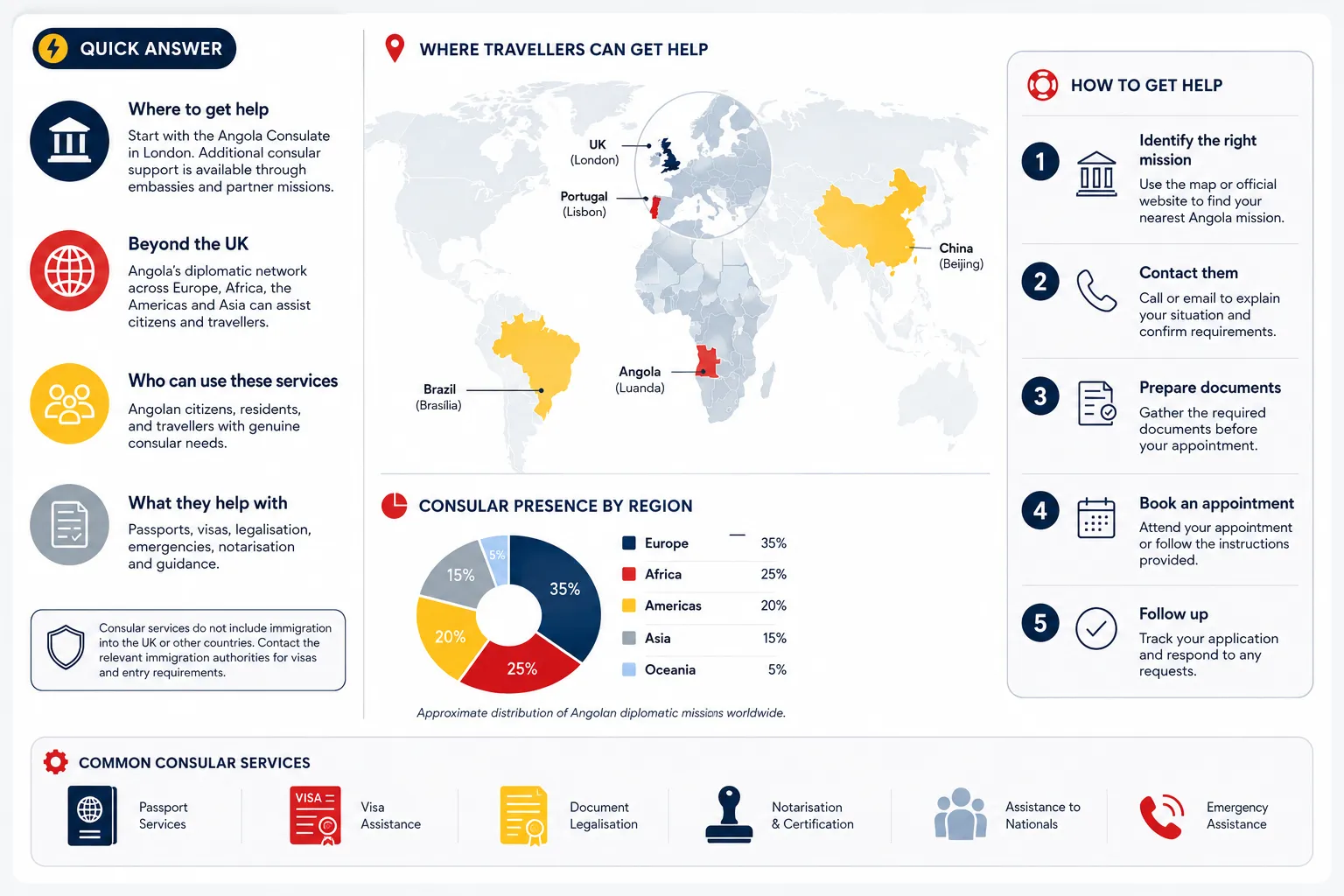
The Angolan Embassy in London handles consular services for the UK, including visas that can’t be processed online, passport renewals for Angolan citizens, document legalisation, and emergency assistance. Most tourists from the UK, EU, US and other visa-exempt or e-visa-eligible countries now apply online instead of visiting in person. Always verify current requirements on the official embassy website before planning a visit, because Angolan visa policy has changed several times since 2023.
Key Takeaways
- The angola consulate uk is located in London and serves all UK-based applicants; there is no second Angolan consulate elsewhere in Britain.
- Most short-stay tourists now use the Angola e-visa portal and never visit a consulate.
- Consulates are still essential for: visa categories not covered by the e-visa, Angolan passport services, document legalisation (Apostille-related work), and emergencies.
- Requirements, fees and processing times change often. Verify on the official embassy site before you go.
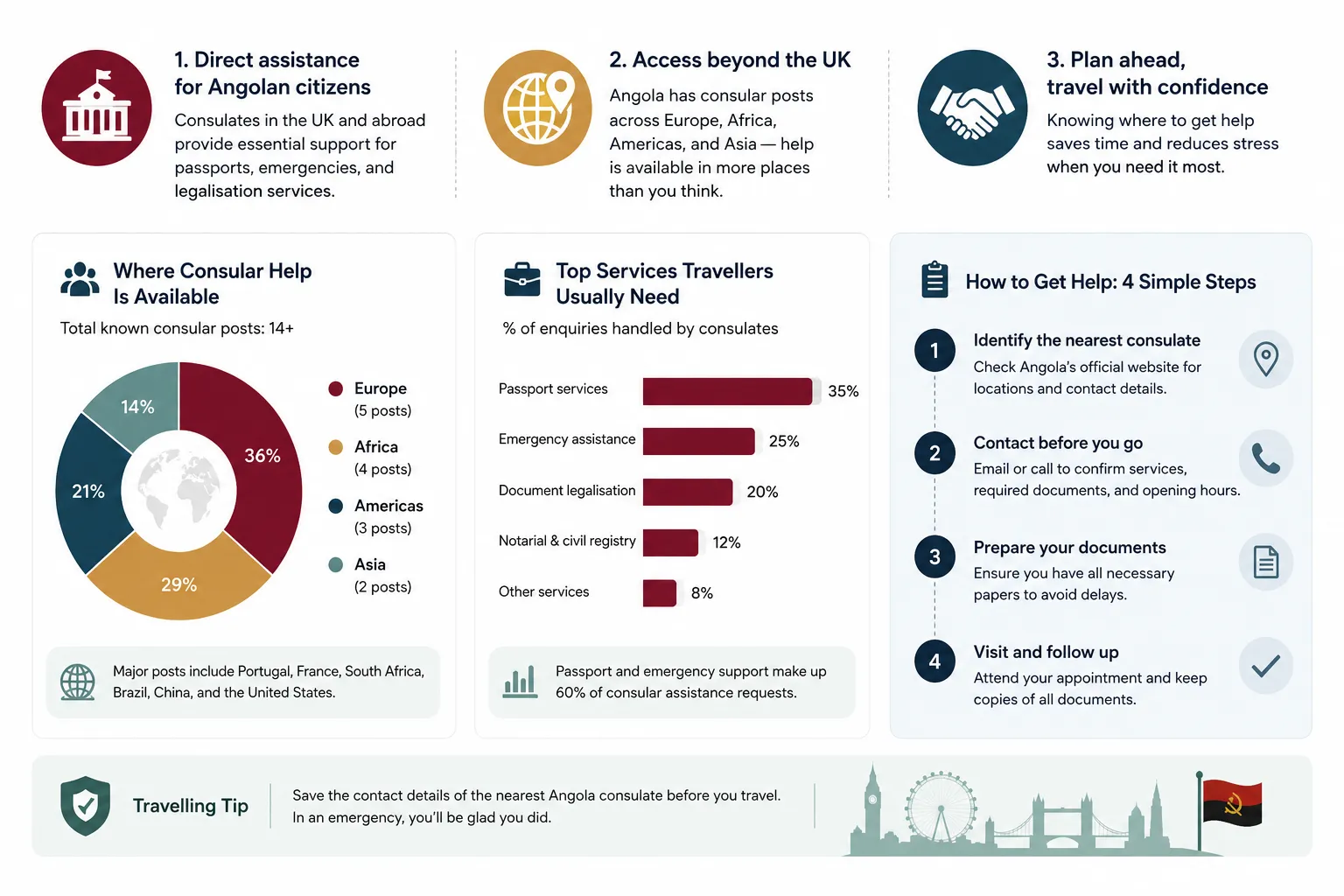
- Angola runs 80 diplomatic missions worldwide as of mid-2026, including 52 embassies and 25 consulates general [4].
- Belgian residents use the embassy in Brussels; US residents use Washington DC plus consulates general in Houston and New York [3].
- Emergency travel documents and lost passport help go through the nearest embassy or consulate, not through the e-visa portal.
Do I Need to Visit the Angola Consulate UK at All?
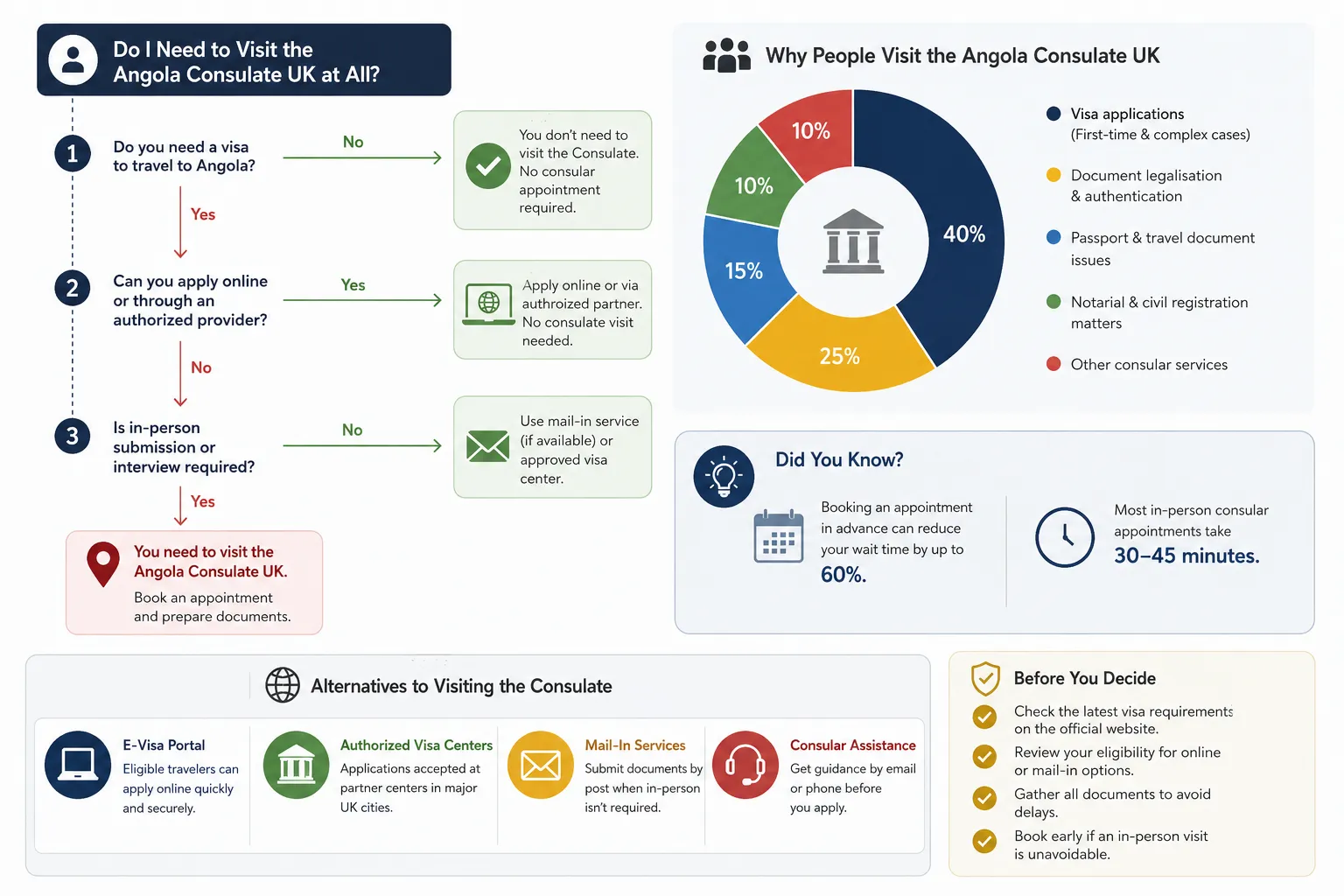
Probably not, if you’re a tourist. Since Angola overhauled its entry rules, citizens of the UK, most EU countries, the US, Canada and Australia can either enter visa-free for short tourist stays or apply for an e-visa online. The physical consulate mainly matters for longer stays, work, study, residence, or passport and legalisation matters.
You still need the consulate if:
- You’re applying for a work, study, residence or long-stay visa (these aren’t handled by the e-visa portal).
- You’re an Angolan citizen needing a new passport, ID card or civil registration.
- You need a document legalised for use in Angola (or an Angolan document legalised for the UK).
- You’ve had a visa refused online and want to reapply on paper.
- You need emergency consular help while abroad.
For the standard tourist route, our dedicated Angola visa guide and the walkthrough on travelling to Angola will save you a trip to London.
Where Is the Angola Consulate in the UK Located?
The Angolan Embassy in London houses the consular section and is the single official Angolan diplomatic mission in the United Kingdom. It’s located in central London and covers all consular affairs for UK residents, including Scotland, Wales and Northern Ireland [3][8]. There is no separate Angolan consulate in Manchester, Edinburgh or Belfast, so every in-person application routes through London.
Practical tip: Because it’s the only mission, appointment slots can fill up. If you need a paper visa or legalisation, plan two to four weeks ahead.
How Do I Contact the Angola Embassy London?
Contact the embassy through the official phone number and email listed on its website, or via the consular section for visa and passport enquiries. Directories such as Embassy Worldwide and Embassy Details maintain up-to-date contact details for the London mission [3][8]. Avoid third-party “visa concierge” sites that charge a markup and are not affiliated with the embassy.
Before you call or email, have ready:
- Your full name as on your passport
- Your nationality and residence status in the UK
- The service you need (visa type, passport, legalisation, notarial act)
- Travel dates, if relevant
What Services Does the Angola Consulate in the UK Provide?
The consulate handles everything the e-visa portal doesn’t. That includes long-stay and work visas, Angolan passport renewals, civil registration, notarial services, and legalisation of foreign documents intended for use in Angola.
Typical services:
- Visas outside the tourist e-visa scope (work, study, residence, ordinary long-stay, diplomatic, courtesy).
- Passport services for Angolan nationals (renewal, replacement, first-issue for children born in the UK).
- Civil registration: births, marriages, deaths of Angolans abroad.
- Legalisation and notarial acts: authenticating UK documents (degrees, powers of attorney, birth certificates) so they’re accepted in Angola.
- Consular assistance for Angolan citizens in distress in the UK.
- Emergency travel documents for Angolans who’ve lost their passport.
What Documents Do I Need for an Angola Visa From the UK?
For paper visa applications lodged at the London consulate, expect to submit a passport valid at least six months beyond your stay, completed application form, recent passport photos, proof of accommodation, return flight booking, yellow fever vaccination certificate, and evidence of funds. Work and study visas require additional employer or institution documentation. Always confirm the current checklist on the embassy site before submitting [1][9].
Standard supporting documents usually include:
- Passport with at least two blank pages, valid 6+ months.
- Completed visa application form, signed.
- Two recent passport photos (biometric standard).
- Return or onward flight itinerary.
- Hotel booking or invitation letter from an Angolan host.
- Yellow fever vaccination certificate (required for most travellers).
- Bank statements or proof of sufficient funds.
- Visa fee (payment method varies, verify in advance).
- For work/study: contract, invitation letter, or acceptance letter from an Angolan entity.
The single most common reason paper visas are delayed is missing yellow fever proof. Sort your vaccination before you start the application, not after.
For the full medical rundown see our Angola vaccinations guide, and cross-check with the World Health Organization yellow fever guidance.
How Much Does an Angola Visa Cost From the UK?
Visa fees vary by visa type, nationality and processing speed. Tourist e-visa fees and paper visa fees at the London consulate are not identical. Because fees change, we don’t publish a specific GBP figure here. Check the official embassy website or the e-visa portal for the current 2026 amount before you apply [1][9].
Rough categories to expect:
- Tourist e-visa (online): a single fixed fee, paid by card.
- Ordinary/short-stay paper visa: consulate fee, usually higher than e-visa.
- Work, study, residence visas: significantly higher, sometimes with separate government charges in Angola.
- Urgent processing: surcharge on top of the standard fee, if offered.
How Long Does an Angola Visa Take to Process?
Processing times depend on visa category and how busy the consulate is. E-visas are typically decided within a few working days. Paper visas at the London consulate often take one to three weeks for ordinary categories, and longer for work or residence visas that require approval from authorities in Luanda. Apply at least a month before travel where possible.
Decision rule: If you’re travelling in under 10 days and you’re eligible, use the e-visa. If you need a category the e-visa doesn’t cover, start the paper process at least 4-6 weeks out.
Can I Apply for an Angola Visa Online From the UK?
Yes, for most tourism and business short stays, UK travellers apply through Angola’s official e-visa portal rather than visiting the consulate. The e-visa was introduced to simplify tourist entry and is now the default route for most nationalities. For a full walkthrough of the online process, timings and screenshots, see our separate Angola visa article.
Use the physical consulate only if:
- Your visa category isn’t available online.
- Your online application was refused.
- You’re an Angolan national needing passport or civil services.
What Are the Opening Hours of the Angola Consulate UK?
Consular sections generally open weekday mornings for submissions and afternoons (or separate windows) for collection, but exact hours change and public holidays include both UK and Angolan national days. Confirm on the embassy website before travelling in. Angola observes 11 November (Independence Day) as a national holiday, and the London mission is typically closed then.
Do I Need a Visa to Visit Angola From the UK?
British passport holders currently benefit from Angola’s relaxed tourist entry regime, which allows either visa-free short stays or e-visa entry depending on the latest rules. Policy has changed multiple times since 2023, so always verify with the UK Foreign, Commonwealth & Development Office travel advice and the official Angolan e-visa portal before booking.
What’s the Difference Between the Angola Embassy and Consulate?
An embassy is the main diplomatic mission in a country’s capital and handles political relations plus consular affairs. A consulate (or consulate general) is a secondary office, usually in another major city, that handles consular services like visas, passports and citizen assistance for its region.
In the UK, there’s only the embassy in London, which contains the consular section, so the two terms are effectively used interchangeably [3][8]. In the US, the embassy is in Washington DC and there are separate consulates general in Houston and New York [7]. In Belgium, the embassy in Brussels covers Belgian residents and the Benelux region.
How Do I Renew My Angolan Passport in the UK?
Angolan nationals renew their passport through the consular section of the embassy in London. You’ll typically need your old passport, biometric data capture (done in person), completed forms, photos, and payment. Because passports are issued from Angola, expect several weeks of processing. Book an appointment well before your current passport expires.
What if My Angola Visa Application Gets Rejected?
If your e-visa is refused, you can either reapply online correcting the issue, or submit a paper application at the consulate with additional supporting documentation. Common reasons for refusal include unclear travel purpose, weak proof of accommodation, and missing yellow fever certificates. There’s usually no formal appeal, but a well-prepared second application often succeeds.
Common mistake: applying again immediately with the same documents. Fix the actual issue first (better hotel booking, clearer invitation letter, complete vaccination record) before resubmitting.
Can I Get an Emergency Angola Visa Quickly?
Some categories allow urgent processing at the consulate for an additional fee, but there’s no guaranteed same-day service. If you have a genuine emergency (family bereavement, urgent medical, business), contact the embassy directly, explain the situation and ask what expedited options exist. Don’t rely on third-party “fast visa” agents claiming 24-hour turnarounds; the decision still sits with the consulate.
Is There an Angola Consulate Outside of London?
No. The UK has one Angolan diplomatic mission, the embassy in London, and it houses the consular section [3][8]. Travellers from Ireland typically use either the London embassy or the Brussels embassy depending on their residence status. If you live outside the UK, always check which mission has jurisdiction over your country of residence.
Angolan Consulates Elsewhere: Brussels, Washington DC and Beyond
For non-UK readers, here’s a quick orientation to the main Angolan missions travellers ask about:
| Country | Main Mission | Additional Offices |
|---|---|---|
| United Kingdom | Embassy, London | None |
| Belgium | Embassy, Brussels | Covers Benelux, EU mission |
| Netherlands | via Brussels embassy | Honorary consul may apply |
| United States | Embassy, Washington DC | Consulates general in Houston and New York [7] |
| Canada | Embassy, Ottawa | Contact for regional jurisdiction |
| Australia | Often via nearest regional mission | Verify current arrangement |
Angola’s full diplomatic network runs to 80 missions in 2026, so if you live outside these countries you’ll usually find an accredited embassy in your region [4][6]. The Embassy Worldwide directory is a practical starting point [3].
Document Legalisation and Notarial Services
The consulate can authenticate UK-issued documents for use in Angola, and Angolan documents for use in the UK. Because Angola isn’t a party to the Hague Apostille Convention, documents usually need consular legalisation rather than a simple Apostille. Typical documents include university degrees, birth and marriage certificates, powers of attorney and company documents.
Common workflow for a UK document going to Angola:
- Notarise the document with a UK notary public.
- Get it legalised by the UK FCDO Legalisation Office.
- Present it at the Angolan consulate in London for consular legalisation.
- Once in Angola, some documents also need registration by local authorities.
A Quick Word on Travel Preparation
If you’re at the point of dealing with consulates, you’re serious about the trip. Before you fly, cross-check Angolan cuisine and Angolan culture so the arrival feels less foreign, and browse the Angola attractions overview to plan beyond Luanda. Solid travel insurance and a working eSIM the moment you land make a real difference.
Conclusion
For the vast majority of British and international tourists, the Angola consulate UK is a piece of infrastructure you’ll happily never use. The e-visa handles standard tourism, and Angola’s visa-free arrangements have made short trips easier than at any point in the past decade. But when you step outside that lane, work visas, passport renewals for Angolan citizens, legalisation of documents, emergencies, the London embassy is still the only door that opens. Bookmark the official site, verify every requirement in the year you actually travel, and start your paperwork earlier than you think you need to. Then get on with the fun part: planning your route through Luanda, Benguela and the Kalandula waterfalls.
Free help from our team in Angola
Not sure which embassy you need?
Tell us your nationality, why you travel and when. We answer from the official rules on evisa.ao and tell you what applies to you. The Angolan embassy or the migration service (SME) always has the final say.
- Local team in Angola
- No obligation, nothing to pay
- Reply by email or WhatsApp
Want to keep this guide? We email you the key points with a link to every section.
Frequently asked questions
Is there an Angolan consulate in Manchester or Edinburgh?
No. The Angolan Embassy in London is the only diplomatic mission in the UK, and it handles all consular services for the whole country.
Can I get an Angola visa on arrival at Luanda airport?
Visa on arrival is not a general option for most nationalities. Use the e-visa in advance, or apply at your nearest embassy for categories the e-visa doesn't cover.
Do children need their own Angola visa?
Yes. Every traveller, including minors, needs their own valid entry authorisation. Requirements for accompanying parents vary; check the current rules.
Does the embassy help UK citizens in trouble in Angola?
No. The Angolan embassy in London serves Angolan citizens in the UK. UK citizens in Angola should contact the British Embassy in Luanda.
How far in advance should I apply?
For an e-visa, 2-4 weeks is comfortable. For a paper visa at the London consulate, 4-6 weeks minimum, and longer for work or residence categories.
Is a yellow fever vaccination still required in 2026?
Yellow fever vaccination is generally required for entry to Angola. Verify with your travel clinic and the [WHO](https://www.who.int/) before applying.