Quick Answer
Portuguese is the official language of Angola and the one you’ll hear everywhere in cities, on TV, in shops and at the airport. Alongside it, roughly a dozen Bantu languages are spoken daily, the biggest being Umbundu, Kimbundu, Kikongo and Chokwe. English is understood only in a limited way, mostly in top hotels and by younger people in Luanda, so a handful of Portuguese phrases will make your trip dramatically smoother.
Key Takeaways
- Portuguese is the sole official language and lingua franca, spoken by the large majority of Angolans, especially in urban areas [7].
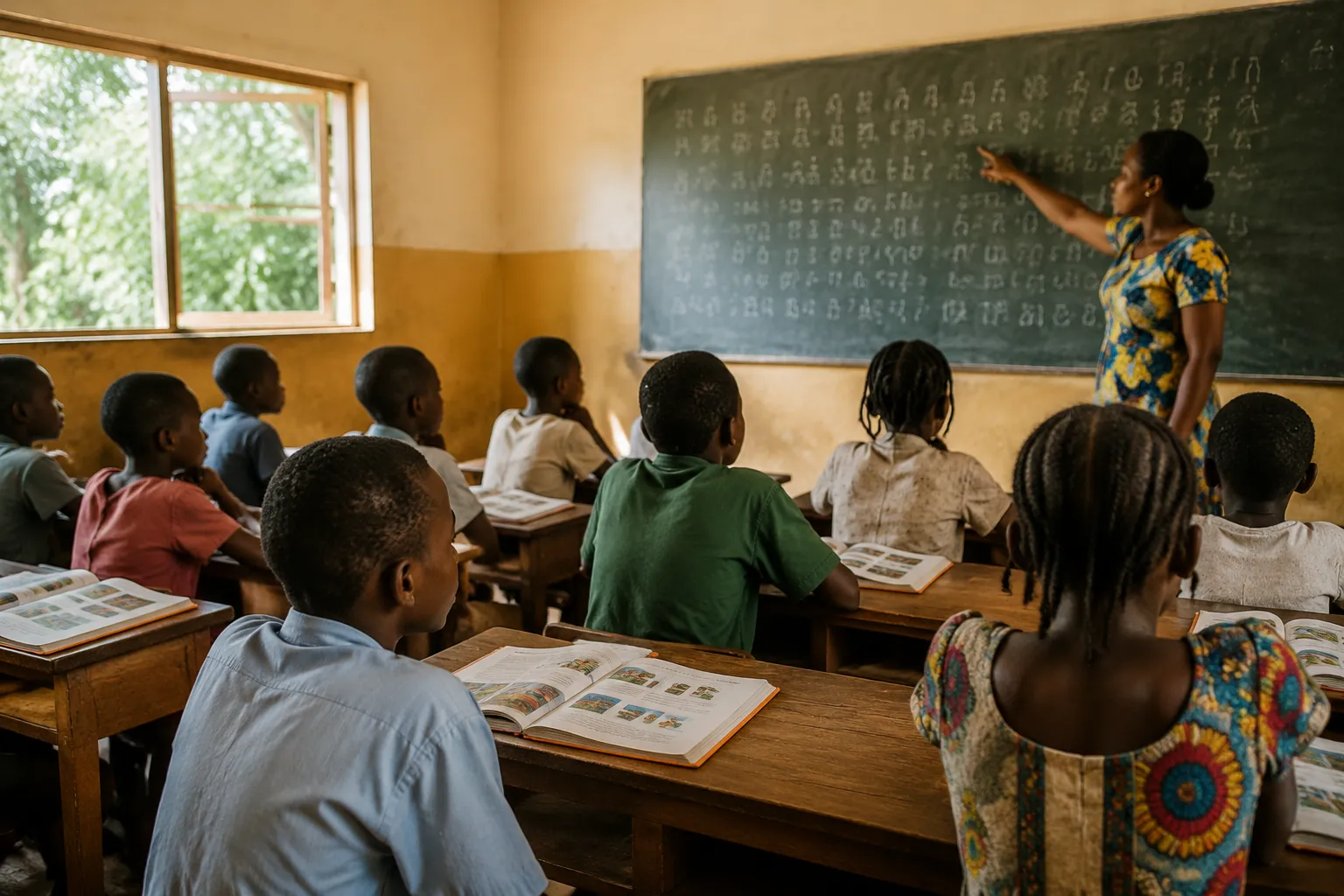
- Nine national Bantu languages are being introduced into primary schools from 2026, a big shift in Angolan language policy [10].
- Umbundu, Kimbundu and Kikongo are the three most widely spoken local languages.
- English is limited outside international hotels, tour operators and expat circles in Luanda.
- Angolan Portuguese differs from European and Brazilian Portuguese in accent, slang and rhythm.
- A small phrasebook (or an offline translation app) will carry you through 95% of traveller situations.
- French was recently made mandatory in Angolan elementary schools, adding another layer to the country’s language landscape [2].
What language do they speak in Angola?
Angolans speak Portuguese as their primary shared language, plus one or more Bantu languages depending on region and family background. Portuguese is what you’ll use for hotels, restaurants, transport, tours and any official business.
In practice, most urban Angolans are bilingual or trilingual: Portuguese for public life, a Bantu language at home or with elders, and often a bit of English or French picked up at school or online. In rural areas, a local language may be the dominant one, with Portuguese used mainly at school, in church or with visitors.
If you’re planning your first trip, our guide to travel to Angola walks through everything from visa to language basics in one place.
Is Portuguese the official language of Angola?
Yes. Portuguese is Angola’s only official language, and in early 2025 a legislative package formally recognised it as “the language of Angola” while committing the state to protect and promote national (Bantu) languages alongside it [7]. That framing matters: it keeps Portuguese as the language of government, courts and schooling, but signals a more inclusive stance toward local languages than in previous decades.
A draft Law on Languages of Angola, reviewed by the National Assembly’s Social Policy Commission in late 2025, sets out categories for national languages (regional, local, transborder and transnational) and pushes back against discrimination based on the language someone speaks [9][4].
Why does Angola speak Portuguese?
Angola speaks Portuguese because it was a Portuguese colony for nearly 500 years, from the late 15th century until independence on 11 November 1975. Portuguese was imposed through administration, trade, missionary schooling and later urban migration, and it stayed after independence as the neutral national language that didn’t favour any one ethnic group [8].
After independence, the ruling MPLA kept Portuguese as the official language partly for unity and partly for international ties (Brazil, Portugal, Mozambique, the wider Lusophone world). Decades of civil war (1975 to 2002) accelerated urbanisation and pushed Portuguese even deeper into daily life.
What percentage of Angolans speak Portuguese fluently?
A large majority of Angolans speak Portuguese, though estimates vary by source and by what “fluent” means. Wikipedia and academic overviews commonly cite that around 70% or more of Angolans speak Portuguese, with roughly 40 to 50% using it as a first language, especially in cities [6][5]. UNICEF’s 2016 language and learning report highlights that many rural children still enter school speaking a Bantu language at home rather than Portuguese, which is one reason bilingual education is now a policy priority [3].
The short version: in Luanda and other big cities, assume Portuguese fluency. In villages, assume Portuguese is a second language and speak slowly.
What are the main languages spoken in Angola besides Portuguese?
Besides Portuguese, Angolans speak a family of Bantu languages, plus small pockets of Khoisan languages in the far south. The main national languages are:
| Language | Approx. region | Notes |
|---|---|---|
| Umbundu | Central highlands (Huambo, Bié, Benguela) | Largest Bantu language by speakers |
| Kimbundu | Luanda, Malanje, Bengo | Historically influential; source of many loanwords |
| Kikongo | North (Uíge, Zaire, Cabinda) | Also spoken in DR Congo and Republic of Congo |
| Chokwe | East (Lunda Norte, Lunda Sul, Moxico) | Transborder language with DRC and Zambia |
| Nganguela | Southeast | Cluster of related varieties |
| Kwanyama / Nyaneka | South (Cunene, Huíla) | Close ties with Namibian communities |
| Fiote | Cabinda enclave | Local Kikongo variety |
From 2026, nine of these national languages are being phased into primary education, a landmark change in Angolan schooling [10].
Is Kimbundu still spoken in Angola, and how is Bantu language used today?
Yes, Kimbundu is very much alive, especially in and around Luanda, Malanje and Bengo, though younger urban Angolans often understand it better than they speak it [6]. Kimbundu has also shaped Angolan Portuguese: words like kubata (house), kamba (friend) and muamba (a rich stew sauce) come from Kimbundu roots [8].
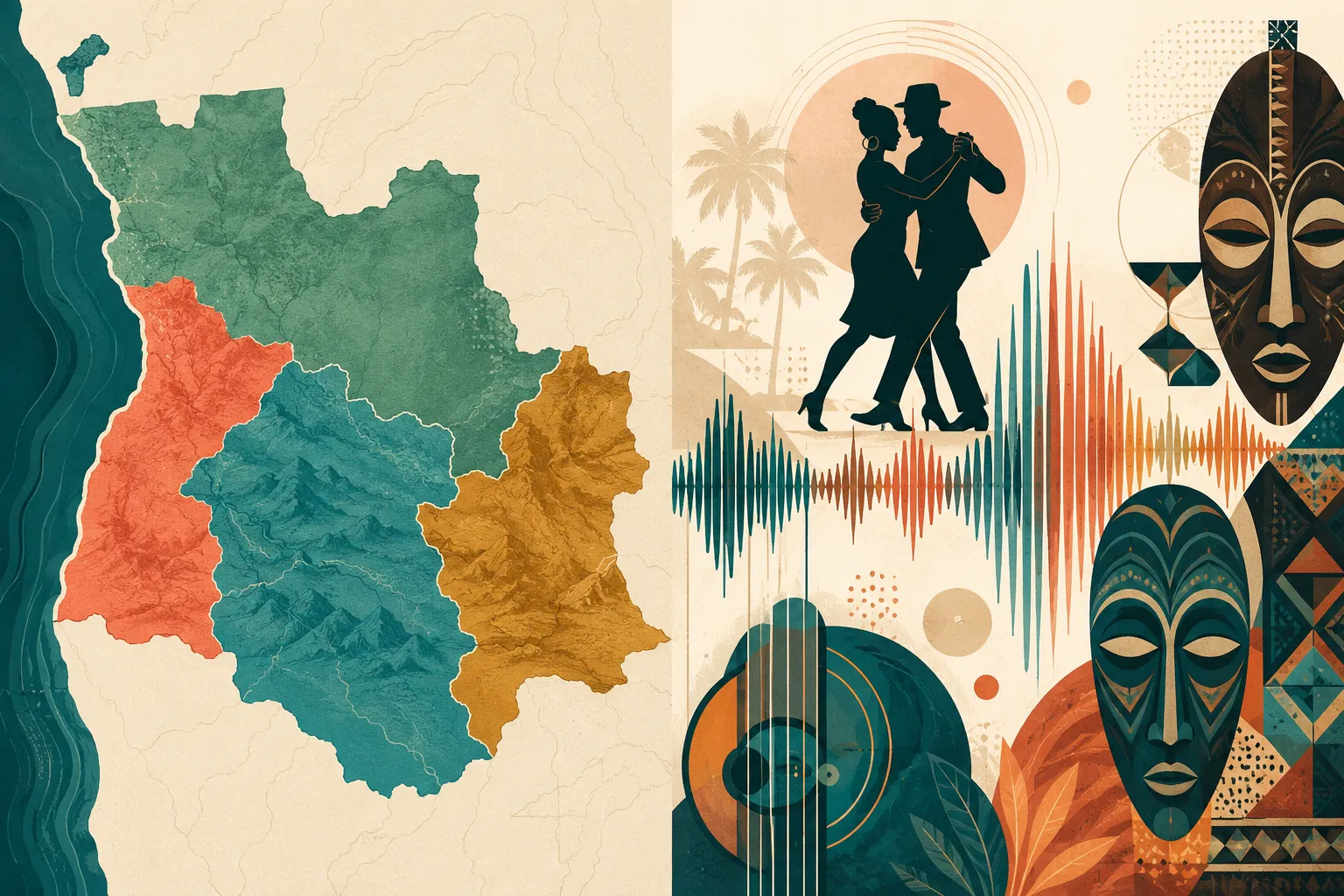
In daily life, Bantu languages are used at home, in markets, in traditional ceremonies, in church services in rural areas, and in music (semba, kizomba and kuduro lyrics often mix Portuguese with Kimbundu or Umbundu). Radio stations broadcast in several national languages, and the 2025 to 2026 policy shift is designed to give them more space in schools and media [4][10].
If you’re curious about how language ties into music, food and daily rhythm, our overview of the culture of Angola is a good next read.
How do Angolans mix Portuguese with local languages?
Angolans code-switch constantly, often mid-sentence, blending Portuguese grammar with Bantu vocabulary, greetings, exclamations and idioms. This mixing is most obvious in Luanda street speech, in music and on social media.
Typical patterns you’ll notice:
- Bantu loanwords inside Portuguese sentences (bué = a lot, kota = elder/big brother, maka = problem/argument).
- Portuguese verbs conjugated normally, with Bantu nouns dropped in.
- Bantu greetings like kalunga or muxima appearing in otherwise Portuguese conversations.
- Song lyrics that switch languages between the verse and chorus.
For linguists, Angolan Portuguese is a fascinating contact variety; for you as a traveller, it just means the “Portuguese” you hear on the street won’t sound exactly like a European textbook.
What is the difference between Angolan Portuguese and Brazilian Portuguese?
Angolan Portuguese is closer to European Portuguese in grammar and pronunciation, while Brazilian Portuguese has its own rhythm, vowel sounds and vocabulary. Angolans tend to speak with clearer consonants than Brazilians and use more European-style verb forms, but with a distinct African intonation and many Bantu-origin words that Portugal and Brazil don’t share [8][5].
Quick contrasts:
- Pronunciation: Angolan speech is often described as musical and rhythmic, softer on the “s” than Portugal, but not as open-vowelled as Brazil.
- Vocabulary: Everyday words like bué (very/a lot) or bazar (to leave) are Angolan, not Portuguese or Brazilian.
- Formality: Você and o senhor / a senhora are common; second-person tu is used with friends and family.
- Understanding: If you learned Brazilian Portuguese from an app, you’ll be understood fine, but expect to adjust your ear.
Can you get by with English in Angola?
Honestly, only partly. English is spoken by staff at international hotels in Luanda, at TAAG check-in, by many tour guides and by younger, educated Angolans, but it’s not a language you can count on with taxi drivers, market sellers, restaurant staff outside top venues, or people in smaller towns like Lubango, Namibe or Malanje.
Practical expectation:
- Luanda 5-star hotels, guided tours, dive operators on Mussulo: English usually fine.
- Airports, immigration: Basic English, but Portuguese speeds things up.
- Restaurants, taxis, shops, road trips: Portuguese strongly recommended.
- Rural areas and national parks: Portuguese essential; a local guide often bridges to Bantu languages.
For more on getting around, see our practical Angola travel tips.
Are there language barriers for tourists in Luanda?
Language barriers exist in Luanda, but they’re manageable. In the city’s business districts, upscale restaurants and hotels along the Marginal, you’ll find English-speaking staff. Step into a candongueiro (blue-and-white minibus), a neighbourhood market like Roque Santeiro’s successors, or a small quitanda, and Portuguese quickly becomes essential.
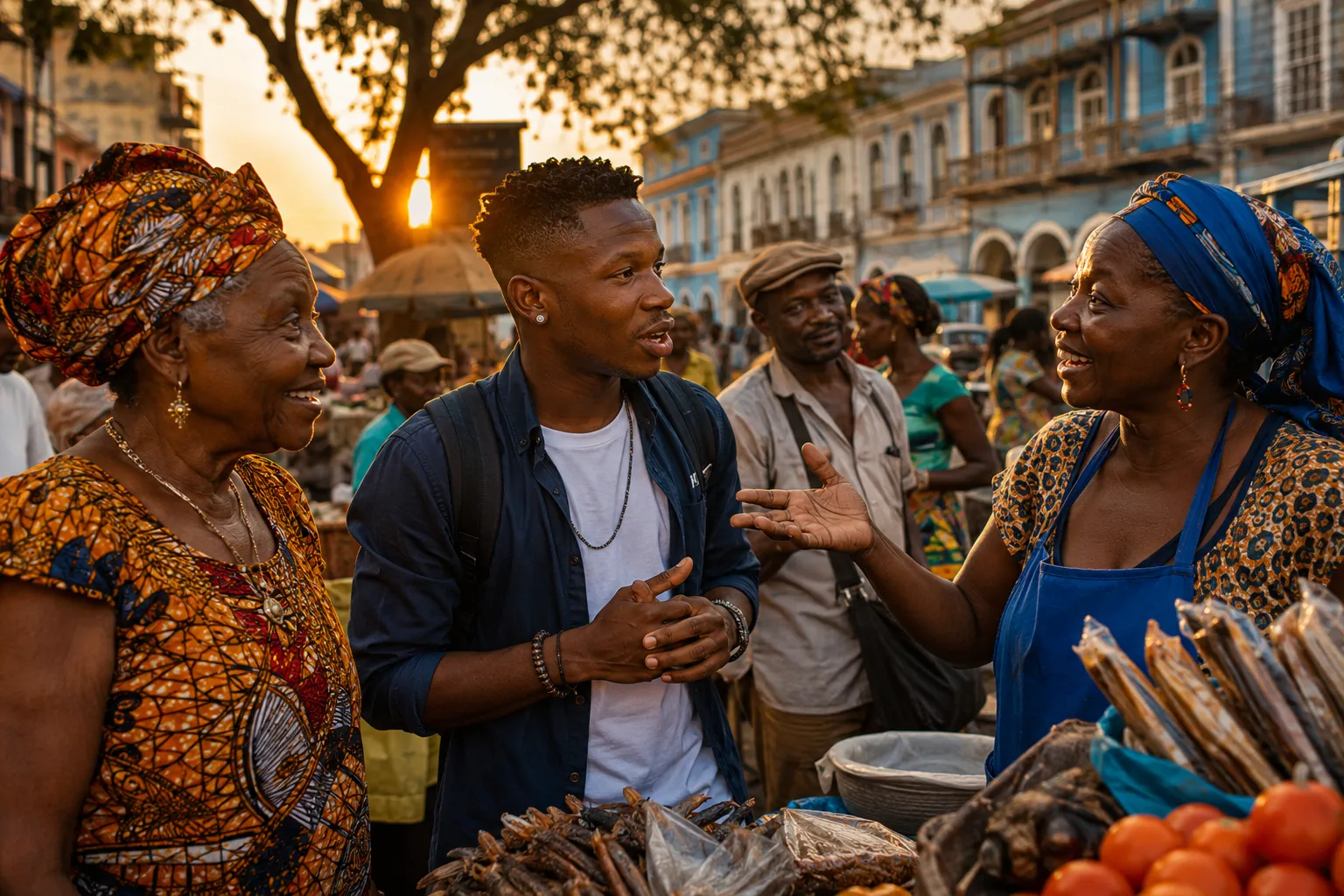
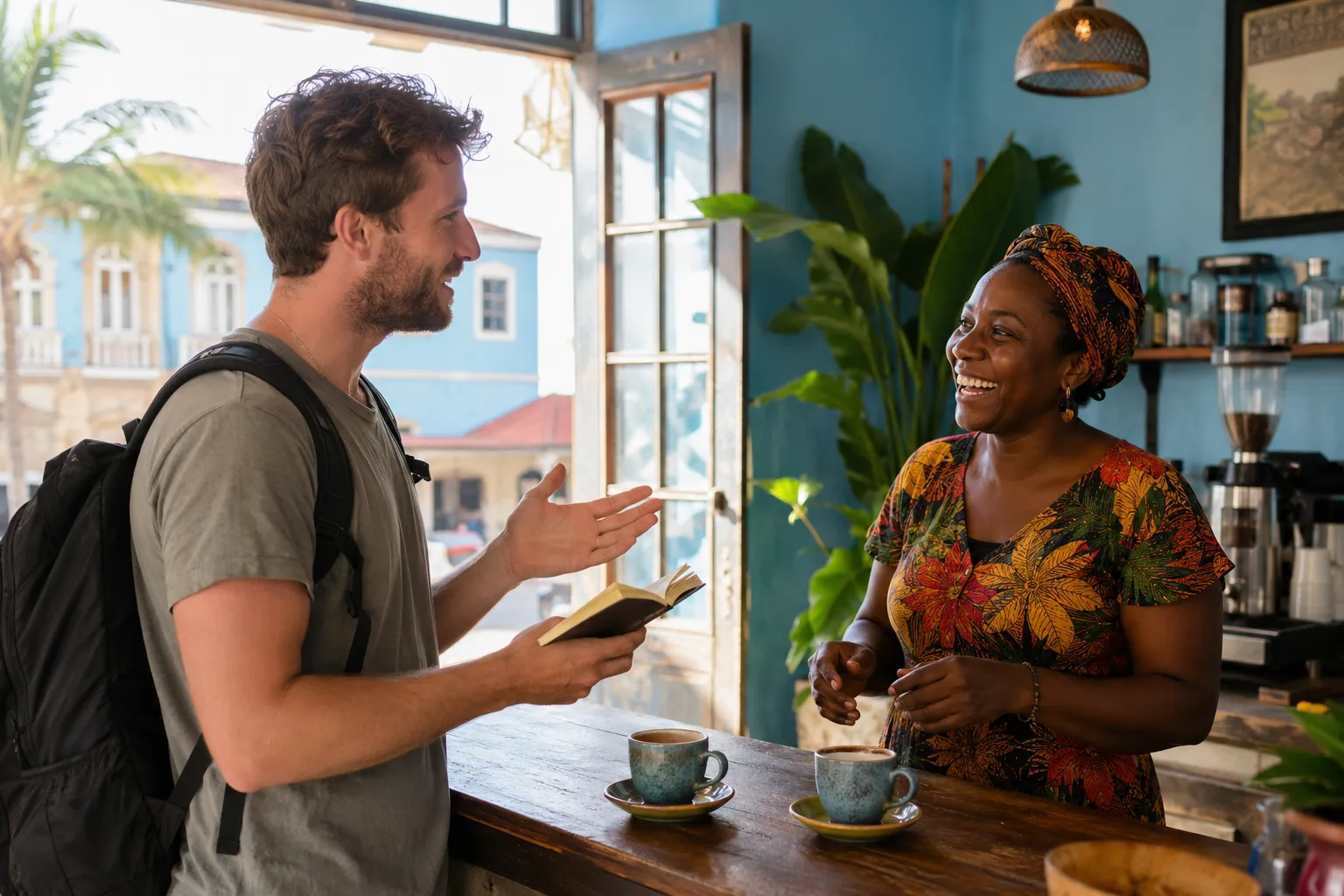
My rule of thumb after several visits: learn 20 to 30 Portuguese phrases, keep Google Translate downloaded offline for Portuguese, and don’t be shy about pointing, smiling and using numbers on your fingers. Angolans are, in my experience, patient and warm with visitors who make even a tiny effort.
For more on the capital itself, see our Luanda guide.
What languages should I learn before visiting Angola?
Learn Portuguese, full stop. Even 10 hours of study before you fly will change your trip. Bantu languages are wonderful but not realistic to pick up for a short visit, and locals don’t expect it.
Focus on:
- Greetings and politeness (bom dia, obrigado/obrigada, por favor, com licença).
- Numbers 1 to 100 for prices, taxis and phone numbers.
- Directions and transport (esquerda, direita, quanto custa, aeroporto).
- Food and drink (água sem gás, sem picante, a conta por favor).
- Emergencies (ajuda, hospital, polícia, não me sinto bem).
Best way to learn Angolan Portuguese
The best approach is to start with European Portuguese on a mainstream app, then tune your ear to Angolan accents through music and video.
A simple plan:
- Weeks 1 to 4: Duolingo, Pimsleur or Babbel in Portuguese (Portugal). Focus on listening.
- Weeks 3 to 6: YouTube channels and Angolan news clips (RTP África, TPA). Listen to semba and kizomba playlists.
- Weeks 5 to 8: iTalki or Preply lessons with an Angolan or Portuguese teacher. Ask for traveller vocabulary.
- On the ground: Repeat what you hear, ask como se diz…? (how do you say…?), keep a small notebook.
Useful Portuguese phrases for travellers in Angola
Here’s a compact survival list. Pronounce boldly; Angolans respond warmly to any attempt.
| Portuguese | English |
|---|---|
| Bom dia / Boa tarde / Boa noite | Good morning / afternoon / evening |
| Olá, tudo bem? | Hi, how are you? |
| Obrigado (m) / Obrigada (f) | Thank you |
| Por favor | Please |
| Desculpe / Com licença | Sorry / Excuse me |
| Fala inglês? | Do you speak English? |
| Não falo português, só um pouco | I don’t speak Portuguese, only a little |
| Quanto custa? | How much is it? |
| A conta, por favor | The bill, please |
| Onde fica o hotel / a casa de banho? | Where is the hotel / the toilet? |
| Sem picante, por favor | No spicy, please |
| Água sem gás | Still water |
| Ajuda! | Help! |
| Preciso de um médico | I need a doctor |
| Bué fixe! | Very cool! (Angolan slang) |
Practical language tips on the ground
A few things I wish someone had told me before my first trip:
- Download offline Portuguese in Google Translate before you land; mobile data can be patchy.
- A local SIM or eSIM makes translation apps and maps much easier. Many travellers now use an eSIM before arrival.
- Learn numbers well. Prices in kwanza have lots of zeros; misreading 5.000 vs 50.000 hurts.
- Photograph menus and signs and translate them in the moment.
- In rural areas, ask your driver or guide to translate to Umbundu, Kimbundu or Kikongo where needed. Most guides handle this naturally.
Conclusion
Angola’s language story is Portuguese at the centre, with a rich chorus of Bantu languages around it, and a policy shift from 2025 to 2026 that’s giving those local languages more room in schools and public life. For you as a traveller, the practical takeaway is simple: learn 30 Portuguese phrases, download an offline translator, and lean into the warmth of Angolans who’ll meet your effort halfway.
Next steps: brush up on Angola attractions to plan your route, then check the current Angola visa rules and pack your phrasebook.
Want to keep this guide? We email you the key points with a link to every section.
Frequently asked questions
How many people speak Portuguese in Angola?
The majority of Angola's roughly 35 million people speak Portuguese, with common estimates around 70% or higher, and around 40 to 50% using it as a first language, mostly in urban areas.
Is French spoken in Angola?
Not widely, but that's shifting. Angola made French mandatory in elementary schools starting in 2026, reflecting closer ties with francophone neighbours. For now, don't count on French with adults.
Will locals be offended if I speak only English?
No, but effort is appreciated. A simple *bom dia* and *obrigado* opens doors faster than any tip.
Which app is best for learning Portuguese before Angola?
Any mainstream app (Duolingo, Pimsleur, Babbel) in the Portugal variant is a solid start. Follow up with Angolan music and YouTube for the accent.
Do I need a phrasebook or is my phone enough?
A phone with an offline Portuguese pack (Google Translate) is usually enough, but a slim phrasebook is a great backup when your battery dies in a rural area.
Is sign language or gesturing okay?
Absolutely. Angolans are expressive communicators. Point, smile, use fingers for numbers, and don't panic if a sentence doesn't land.
References
- [1] Local Languages
- [2] Angola Makes French Mandatory In Elementary School
- [3] UNICEF 2016 Language and Learning Angola
- [4] Government Wants Minorities To Use Their Own Language Without Discr...
- [5] Gerards Meisnitzer 2023 Angola
- [6] Languages Of Angola
- [7] Portuguese Language Recognized As The Language Of Angola In Legisla...
- [8] Angolan Portuguese The Colonisation Of A Language
- [9] Social Policy Commission Analyzes Proposed Law On Languages
- [10] Angola Includes 9 National Languages In Education System For Primar...