Quick answer
The most useful Portuguese phrases for Angola travellers are the ones you use before anything else: bom dia (good morning), boa tarde (good afternoon), por favor (please), obrigado/obrigada (thank you) and quanto custa? (how much is it?). Portuguese is the language of daily life, shops, taxis and government offices in Angola, and English is not widely spoken outside international hotels and the oil sector. You do not need fluency. Around 40 to 60 memorised phrases, plus a polite greeting habit, will carry you through most of a trip.
Key takeaways
- Greet first, ask second. In Angola a request without a greeting feels abrupt. Lead with bom dia, boa tarde or boa noite.
- Angolan Portuguese is close to European Portuguese, with its own accent, rhythm and vocabulary, including loanwords from Bantu languages, especially Kimbundu.
- The tu/você rule is reversed compared with what most textbooks teach. In Angola, tu generally feels more respectful and você more casual.
- If you already speak European or Brazilian Portuguese, you will be understood everywhere.
- Bué means “a lot” or “very”. It is Angolan in origin and later travelled to Portugal.
- Learn three rescue phrases: não entendo (I don’t understand), pode repetir? (can you repeat?) and mais devagar, por favor (slower, please).
- Download offline Portuguese in your translation app before you fly. Mobile data is patchy outside big cities.
- Numbers, prices and directions cause the most confusion. Ask people to write numbers down.
Do people in Angola speak English, or just Portuguese?
Assume Portuguese. English exists in five-star hotels in Luanda, in the oil and gas industry, at some tour operators and among younger, university-educated Angolans, but it is not a language you can rely on with a taxi driver, a market seller, a police officer or a nurse. Portuguese is the working language of daily life and administration across the whole country.
How much Portuguese do you actually need? Here is a simple rule:
- Guided trip with a driver and fixed hotels: 20 to 30 phrases. Courtesy, food, numbers.
- Independent travel between cities: 60 or more phrases, plus numbers to 1,000 and a translation app that works offline.
- Road trip or remote areas: the more the better. In small towns you may meet nobody who speaks a word of English.
If you want the background on Angola’s wider language picture, including Umbundu, Kimbundu and Kikongo, read our guide to language in Angola. This article stays practical.
What’s the difference between Portuguese in Angola and Portugal?
Angolan Portuguese is mutually intelligible with European Portuguese. The grammar and spelling are essentially the same. What changes is the accent, the rhythm (often clearer and more open than in Lisbon, with fewer swallowed vowels) and a layer of vocabulary borrowed from Bantu languages, especially Kimbundu.
One difference is genuinely worth knowing before you land:
In Angola, tu is generally felt as the more formal, respectful form, and você as the more casual, familiar one. That is the reverse of the pattern learners are taught for Portugal and Brazil.
Do not overthink it. As a visitor, be polite and let people set the tone. With strangers, older people, officials and anyone serving you, use o senhor (to a man) or a senhora (to a woman) with the verb form for “he/she”: O senhor pode ajudar-me? (Can you help me?). That is safe and courteous anywhere in the Portuguese-speaking world. Switch to a first name and a casual tone only once your Angolan companion does.
Angolan Portuguese vs Brazilian Portuguese: which should I learn?
If you are starting from zero and going to Angola, learn European Portuguese materials. The vocabulary, verb forms and written style are closer to what you will hear and see on menus, signs and official documents in Angola. Brazilian Portuguese is easier to find in apps and courses, and Angolans understand it perfectly well thanks to widely watched Brazilian television, so it is not a wasted effort. It just leaves you saying ônibus when the sign says autocarro.
The most useful Portuguese phrases for Angola travellers: greetings and courtesy
Start here. Greetings do more work in Angola than any other category of phrase, because people generally greet before they transact. Walking up to a stall and saying “how much” with no bom dia first reads as rude, even if your accent is perfect.
)
| Portuguese | English | Say it like |
|---|---|---|
| Bom dia | Good morning | bong DEE-ah |
| Boa tarde | Good afternoon | BOH-ah TARD |
| Boa noite | Good evening / good night | BOH-ah NOYT |
| Olá | Hello | oh-LAH |
| Tudo bem? | All good? / How are you? | TOO-doo BENG |
| Tudo bem, obrigado | All good, thanks (man speaking) | TOO-doo BENG, oh-bree-GAH-doo |
| Como está? | How are you? (polite) | KOH-moo shTAH |
| Por favor | Please | poor fah-VOR |
| Obrigado / Obrigada | Thank you (man / woman speaking) | oh-bree-GAH-doo / -dah |
| Muito obrigado | Thank you very much | MWEEN-too oh-bree-GAH-doo |
| De nada | You’re welcome | deh NAH-dah |
| Desculpe | Sorry / excuse me | dish-KOOLP |
| Com licença | Excuse me (squeezing past) | kong lee-SEN-sah |
| Até logo | See you later | ah-TEH LOH-goo |
Note on obrigado: the ending matches the speaker, not the listener. Men say obrigado, women say obrigada, always.
Useful Portuguese phrases for Angola travellers on the move: taxis and directions
Say your destination clearly, agree the price before you get in, and repeat the number back. Most shared minibus taxis in Luanda are the blue-and-white candongueiros, which run fixed routes rather than door to door. For private cars and app-based rides, confirm the fare or that the meter is running.
| Portuguese | English | Say it like |
|---|---|---|
| Onde fica…? | Where is…? | ON-deh FEE-kah |
| Quanto custa até ao centro? | How much to the centre? | KWAN-too KOOSH-tah ah-TEH ow SEN-troo |
| Pode levar-me a este endereço? | Can you take me to this address? | POH-deh leh-VAR-meh ah ESH-teh en-deh-REH-soo |
| Está a usar o taxímetro? | Are you using the meter? | shTAH ah oo-ZAR oo tak-SEE-meh-troo |
| É longe? | Is it far? | eh LON-zheh |
| Quanto tempo demora? | How long does it take? | KWAN-too TEM-poo deh-MOH-rah |
| Vou para o aeroporto | I’m going to the airport | voh PAH-rah oo ah-eh-roo-POR-too |
| Pare aqui, por favor | Stop here, please | PAH-reh ah-KEE |
| Espere um momento | Wait a moment | shPEH-reh oong moo-MEN-too |
| Mais devagar, por favor | Slower, please | mysh deh-vah-GAR |
| Pode chamar um táxi? | Can you call a taxi? | POH-deh shah-MAR oong TAK-see |
Before you rely on these, read our practical breakdown of getting around Angola so you know which transport you are actually negotiating for.
Useful Portuguese phrases for Angola travellers at a restaurant or food stall
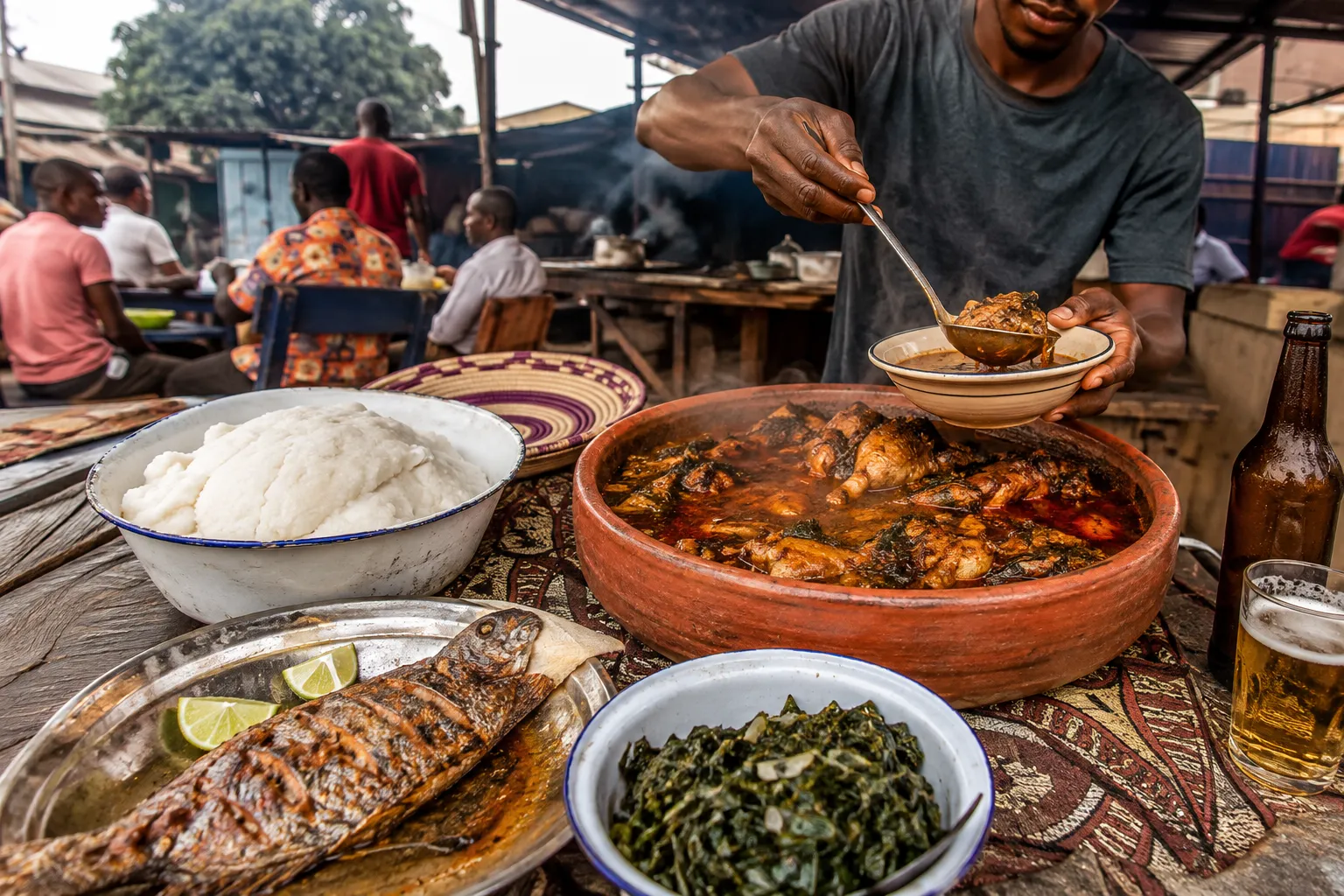
Ordering is the easiest place to practise, because the vocabulary repeats. Point, name the dish and add por favor. Coastal Angola runs on fresh fish and seafood, and the national dish is muamba de galinha, chicken in palm oil sauce, usually served with funge, a smooth cassava or maize porridge.
)
| Portuguese | English | Say it like |
|---|---|---|
| Uma mesa para dois, por favor | A table for two, please | OO-mah MEH-zah PAH-rah doysh |
| A ementa, por favor | The menu, please | ah eh-MEN-tah |
| O que recomenda? | What do you recommend? | oo keh reh-koo-MEN-dah |
| Eu quero isto | I’d like this one | eh-oo KEH-roo EESH-too |
| Tem peixe fresco? | Do you have fresh fish? | teng PAY-sheh FRESH-koo |
| Isto é picante? | Is this spicy? | EESH-too eh pee-KAN-teh |
| Sou vegetariano / vegetariana | I’m vegetarian | soh veh-zheh-tah-ree-AH-noo / -nah |
| Não como carne | I don’t eat meat | nowng KOH-moo KAR-neh |
| Uma água sem gás | A still water | OO-mah AH-gwah seng gash |
| Uma cerveja, por favor | A beer, please | OO-mah ser-VEH-zhah |
| Está delicioso | It’s delicious | shTAH deh-lee-see-OH-zoo |
| A conta, por favor | The bill, please | ah KON-tah |
| Posso pagar com cartão? | Can I pay by card? | POH-soo pah-GAR kong kar-TOWNG |
Card acceptance is limited outside larger hotels and city restaurants, so carry kwanza notes. For places to try these lines, see our roundup of the best restaurants in Luanda.
Portuguese phrases for shopping, money and negotiating prices
Bargaining is normal in markets and with street vendors, and firmly not normal in supermarkets, pharmacies or restaurants with printed prices. Keep it friendly. A smile, a greeting and a slow walk away do more than aggressive haggling.
| Portuguese | English | Say it like |
|---|---|---|
| Quanto custa? | How much does it cost? | KWAN-too KOOSH-tah |
| Quanto é? | How much is it? | KWAN-too eh |
| É muito caro | It’s very expensive | eh MWEEN-too KAH-roo |
| Pode fazer um desconto? | Can you give a discount? | POH-deh fah-ZEHR oong dish-KON-too |
| Qual é o último preço? | What’s your final price? | kwal eh oo OOL-tee-moo PREH-soo |
| Tem troco? | Do you have change? | teng TROH-koo |
| Só tenho kwanzas | I only have kwanzas | saw TEN-yoo KWAN-zash |
| Aceita cartão? | Do you accept cards? | ah-SAY-tah kar-TOWNG |
| Onde há um multibanco? | Where is there an ATM? | ON-deh ah oong mool-tee-BAN-koo |
| Levo este | I’ll take this one | LEH-voo ESH-teh |
| Vou pensar, obrigado | I’ll think about it, thanks | voh pen-SAR |
Decision rule: if the price is written on a label or a menu, do not negotiate. If it is spoken to you, asking qual é o último preço? is fair game.
Phrases for hotels and accommodation
| Portuguese | English | Say it like |
|---|---|---|
| Tenho uma reserva | I have a reservation | TEN-yoo OO-mah reh-ZER-vah |
| Tem quartos livres? | Do you have rooms free? | teng KWAR-toosh LEE-vresh |
| Um quarto para uma noite | A room for one night | oong KWAR-too PAH-rah OO-mah NOYT |
| Tem ar condicionado? | Does it have air conditioning? | teng ar kon-dee-see-oo-NAH-doo |
| Há água quente? | Is there hot water? | ah AH-gwah KEN-teh |
| Qual é a senha do wi-fi? | What’s the wifi password? | kwal eh ah SEH-nyah doo wee-fee |
| A que horas é o pequeno-almoço? | What time is breakfast? | ah keh OH-rash eh oo peh-KEH-noo al-MOH-soo |
| Isto não funciona | This doesn’t work | EESH-too nowng foon-see-OH-nah |
| Pode guardar a minha mala? | Can you store my bag? | POH-deh gwar-DAR ah MEE-nyah MAH-lah |
Phrases for problems, health and emergencies
Learn these before you need them, and store your allergies and medication names in Portuguese in your phone notes. Malaria is present throughout Angola, so tenho febre is a phrase that matters more here than in most destinations.
| Portuguese | English | Say it like |
|---|---|---|
| Ajuda! | Help! | ah-ZHOO-dah |
| Preciso de um médico | I need a doctor | preh-SEE-zoo deh oong MEH-dee-koo |
| Chame uma ambulância | Call an ambulance | SHAH-meh OO-mah am-boo-LAN-see-ah |
| Onde é o hospital mais próximo? | Where is the nearest hospital? | ON-deh eh oo osh-pee-TAL mysh PRO-see-moo |
| Estou doente | I’m ill | shtoh doo-EN-teh |
| Dói-me aqui | It hurts here | DOY-meh ah-KEE |
| Tenho febre | I have a fever | TEN-yoo FEH-breh |
| Sou alérgico a… | I’m allergic to… | soh ah-LEHR-zhee-koo ah |
| Perdi o meu passaporte | I lost my passport | per-DEE oo meh-oo pah-sah-PORT |
| Fui roubado | I was robbed | fwee roh-BAH-doo |
| Chame a polícia | Call the police | SHAH-meh ah poo-LEE-see-ah |
For context on what risks are realistic and where extra care pays off, see our practical guide to whether Angola is safe to visit.
Small talk and making friends
Angolans are generally warm with visitors who try. Even a clumsy sentence in Portuguese usually gets a smile and a slower reply.
| Portuguese | English | Say it like |
|---|---|---|
| Como se chama? | What’s your name? | KOH-moo seh SHAH-mah |
| Chamo-me… | My name is… | SHAH-moo-meh |
| Prazer | Pleased to meet you | prah-ZEHR |
| Sou de Inglaterra | I’m from England | soh deh een-glah-TEH-rah |
| É a minha primeira vez em Angola | It’s my first time in Angola | eh ah MEE-nyah pree-MAY-rah vezh eng an-GOH-lah |
| Angola é muito bonita | Angola is very beautiful | an-GOH-lah eh MWEEN-too boo-NEE-tah |
| Gosto bué da comida angolana | I like Angolan food a lot (informal) | GOSH-too bweh dah koo-MEE-dah an-goo-LAH-nah |
| Estou a aprender português | I’m learning Portuguese | shtoh ah ah-pren-DEHR poor-too-GEHSH |
| Podemos tirar uma foto? | Can we take a photo? | poo-DEH-moosh tee-RAR OO-mah FOH-too |
Always ask before photographing people, and never photograph military sites, airports or government buildings.
Angolan slang and words tourists should know
Only a handful of Angolan-specific words really matter for a short trip. These are the ones you will hear or see, and I have flagged which are informal.
- Bué (bweh): a lot, very. Angolan in origin and now common in Portugal too. Informal but everywhere.
- Candongueiro (kan-don-GAY-roo): the blue-and-white shared minibus taxi.
- Zungueira (zoon-GAY-rah): a woman selling goods on the street, usually carrying them on her head.
- Musseque (moo-SEH-keh): an informal, densely built neighbourhood, especially in Luanda.
- Funge (FOON-zheh): the staple cassava or maize porridge.
- Kwanza (KWAN-zah): the currency, AOA.
- Mano / mana: brother / sister, used informally between friends and peers. Do not use it with officials.
- Semba, kizomba, kuduro: Angola’s core music and dance styles.
Beyond that, treat street slang with caution. Words shift meaning by neighbourhood and age group, and a phrase that sounds playful from a local can land badly from a stranger. If you want the cultural context rather than the vocabulary, our guides to Angolan culture and etiquette and the people of Angola are the better starting points.
How to pronounce Angolan Portuguese correctly
Portuguese pronunciation trips up English speakers in four specific places. Fix these and your accent improves fast.
- Nasal vowels. ão, ã, õe, and vowels before m or n go through the nose. Não sounds roughly like “nowng” with the g barely there. Bom is “bong”. Do not close your lips on that final sound.
- lh as in milho or trabalho: the “lli” in “million”. Not “L-H”.
- nh as in senha or dinheiro: the “ny” in “canyon”.
- rr and initial r. In much of Angola the double rr and word-initial r are pronounced as a rolled or tapped r, closer to Spanish or Italian than the throaty French-style r common in Lisbon. Carro rolls. So does rua.
- Final -s is often a soft “sh” sound, as in European Portuguese: dois is “doysh”.
- ç and c before e/i are a plain “s”. Licença is “lee-SEN-sah”.
Angolan speech is often described as clearer and more evenly stressed than Lisbon Portuguese, which is good news for beginners. Vowels get swallowed less.
What to say if you don’t understand Angolan Portuguese
Do not nod along. Say one of these instead, and people will almost always slow down and simplify.
| Portuguese | English | Say it like |
|---|---|---|
| Não entendo | I don’t understand | nowng en-TEN-doo |
| Não falo bem português | I don’t speak Portuguese well | nowng FAH-loo beng poor-too-GEHSH |
| Pode repetir, por favor? | Can you repeat that, please? | POH-deh reh-peh-TEER |
| Pode falar mais devagar? | Can you speak more slowly? | POH-deh fah-LAR mysh deh-vah-GAR |
| Pode escrever, por favor? | Can you write it down, please? | POH-deh shkreh-VEHR |
| Como se diz… em português? | How do you say… in Portuguese? | KOH-moo seh deesh … eng poor-too-GEHSH |
| Fala inglês? | Do you speak English? | FAH-lah een-GLEHSH |
Pro tip: for prices, always ask pode escrever? Numbers in a second language are the single biggest source of misunderstanding, and a written figure removes all doubt.
What’s the best translation app for Angolan Portuguese?
No mainstream translation app offers a dedicated “Angolan Portuguese” setting. Choose European Portuguese (Portugal) where the option exists, because it is closer to Angolan written and spoken norms than the Brazilian variant. Then do the one thing that actually matters: download the offline Portuguese language pack before you leave home.
What works well in practice:
- Offline text translation for menus, signs and short sentences.
- Camera translation for printed menus and pharmacy labels.
- A saved notes file with your allergies, medications, hotel address and blood group written in Portuguese. No signal required.
- Conversation mode only where you have reliable data, which mostly means Luanda and larger hotels.
Machine translation handles standard Portuguese fine. It handles Angolan slang and regional vocabulary badly, so keep sentences plain.
The biggest mistakes tourists make with Portuguese in Angola
The errors that cause friction are social, not grammatical.
- Skipping the greeting. Asking a question with no bom dia first is the most common misstep visitors make.
- Opening in English by default. Try Portuguese first, even badly. It changes how people respond to you.
- Assuming Spanish will do. Some words overlap, but Spanish is not understood as a courtesy in Angola.
- Being too familiar too fast. With officials, elders and service staff, stay with o senhor / a senhora.
- Copying slang you heard once. Meanings vary by group and context.
- Agreeing a price you did not repeat back. Say the number out loud, or have it written.
- Using obrigada as a man (or obrigado as a woman). Small, but locals notice.
Politeness and body language
Portuguese words are only half of it. Angolan interactions lean warm and formal at the same time.
- Handshakes are standard when meeting and when leaving. A slightly softer grip than the Anglo-American norm is normal.
- Greet everyone present, not just the person you came to talk to.
- Give and receive money, documents and gifts with the right hand, or both hands, rather than one careless hand.
- Titles matter in offices. Senhor doutor or senhora doutora is a common courtesy for professionals.
- Patience is a form of politeness. Small talk before business is the norm, not a delay.
- Dress neatly in cities. Effort in appearance is read as respect, and it changes how you are treated.
Conclusion: your next steps
You do not need to be fluent to travel well in Angola. You need a greeting habit, a short set of situation-specific phrases and the confidence to say não entendo instead of nodding. That combination turns almost every transaction from a negotiation into a conversation.
Do these four things before you fly:
- Memorise 15 phrases this week: the greetings, please, thank you, quanto custa?, onde fica?, não entendo and pode falar mais devagar?
- Learn numbers 1 to 20, then 100, 500 and 1,000 so kwanza prices make sense.
- Download offline European Portuguese in your translation app, and save your allergies, medication and hotel address in Portuguese in your phone notes.
- Practise saying the greetings out loud with the nasal endings. Ten minutes a day for a week is enough to sound like you tried.
Then use them on day one, starting with the person who checks your passport. Bom dia costs nothing and changes everything.
Portuguese audio phrasebook
Listen to handy basic Portuguese phrases. Portuguese is the official language of Angola.
Your browser does not support speech playback. You can still read and practise the phrases and translations.
- OláHello
- Bom diaGood morning
- Boa noiteGood evening
- Por favorPlease
- ObrigadoThank you (said by a man)
- ObrigadaThank you (said by a woman)
- SimYes
- NãoNo
- Com licençaExcuse me / may I get past
- DesculpeSorry
- Fala inglês?Do you speak English?
- Quanto custa?How much does it cost?
- Onde fica...?Where is...?
- A conta, por favorThe bill, please
- Não entendoI do not understand
- Ajuda!Help!
The pronunciation is computer-generated (pt-PT) and therefore an approximation. Read more about the language in Angola in our guide which language is spoken in Angola.
Want to keep this guide? We email you the key points with a link to every section.
Frequently asked questions
How do you say hello and thank you in Angolan Portuguese?
Say bom dia (bong DEE-ah) before noon, boa tarde (BOH-ah TARD) in the afternoon and boa noite (BOH-ah NOYT) after dark. Thank you is obrigado if you are male and obrigada if you are female.
Is Portuguese in Angola hard to understand for a beginner?
Less than you might fear. Angolan Portuguese tends to be pronounced clearly, with fewer reduced vowels than Lisbon Portuguese, which makes individual words easier to pick out.
Will people understand my Brazilian or European Portuguese in Angola?
Yes. Speakers of both varieties are understood throughout Angola. You may need to swap the occasional word, but comprehension is not an issue.
Do I really need to use tu the Angolan way?
No. As a visitor, use o senhor or a senhora with strangers and older people and you will always be polite. Just do not assume você is the respectful choice, because in Angola it usually reads as the casual one.
How many phrases should I learn before flying to Angola?
Aim for 40 to 60. Prioritise greetings, numbers to 1,000, food, prices, directions and the three rescue phrases (*não entendo*, pode repetir, mais devagar).
Can I get by with English in Luanda?
Partly. In upmarket hotels, some restaurants and business settings, yes. On the street, in taxis, in markets and in pharmacies, no. Read our Luanda travel guide for where English is realistically available.