In 1491, on a plateau in what is now northern Angola, a king was baptised and a church was built. That church became the first Catholic cathedral in sub-Saharan Africa, and its ruins still stand today.
Quick answer: The oldest Catholic church in sub-Saharan Africa was founded in Mbanza Kongo, northern Angola, in 1491, under ManiKongo Joao I. Known locally as Kulumbimbi, the ruins of the Cathedral of the Holy Saviour are part of a UNESCO World Heritage site inscribed in 2017. No Catholic church in sub-Saharan Africa has an earlier founding date.
Key Takeaways
- The Cathedral of the Holy Saviour (Igreja do Santissimo Salvador) in Mbanza Kongo was founded between May and July 1491, making it the oldest Catholic church by foundation date in sub-Saharan Africa.
- The ruins are called Kulumbimbi in Kikongo. Local tradition says the church was built overnight by angels.
- Africa’s oldest church buildings overall are in Egypt and Ethiopia, but those are Coptic and Ethiopian Orthodox, not Catholic.
- The oldest largely intact Catholic church building in sub-Saharan Africa is the Portuguese Chapel in Malindi, Kenya, built around 1502 [2].
- Mbanza Kongo was inscribed on the UNESCO World Heritage List in 2017. It was Angola’s first cultural World Heritage site.
- In January 2024, Angola approved a US$120 million restoration program for the site. Expect works in progress when you visit.
- Under Presidential Decree 189/23, nationals of close to 100 countries, including the UK, US, Canada and Australia, can enter Angola visa-free for up to 30 days for tourism. Always verify with the Servico de Migracao e Estrangeiros before booking.
- The dry season (May to October) is the best time to visit Mbanza Kongo. Northern roads can become difficult during the rainy season.
What Is Kulumbimbi and Where Is It?
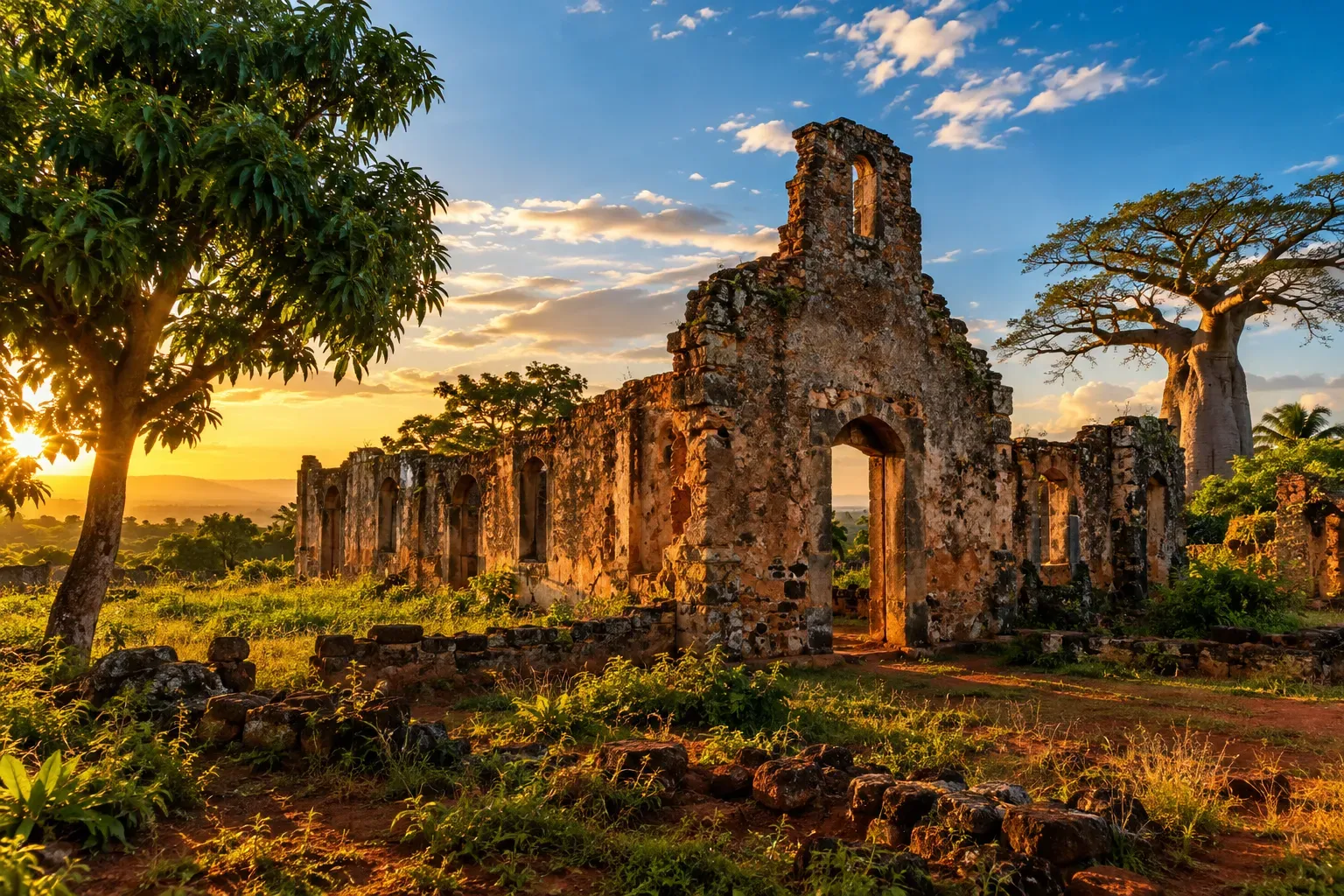
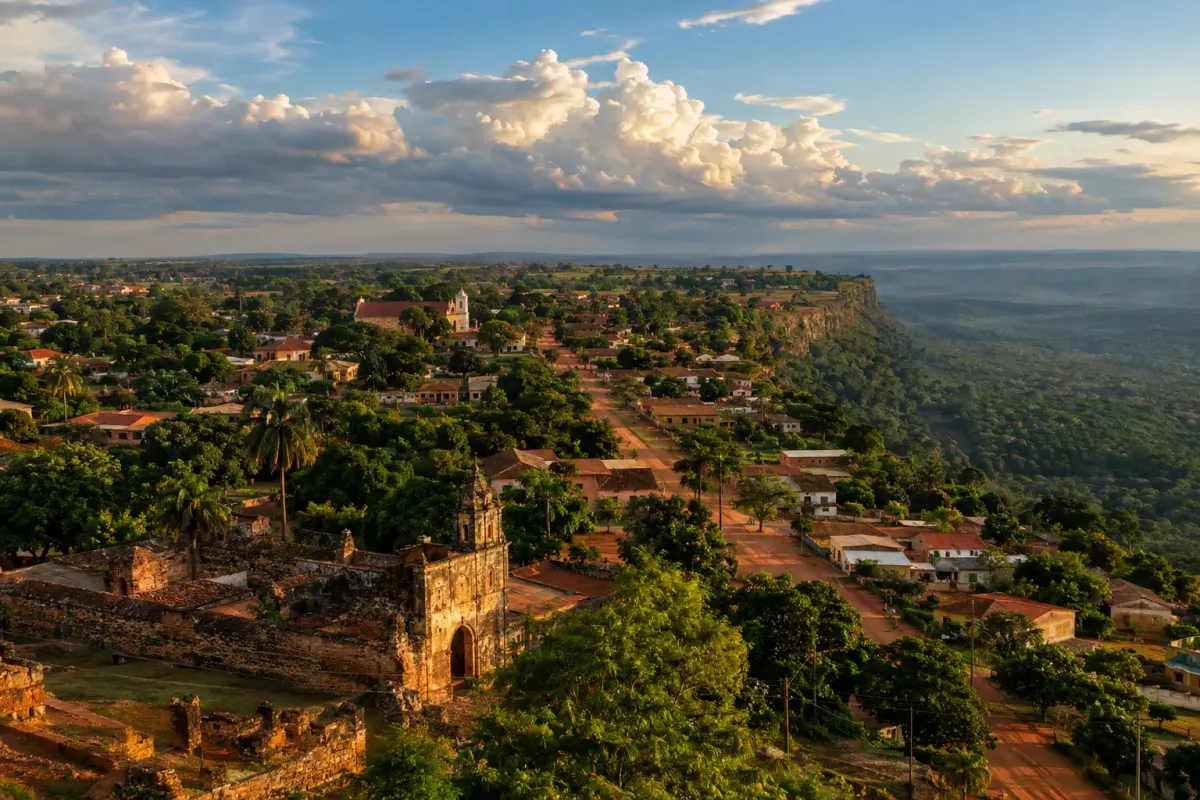
Kulumbimbi is the Kikongo name for the ruins of the Cathedral of the Holy Saviour of Congo, the oldest Catholic church by foundation date in sub-Saharan Africa. The ruins sit on a plateau at about 570 metres altitude in Mbanza Kongo, the capital of Zaire province in far northern Angola, close to the border with the Democratic Republic of Congo.
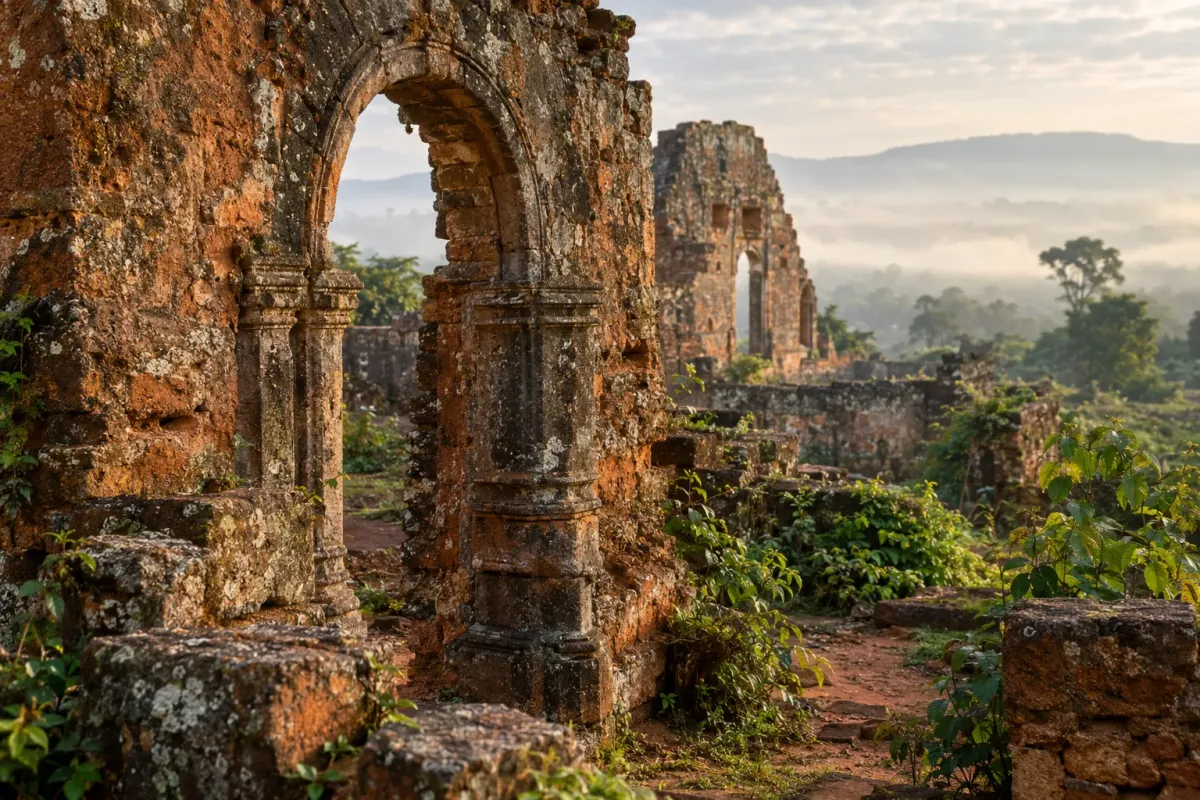
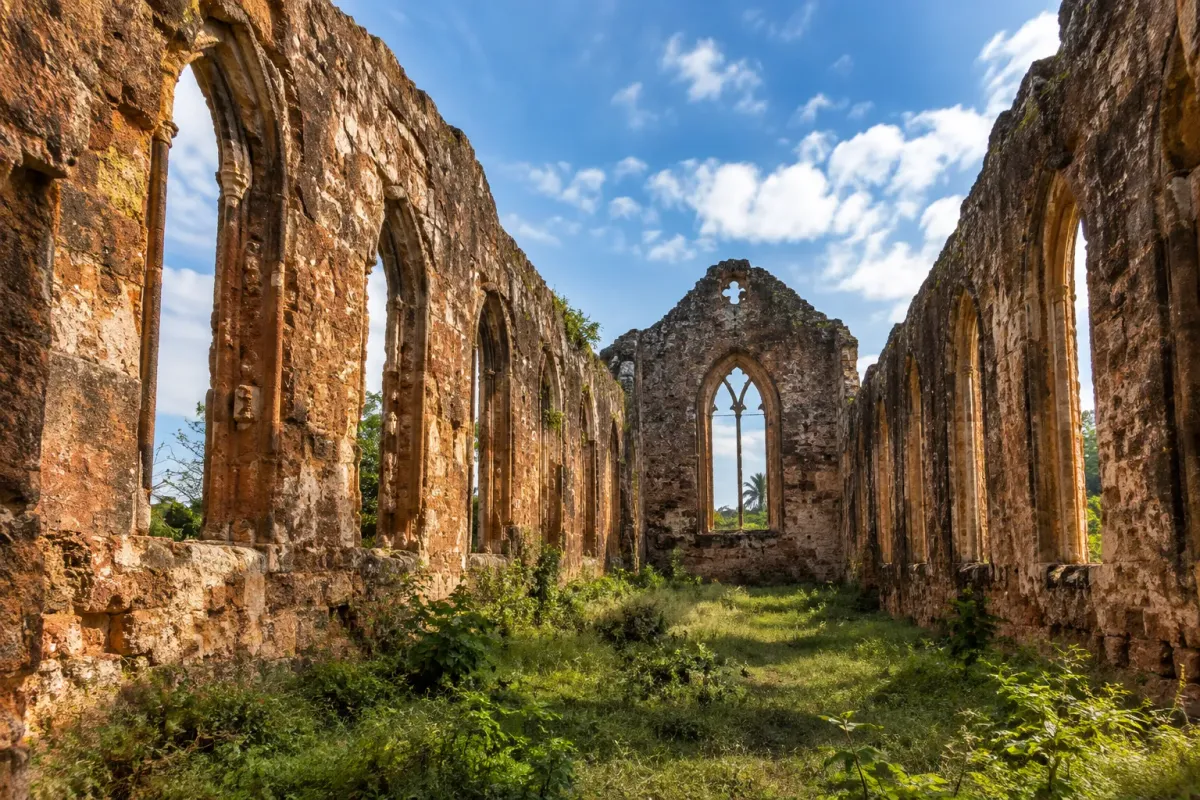
The name Kulumbimbi (also written nkulumbimbi) belongs to the Kikongo language, which is still widely spoken across Zaire province. The ruins consist of thick stone walls, Portuguese colonial masonry, and the footprint of what was once the most important Catholic building in central Africa. They sit remarkably close to the northern end of the Mbanza Kongo airport runway, so the walk from the airstrip to the site is genuinely short.
Local tradition holds that the church was built overnight by angels. That legend is not just a curiosity: it is part of how the site is experienced today, and Bakongo guides will often share it when they walk you through the ruins. It speaks to how deeply the site is embedded in local identity, long after the building itself fell.
For a deeper look at the city and its surroundings, see the full Mbanza Kongo destination guide on this site.
The 1491 Story: Joao I, Afonso I and the First Catholic Church in Sub-Saharan Africa
The oldest Catholic church in Africa south of the Sahara was not built by European missionaries working alone. It was built at the initiative of an African king, on African soil, as a deliberate act of political and spiritual alliance.
Portuguese navigator Diogo Cao reached the mouth of the Congo river in 1483, opening the first sustained contact between Portugal and the Kingdom of Kongo. The kingdom was a sophisticated, centrally governed state, and its rulers saw in the Portuguese alliance both commercial opportunity and diplomatic leverage.
On 3 May 1491, the ManiKongo (king) Nzinga a Nkuwu was baptised at the royal capital and took the Christian name Joao I. He had reigned from about 1470 and would continue until 1506. Construction of the church that would later become the Cathedral of the Holy Saviour (Igreja do Santissimo Salvador) was initiated between 6 May and 6 July 1491, under his authority.
His son, known to history as Afonso I (Mvemba a Nzinga), took the Christianisation of the kingdom much further. Ruling from 1509 to 1542, Afonso I repaired and extended the church by 1534. He corresponded directly with the Portuguese crown and the Pope, established schools, and worked to build a Christian Kongo state on his own terms. His letters, which survive in Portuguese archives, are among the most remarkable documents of early African-European contact.
It is also honest to note that this same period saw the beginning of the transatlantic slave trade, in which the Kingdom of Kongo became entangled, often against its rulers’ stated wishes. Afonso I wrote to the King of Portugal explicitly protesting the trade. The church at Mbanza Kongo was built in a moment of genuine cross-cultural exchange, but that exchange was inseparable from one of history’s most destructive systems. Visitors who engage with this history at the site will find it richer, not poorer, for that honesty.
For more context on this period, the Angola history guide covers the Kingdom of Kongo and the colonial era in detail.
From Cathedral to Ruin: How the Church Was Lost
The Cathedral of the Holy Saviour became the first cathedral in sub-Saharan Africa in 1596, serving as the seat of the Diocese of Sao Salvador (the Diocese of Congo and Angola), erected under king Alvaro II. Before that, around 1570, Jaga forces attacked the city during the reign of Alvaro I, briefly took it and burned the church. It was rebuilt.
The cathedral’s final destruction came not from outside but from within. The Kongo Civil War, which began after 1665, brought repeated sackings of the capital. In 1678, troops loyal to the pretender Pedro III destroyed the city. The cathedral was left in ruins and the site was abandoned. It has remained in that state ever since, which is part of what makes it so striking to visit.
The ruins are described in the Wikipedia entry on the Cathedral of the Holy Saviour of Congo and are listed as part of the UNESCO World Heritage site for Mbanza Kongo, inscribed in 2017 under criteria (iii) and (iv). The inscribed property covers about 89.29 hectares, with a buffer zone of about 622.16 hectares. It was Angola’s first cultural World Heritage inscription, and one of only a handful of UNESCO sites in Angola.
Oldest Catholic Church in Africa: The Honest Comparison
The phrase “oldest Catholic church in Africa” needs a qualifier to be accurate. Africa’s oldest church buildings are not Catholic, and the oldest Catholic foundation is not the oldest surviving structure. Here is the full picture.
| Church / Site | Place | Founded | Tradition | Status today |
|---|---|---|---|---|
| Abu Mena basilica | Egypt | 3rd to 4th century | Coptic Christian | Ruined; UNESCO site |
| Beta Samati basilica | Ethiopia (Aksum region) | 4th century | Ethiopian Orthodox | Excavated ruins |
| Church of Our Lady Mary of Zion | Aksum, Ethiopia | Originally 4th century | Ethiopian Orthodox | Active; rebuilt multiple times |
| Cathedral of the Holy Saviour (Kulumbimbi) | Mbanza Kongo, Angola | 1491 | Catholic | Ruins; UNESCO site |
| Portuguese Chapel (St Francis Xavier) | Malindi, Kenya | c. 1502 | Catholic | Largely intact; national monument since 1935 [2] |
To be precise: Africa’s oldest church buildings are in Egypt and Ethiopia, but they are Coptic and Ethiopian Orthodox, not Catholic. The Beta Samati basilica excavation in Ethiopia dates to the 4th century and is one of the most significant early Christian discoveries on the continent.
Angola’s claim is specific and defensible: Mbanza Kongo holds the first Catholic church founded in sub-Saharan Africa, initiated in 1491. The oldest largely intact Catholic church building in sub-Saharan Africa is the Portuguese Chapel in Malindi, Kenya, built around 1502 and a gazetted national monument since 1935 [2]. A 2025 report noted that this chapel, described as “Africa’s oldest surviving Catholic church,” faces serious threats from salt air, coastal erosion and insufficient conservation funding [1].
Angola’s Kulumbimbi is the oldest in foundation. Malindi’s chapel is the oldest that survives largely intact. Both claims are true, and neither cancels the other.
Tip: When you read “oldest Catholic church in Africa” in travel writing, always check which qualifier is being used: oldest by foundation date, oldest surviving structure, or oldest in a specific region. The answer changes depending on the question.
What to See in Mbanza Kongo Beyond the Ruins
Mbanza Kongo offers more than the Kulumbimbi ruins alone. The city sits on a plateau with sweeping views over the surrounding forest, and the UNESCO-inscribed area contains several sites worth your time.
The Museum of the Kings of Kongo (Museu dos Reis do Kongo) holds artefacts, regalia and documentation related to the Kongo kingdom, giving essential context before or after you walk the ruins. The royal tombs of the Kongo kings are within the inscribed area, as is the sacred Yala Nkuwu tree, a large fig tree with deep ceremonial significance to the Bakongo people. The plateau itself, at 570 metres, offers views that reward a slow walk.
The city is a living community, not just a heritage site. Kikongo is the language you will hear in the market and on the streets. Portuguese will get you through most practical situations, but a few words of Kikongo will be appreciated. English is rarely spoken outside hotels, so come prepared.
In January 2024, Angolan President Joao Lourenco approved a restoration and conservation agreement worth around US$120 million for the historical and cultural sites of Mbanza Kongo, structured with Banco Angolano de Investimento. The program is intended to bring the site into line with UNESCO recommendations and to develop cultural tourism infrastructure. When you visit in 2026, expect some areas to be under active restoration. That is not a reason to delay: the works are a sign of serious investment, and the site is open to visitors.
For the full picture of Angolan culture and what shaped it, the Angola culture and etiquette guide is a good companion read.
How to Get to Mbanza Kongo from Luanda
Getting to Mbanza Kongo takes planning, but it is straightforward once you know the steps. The city is in far northern Angola, roughly 350 kilometres north of Luanda in a straight line, and appreciably more by road, near the DRC border.
Step-by-step: planning your visit to Mbanza Kongo
- Book your international flight to Luanda. TAAG Angola Airlines is the national carrier and connects Luanda to Lisbon, Johannesburg, Addis Ababa and other hubs. See the flights to Angola guide for route options. Travellers from the UK can also check flights to Angola from the UK and from the US, the flights to Angola from the US guide.
- Check your visa status. Under Presidential Decree 189/23, nationals of close to 100 countries, including the UK, US, Canada, Australia and most EU states, can enter visa-free for up to 30 days for tourism, with a passport valid at least six months. Rules change: always verify current requirements with the Servico de Migracao e Estrangeiros and our Angola visa guide before booking.
- Arrange your domestic connection. TAAG operates domestic flights from Luanda to Mbanza Kongo (M’Banza Congo Airport). Check current schedules and availability directly with TAAG, as frequencies change. Do not rely on any schedule printed here.
- Plan your accommodation. Mbanza Kongo has limited hotel options compared to Luanda. Book in advance, especially during the dry season. Check current availability through your preferred booking platform.
- Time your visit for the dry season. Roughly May to October is the best time to visit Angola. The rainy season (November to April) can make northern roads difficult and may affect access to some sites.
- Carry cash in Angolan kwanza (AOA). Card acceptance is limited outside Luanda. ATMs in Mbanza Kongo may be unreliable. Bring sufficient kwanza from Luanda.
- Arrange a local guide. The site is more rewarding with a Kikongo-speaking guide who can explain the oral history and the significance of the sacred tree and royal tombs. Ask your hotel or contact local tour operators in advance.
Warning: Do not attempt the Luanda-to-Mbanza Kongo road journey without a reliable 4x4 and local knowledge, particularly during or just after the rainy season. The domestic flight is the safer and faster option for most visitors.
Fitting Mbanza Kongo Into a Wider Angola Trip
Mbanza Kongo works best as part of a longer Angola itinerary rather than a standalone trip. Angola is a large country, over 1.2 million square kilometres, and internal travel takes time and planning.
A practical combination: spend two to three days in Luanda (the Fortaleza de Sao Miguel, Ilha de Luanda, the Marginal promenade), fly north to Mbanza Kongo for two nights, then return to Luanda and fly south to Lubango or the Namibe coast for the landscape contrast. That gives you colonial history, the oldest Catholic church in Africa, and some of the continent’s most dramatic scenery in one trip.
If you have seven to ten days, the Angola itinerary guide maps out several route options including the north. The 7-day Angola itinerary is a good starting point for first-time visitors.
Travel insurance is not optional for Angola. Medical facilities outside Luanda are limited, and evacuation costs are high. See the Angola travel insurance guide for what cover you actually need.
Why Angola Is Worth the Effort Right Now
Angola in 2026 is at a turning point for tourism. The country has some of the continent’s most undervisited landscapes and heritage sites, and the government is investing seriously in making them accessible. The visa liberalisation under Presidential Decree 189/23 removed one of the biggest barriers for international travellers. The US$120 million Mbanza Kongo restoration program signals that heritage tourism is a national priority, not an afterthought.
Luanda is still one of the world’s more expensive cities for visitors, and infrastructure outside the capital requires patience. But the reward is a country where the crowds have not yet arrived. You can stand at the ruins of the oldest Catholic church in sub-Saharan Africa with almost no one else around. That will change as the restoration progresses and the site gains more international attention.
For a grounded overview of what Angola is like to visit, including safety, costs and practical realities, the Angola travel advice guide is the place to start. For safety specifics, check the UK FCDO travel advice for Angola and equivalent advisories from the US State Department and Australia’s Smartraveller before you travel.
Conclusion
The ruins of Kulumbimbi in Mbanza Kongo are not just Angola’s most important heritage site. They are one of the most significant Catholic heritage sites anywhere in the world, and almost no international travellers know they exist. That is, for now, part of the appeal.
The combination of a 1491 founding date, a UNESCO World Heritage inscription, an active US$120 million restoration program and newly liberalised visa rules makes 2026 a genuinely good moment to visit. The site is accessible, the country is opening up, and the crowds have not yet arrived.
Your next step: use the Angola itinerary guide to plan a route that combines Mbanza Kongo with Luanda and one more region, then check the flights to Angola guide for your best route in. If you want the full picture before you commit, the Angola travel advice guide covers safety, costs and practical realities honestly.
Want to keep this guide? We email you the key points with a link to every section.
Frequently asked questions
What is the oldest Catholic church in Africa?
The oldest Catholic church in sub-Saharan Africa by foundation date is the Cathedral of the Holy Saviour (Igreja do Santissimo Salvador) in Mbanza Kongo, Angola, founded in 1491 under ManiKongo Joao I. Its ruins, called Kulumbimbi, are part of a UNESCO World Heritage site. Africa's oldest church buildings overall are Coptic and Ethiopian Orthodox sites in Egypt and Ethiopia, dating to the 3rd and 4th centuries.
Is the oldest church in Africa in Ethiopia or Angola?
Ethiopia has Africa's oldest church buildings: the Beta Samati basilica and the Church of Our Lady Mary of Zion in Aksum both date to the 4th century. However, these are Ethiopian Orthodox, not Catholic. Angola's Mbanza Kongo holds the oldest Catholic church in sub-Saharan Africa by foundation date (1491). The distinction is tradition: Orthodox versus Catholic.
Can you visit Kulumbimbi?
Yes, the Kulumbimbi ruins in Mbanza Kongo are open to visitors. The site is part of a UNESCO World Heritage area and is accessible from the city centre. A US$120 million restoration program was approved in January 2024, so expect some areas under active conservation work. Check current access conditions locally and consider hiring a Kikongo-speaking guide for the full context.
Is Mbanza Kongo worth visiting?
Mbanza Kongo is one of the most historically significant cities in central Africa and one of Angola's most rewarding heritage destinations. Beyond the Kulumbimbi ruins, the UNESCO-inscribed area includes the Museum of the Kings of Kongo, royal tombs, the sacred Yala Nkuwu tree and plateau views. It is not a mass-tourism destination, which is part of its appeal in 2026.
How do you get to Mbanza Kongo from Luanda?
The most practical route is a domestic flight with TAAG Angola Airlines from Luanda to Mbanza Kongo Airport. The flight is far faster than the road, which is far longer than the 350 kilometre straight-line distance suggests and requires a 4x4, especially near the rainy season. Check current TAAG schedules directly, as frequencies change. The airport is close to the Kulumbimbi ruins, so the walk from the airstrip to the site is short.
Do you need a visa to visit Angola?
Under Presidential Decree 189/23 (late 2023), nationals of close to 100 countries, including the UK, US, Canada, Australia and most EU states, can enter Angola visa-free for up to 30 days for tourism, with a passport valid at least six months. Rules change and vary by nationality. Always verify current requirements with the Servico de Migracao e Estrangeiros before booking.
Is Angola safe for tourists?
Angola is generally manageable for prepared travellers. Petty crime is the main concern in Luanda. Cabinda province carries stricter advisories. Some rural areas have residual landmine risk: stay on established routes. Our guide on whether Angola is safe to visit goes through this in detail. The UK FCDO, US State Department and Australia's Smartraveller all publish current advisories for Angola. Check these before you travel and review your Angola travel advice carefully.
What is the oldest surviving Catholic church building in sub-Saharan Africa?
The oldest largely intact Catholic church building in sub-Saharan Africa is the Portuguese Chapel in Malindi, Kenya, built around 1502 and a gazetted national monument since 1935. A 2025 report described it as facing serious conservation threats from coastal erosion and salt air. Angola's Kulumbimbi is older by foundation date (1491) but exists as ruins. Both sites are significant; neither claim cancels the other.
References
- [1] The Economist, Africa's oldest surviving Catholic church is under t...
- [2] National Museums of Kenya, The Portuguese Chapel, Malindi
- [3] UNESCO World Heritage Centre, Mbanza Kongo listing (inscribed 2017)
- [4] Cathedral of the Holy Saviour of Congo
- [5] Smithsonian Magazine, Church unearthed in Ethiopia rewrites history
- [6] UK FCDO, Foreign travel advice for Angola