Angola has more protected wilderness than most travellers realise, yet fewer people set foot in its parks each year than visit a single popular reserve in Kenya. That is exactly why serious safari lovers are starting to pay attention. From desert elephants on the Namib coast to the critically endangered giant sable antelope hiding in miombo woodland, the country offers wild places that feel genuinely undiscovered.
Quick answer: what are Angola’s national parks?
Angola has six main national parks: Kissama (Quiçama), Iona, Cangandala, Cameia, Bicuar and Mupa, plus several smaller reserves. The most accessible is Kissama, about 70 km south of Luanda, known for reintroduced elephants. Iona in the southwest is the largest and wildest. Cangandala protects the country’s national symbol, the giant sable antelope. Safaris are possible but infrastructure is limited compared to Kenya or Namibia.
Key takeaways
- Angola has six main national parks and several game reserves, covering roughly 6.5% of the country.
- Kissama National Park is the easiest to visit as a day or weekend trip from Luanda.
- Iona National Park, managed since 2019 by African Parks, is the largest at 15,150 km² and borders Namibia’s Skeleton Coast.[3]
- Cangandala is the only realistic place to try to see the giant sable antelope, Angola’s national animal.[4]
- The best time to visit is the dry season, roughly May to October.
- Independent travel is possible but a local guide or organised tour is strongly recommended.
- Wildlife densities are lower than in East or Southern Africa, so come for wilderness and rarity, not sheer numbers.
My honest take: Angola is not the place for a first safari. It is the place for your fifth, when you want silence, empty tracks, and a story no one else at the campfire has.
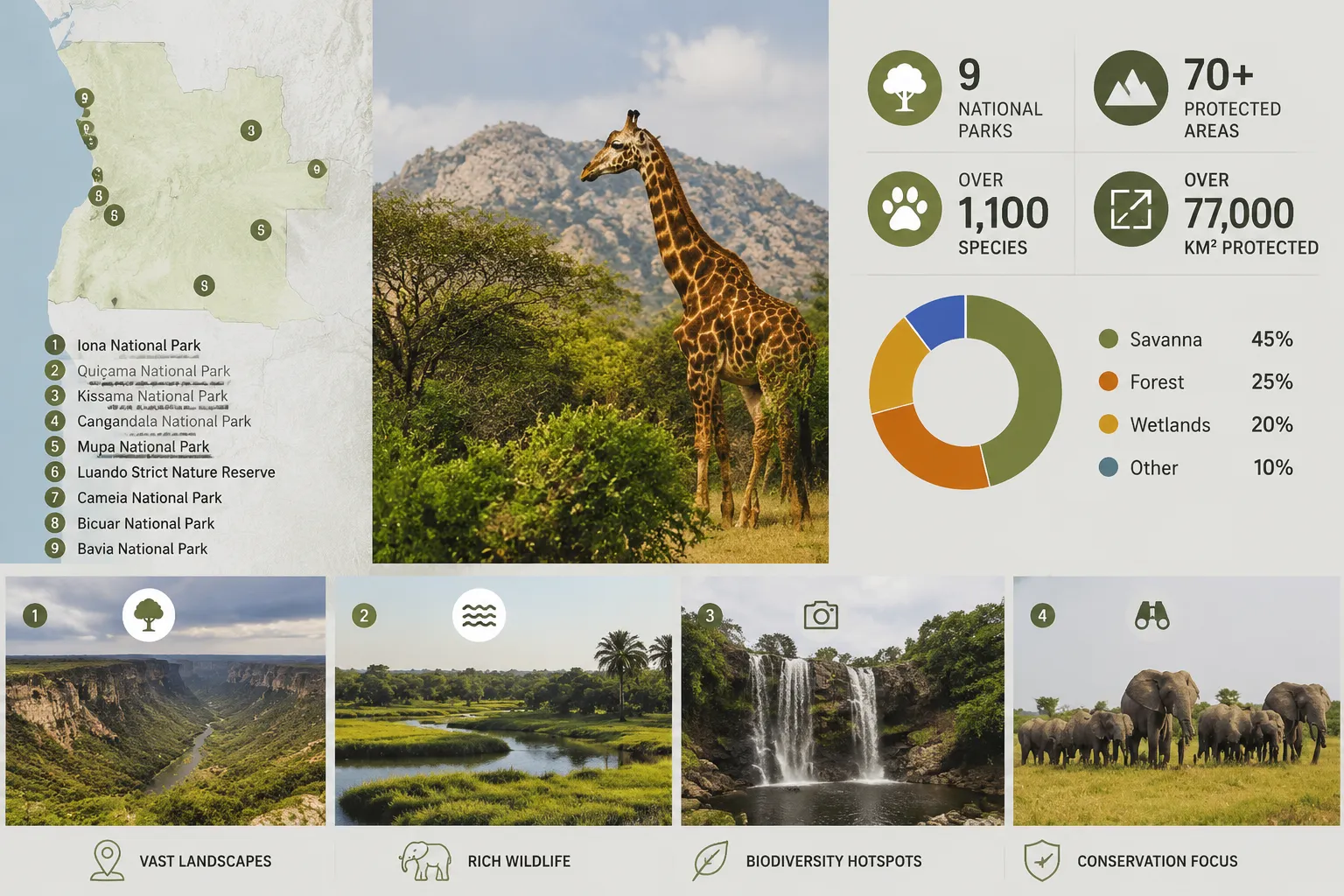
An overview of Angola’s national parks
Angola sits at the meeting point of three great African ecosystems: the Congo rainforest to the north, the miombo woodlands of the central plateau, and the Namib desert to the south. That variety means the country’s parks look and feel very different from one another.
The main angola national parks are:
| Park | Province | Size (km²) | Habitat | Star species |
|---|---|---|---|---|
| Kissama (Quiçama) | Bengo/Luanda | ~9,600 | Coastal savanna, baobabs | Elephant, eland, red buffalo |
| Iona | Namibe | 15,150 | Desert, coast, mountains | Oryx, springbok, welwitschia |
| Cangandala | Malanje | ~630 | Miombo woodland | Giant sable antelope |
| Cameia | Moxico | ~14,450 | Wetlands, floodplains | Lechwe, sitatunga, birds |
| Bicuar | Huíla | ~7,900 | Mopane woodland | Small herds recovering |
| Mupa | Cunene | ~6,600 | Dry woodland | Recovering wildlife |
Decades of civil war (1975 to 2002) devastated wildlife populations. Recovery is slow, but partnerships like the one between African Parks and the Angolan government in Iona are changing that story. For broader travel planning context, see our guide to travelling to Angola.
Kissama (Quiçama) National Park
Direct answer: Kissama National Park is the most accessible reserve in Angola, located roughly 70 to 75 km south of Luanda, between the Cuanza and Longa Rivers, and covering between 9,600 and 12,000 km² depending on the boundary used.[1] It is the go-to option for a first safari in the country.
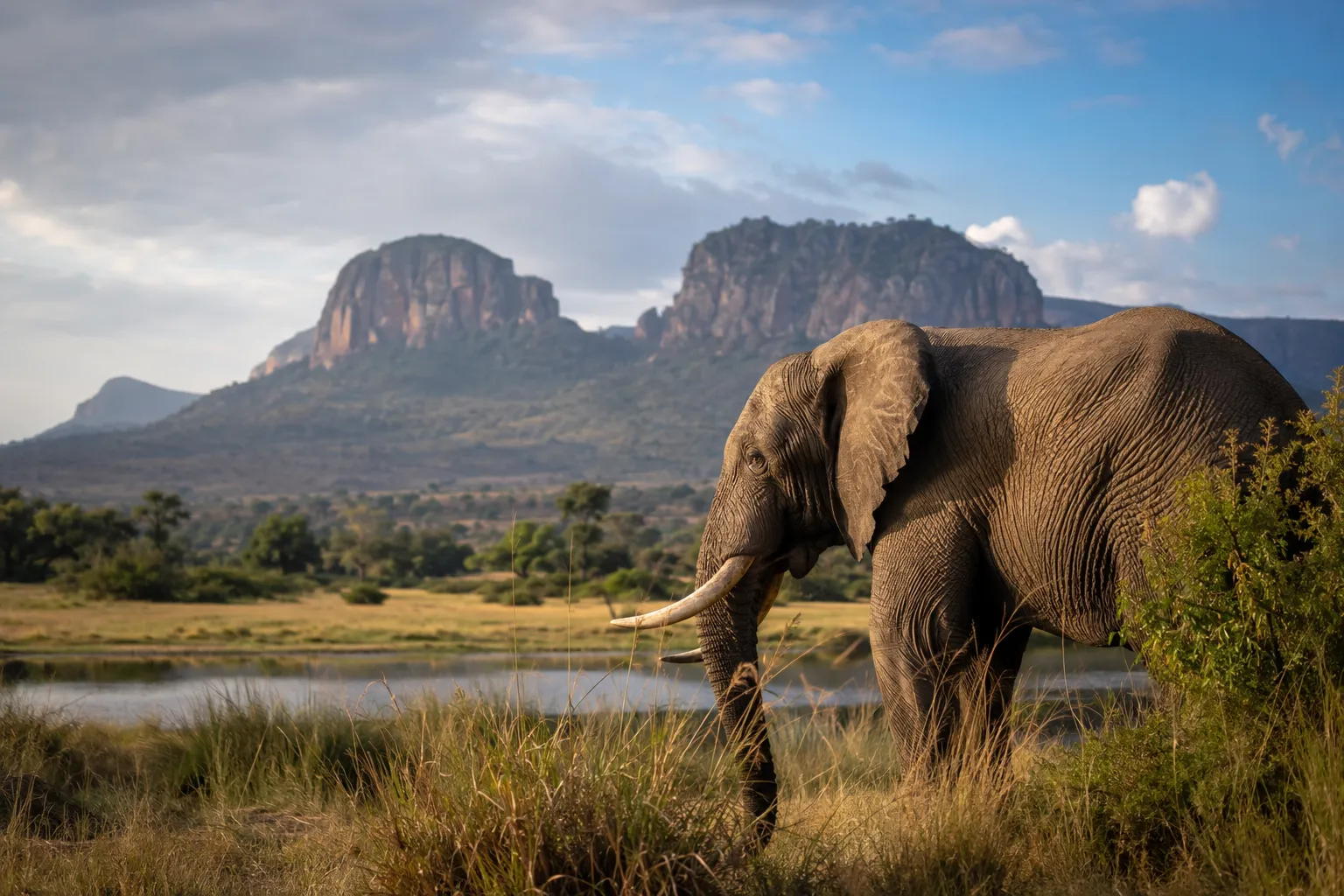
Kissama’s story is remarkable. During the civil war, poaching wiped out most of the large mammals. In the early 2000s, Operação Arca de Noé (Operation Noah’s Ark) translocated elephants and other species from Botswana and South Africa to repopulate the park.[2]
What you can see today:
- African elephants (the flagship reintroduced population)
- Roan antelope, eland, kudu, waterbuck
- Red buffalo, bushbuck, warthog
- Sea turtles nesting on the coastal strip (seasonal)
- Rich birdlife along the rivers
Practical info:
- Access: roughly 2 to 3 hours by 4x4 from Luanda on the EN-100.
- Where to stay: Kissama Lodge and a small number of tented camps inside or near the park.
- Best for: weekend safaris, families, first-time visitors.
For more on this park specifically, read our dedicated page on Kissama National Park.
Iona National Park
Direct answer: Iona is Angola’s largest national park at 15,150 km², located in the southwest corner of Namibe Province. It borders Namibia’s Skeleton Coast and together they form one of the world’s largest transfrontier conservation areas.[3]
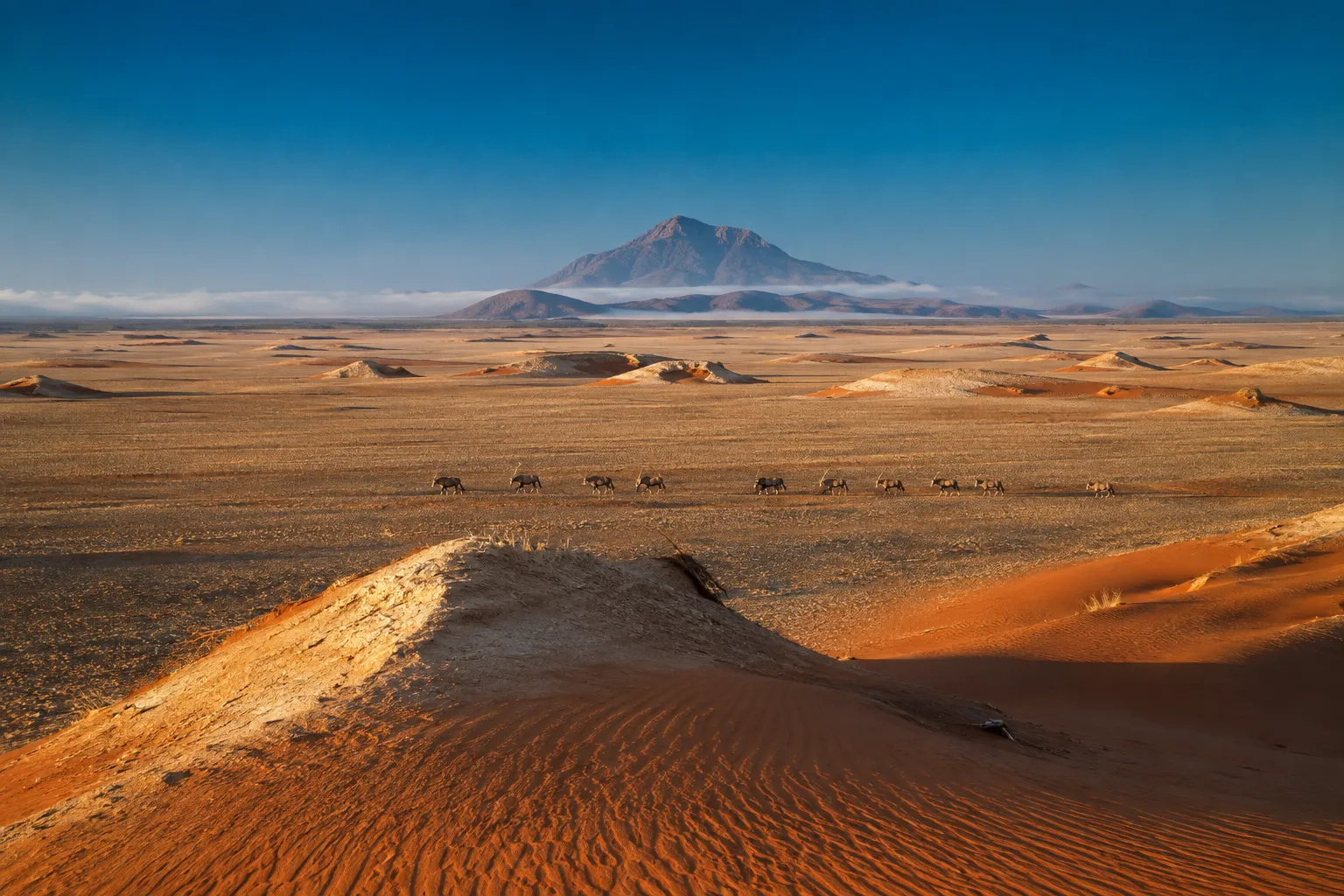
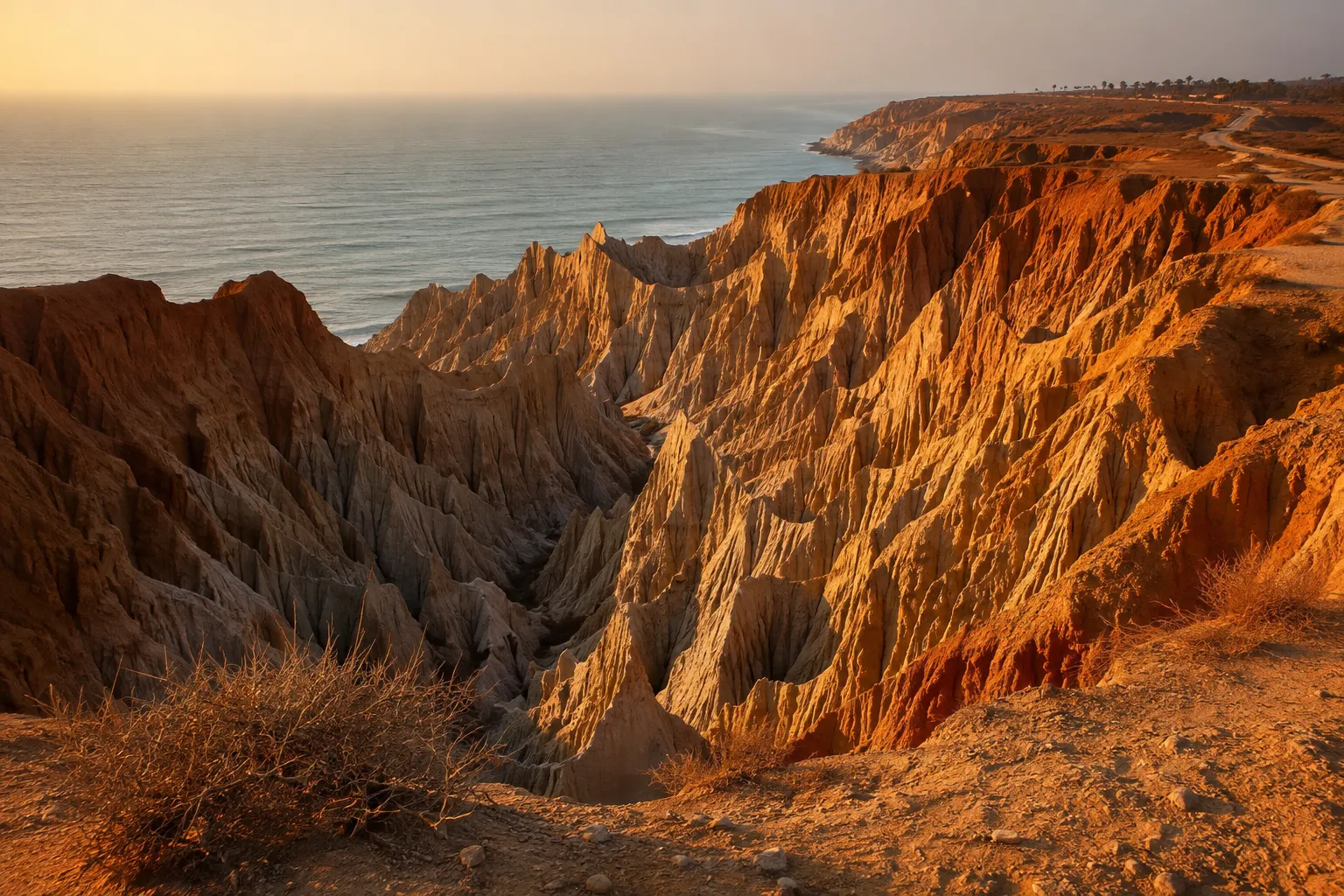
Iona is otherworldly. Think rust-red dunes running into the Atlantic, shipwrecks half-buried in sand, and the ancient Welwitschia mirabilis plants that can live for over a thousand years.[3] Since 2019, African Parks has co-managed Iona with the Angolan government, which has meant better anti-poaching, community programmes, and slowly returning wildlife.
Wildlife you might see:
- Oryx (gemsbok), springbok, ostrich
- Brown hyena, black-backed jackal
- Desert-adapted elephants (rare, roaming from Namibia)
- Cape fur seals along the coast
- Endemic desert birds
How do I get to Iona National Park from Luanda?
You have three realistic options:
- Fly to Namibe (Moçâmedes) with TAAG from Luanda (roughly 2 hours), then drive 4 to 6 hours south by 4x4 with a guide.
- Drive the full route from Luanda, which is a serious 1,200+ km overland trip via Benguela and Lubango. Allow 2 to 3 days each way.
- Join an organised expedition that handles logistics, permits, and vehicles. This is what I recommend for a first visit.
More on the region in our Namibe guide.
Cangandala and the giant sable antelope
Direct answer: Cangandala National Park in Malanje Province covers about 630 km² and was created specifically to protect the critically endangered giant sable antelope (Hippotragus niger variani), Angola’s national symbol.[4]
The giant sable was thought extinct after the war. Camera traps rediscovered it in 2004. Today the global population is estimated at around 300 individuals, mostly split between Cangandala and the neighbouring Luando Reserve.[5] A fenced sanctuary within Cangandala protects a breeding herd.
Realistic expectations:
- Seeing a giant sable in the wild is genuinely rare, even for locals.
- Access to the sanctuary requires advance permission and usually an official escort.
- The park’s landscape of miombo woodland is beautiful but dense, so visibility is limited.
Come here for the story and the conservation experience, not for guaranteed sightings. Read more about this iconic animal on our palanca negra page.
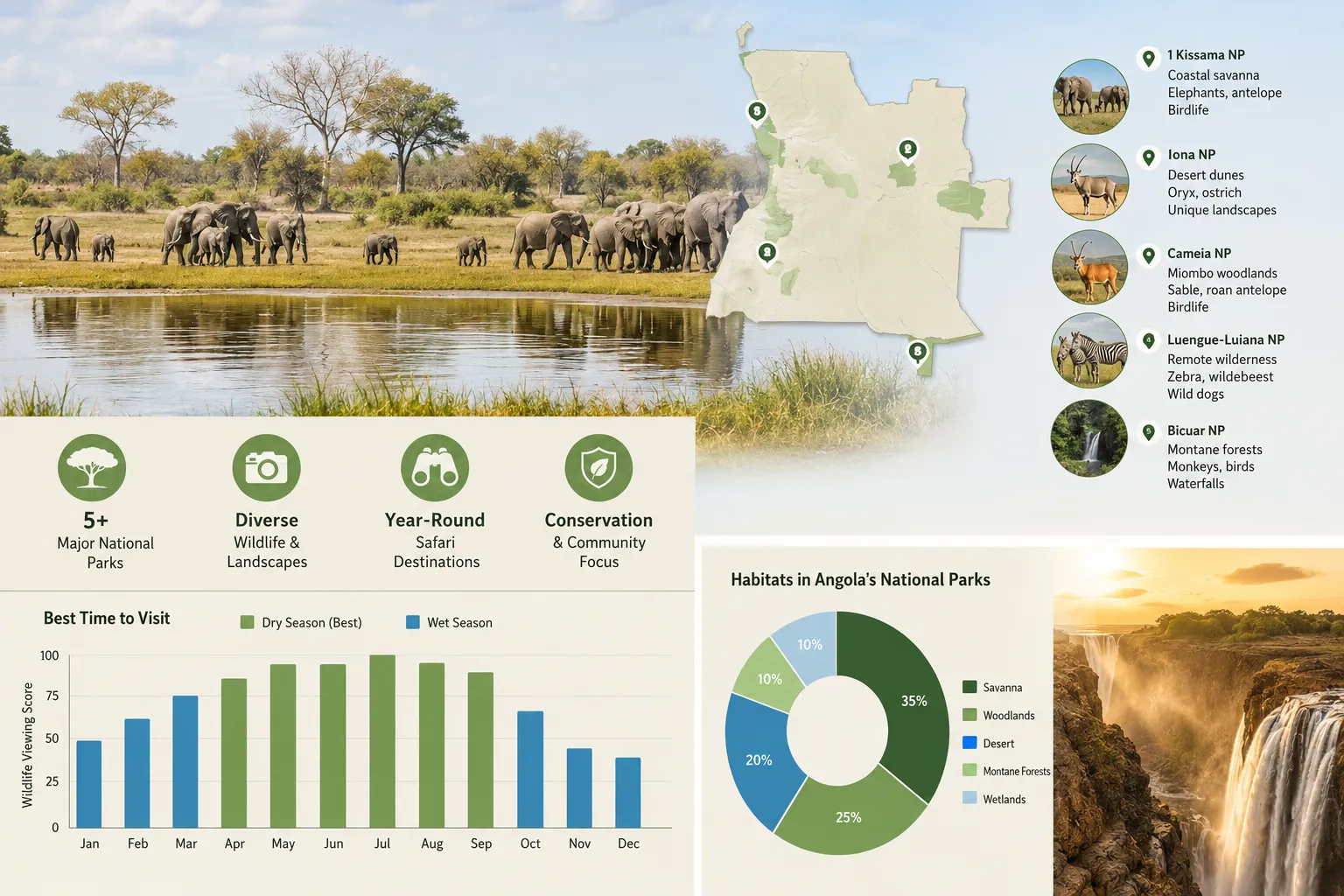
Other parks and reserves: Cameia, Bicuar, Mupa
These parks see almost no tourism and require serious planning.
Cameia National Park (Moxico, eastern Angola)
Vast floodplains and wetlands linked to the Zambezi system. Great potential for wetland wildlife such as lechwe, sitatunga, and huge birdlife, but infrastructure is minimal and access roads can be impassable in the wet season.
Bicuar National Park (Huíla)
Mopane woodland in southern Angola. Wildlife populations were hit hard by the war and are slowly recovering. Currently more of an adventure route than a classic safari destination.
Mupa National Park (Cunene)
Dry woodland close to the Namibian border. Little tourist infrastructure, sparse wildlife, but stunning landscapes if you are self-sufficient.
Cabinda’s Mayombe forest is not technically a national park but is a protected rainforest reserve in the northern exclave, worth mentioning for its biodiversity and forest elephants.
Which angola national park should you choose?
Quick decision guide:
- Short on time, based in Luanda? → Kissama.
- Want the most dramatic landscape? → Iona.
- Care about rare species and conservation? → Cangandala.
- Serious 4x4 expedition traveller? → Cameia or Bicuar.
- Combining with Namibia? → Iona is the obvious link.
How much does it cost to visit Angola national parks?
Costs vary widely and change often, so verify before you book. As a general guide (2026):
- Kissama entry fee: a modest per-person fee, plus vehicle fee. Lodge stays typically 150 to 300 USD per night.
- Iona: access usually via organised expedition; multi-day trips can run 2,000 to 5,000+ USD per person including flights, guides and camping.
- Cangandala: low entry fee but you need a permit and vehicle; independent visits are difficult.
Always check current fees with park authorities or a licensed operator.
Can you do a safari in Angola?
Yes, but Angolan safaris are different from Kenya or Botswana. Expect fewer other tourists, more rustic camps, longer drives, and lower wildlife densities.[6] The reward is genuine wilderness and a real sense of exploration.
Disclosure: Some links below are affiliate links. If you book through them we may earn a small commission at no extra cost to you.
Organised safaris and tours can be booked through specialist operators. For inspiration on wider itineraries, browse our Angola itinerary ideas or check availability with a specialist Angola tour operator.
Do I need a guide to explore Angola national parks?
Short answer: yes, for almost every park except a self-drive visit to Kissama with a good 4x4 and offline maps. A local guide handles permits, language (Portuguese is essential), tracks, and safety. For Iona and Cangandala, a guide or organised operator is effectively required.
What should I pack for an Angola safari?
- Lightweight neutral clothing (khaki, olive, beige)
- Warm layer for early mornings (deserts get cold at night)
- Sturdy walking shoes
- Wide-brim hat, sunglasses, high-SPF sunscreen
- Malaria prophylaxis and DEET insect repellent
- Yellow fever vaccination certificate (verify current requirements)
- Cash in USD or kwanza (cards rarely work in parks)
- Reusable water bottle and water purification tablets
- Binoculars and a proper camera with zoom
- Basic first-aid kit
Are there lodges inside Angola national parks?
Only a handful. Kissama has a lodge and a few camps. Iona is mostly tented mobile camps run by expedition operators. Cangandala has very basic accommodation. Cameia, Bicuar and Mupa are essentially camping only. Expect simpler comfort levels than in Kenya or South Africa.
🐘 Want big game and easy access? Kissama
🏜️ Want desert and coast? Iona
🦌 Want rare species and conservation? Cangandala
🦩 Want wetlands and birds? Cameia
🌲 Want rainforest? Mayombe (Cabinda)
Conservation and responsible safaris
Angola is at a fragile turning point. Populations are recovering, but poaching, habitat loss, and lingering landmines from the civil war still threaten wildlife. As a visitor you play a real role.
Responsible travel principles:
- Book through operators that channel funds back into park management (African Parks in Iona is a strong example).
- Never buy wildlife products, including ivory, bushmeat, or coral.
- Stay on established tracks (landmine risk still exists in rural areas).
- Respect local communities and ask before photographing people.
- Carry out every piece of trash you carry in.
- Follow guide instructions around wildlife, no exceptions.
For more on the ethics of Angola travel, our overview on things to do in Angola puts the parks in context with the country’s other highlights.
Is it safe to visit Angola national parks?
Angola is generally safe for prepared travellers, but risks vary by region. Petty crime is mostly a Luanda issue. Rural areas and parks are quieter but require self-sufficiency. Cabinda has stricter travel advisories. Landmines are largely cleared but stay on marked tracks. Always check your government’s official travel advice (for example the UK FCDO or the US State Department) before you travel.
Best time to visit Angola national parks
Direct answer: the dry season from May to October is the best window. Roads are passable, wildlife concentrates around water, and skies are clear. November to April brings heavy rain, difficult tracks, and lush but harder-to-spot wildlife.
- May to July: cool, dry, excellent visibility
- August to October: warmer, best wildlife viewing near water
- November to April: wet season, dramatic skies, birdlife, but limited access
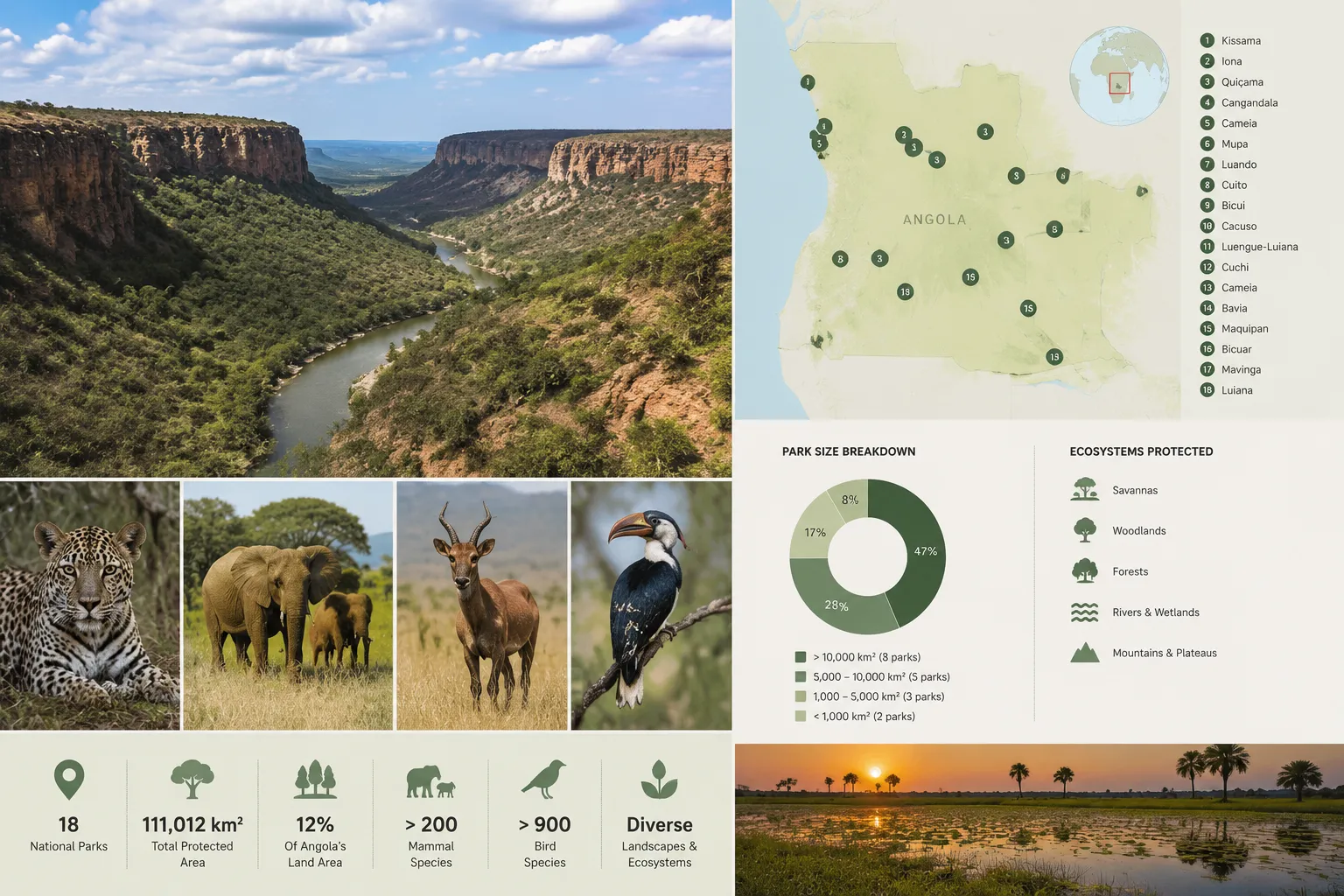
Why are Angola’s parks less visited than other African parks?
Three main reasons: access, information, and history. Angola only really opened up to tourism after 2002. Portuguese-language dominance, complex logistics, and until recently strict visa rules kept casual visitors away. That is changing fast, with visa-free entry now available for many EU passports (verify current rules with the SME e-visa portal).
The upside for you: no crowds, no queues, and landscapes that feel truly your own.
Conclusion: is Angola right for your next safari?
If you want lion sightings every morning and hot showers every night, book Kenya. If you want to walk through baobab forests where your guide points to elephant tracks laid overnight, drive dunes taller than skyscrapers with no other vehicle in sight, and possibly glimpse an antelope so rare it was thought extinct twenty years ago, then Angola is calling.
Your next steps:
- Pick your park based on the decision guide above.
- Verify current visa rules, vaccinations, and safety advice.
- Contact a licensed local operator or start planning a self-drive trip with a solid 4x4.
- Book flights early, especially for the dry season.
- Read our full things to do in Angola guide to build a wider itinerary.
Angola will not be quiet forever. Go while it still feels like discovery.
Free help from our team in Angola
Want to visit Angola’s national parks?
Tell us which parks interest you and when you travel. We tell you what is realistic and arrange the transport, a guide and places to stay.
- Local team in Angola
- No obligation, nothing to pay
- Reply by email or WhatsApp
Want to keep this guide? We email you the key points with a link to every section.
Frequently asked questions
How many national parks does Angola have?
Angola has six main national parks (Kissama, Iona, Cangandala, Cameia, Bicuar, Mupa) plus several game reserves and protected areas, covering roughly 6.5% of the country's territory.
Which is the best national park to visit?
For most first-time visitors, Kissama is the best choice thanks to its proximity to Luanda and reintroduced elephant population. For serious wilderness lovers, Iona is unmatched.
Can you go on safari in Angola?
Yes. Safaris are possible in Kissama, Iona and, with special permission, Cangandala. Expect a wilder, more rustic experience than in East or Southern Africa.
What is the giant sable antelope?
The giant sable (*Hippotragus niger variani*) is a large antelope endemic to Angola and the country's national symbol. It is critically endangered, with an estimated 300 individuals globally.
Are the parks easy to reach?
Kissama is easy from Luanda by 4x4. Iona requires a flight to Namibe plus overland travel or an organised expedition. Cangandala needs permits and a guide. The others require serious 4x4 self-sufficiency.
When is the best time for a safari?
The dry season from May to October, with June to September being ideal for wildlife viewing and comfortable temperatures.