Angola’s largest protected area holds fewer large animals than a single well-stocked private reserve in South Africa, and that is precisely the point. Iona National Park Angola covers roughly 15,150 square kilometres of the northern Namib, and for long stretches you can drive without seeing another vehicle, a fence, a building, or a footprint. It is one of the few places left on the continent where the landscape, not the game drive, is the main event.
Quick answer
Iona National Park is Angola’s biggest national park, about 15,150 km² in Namibe province in the far south-west, forming the northern end of the Namib Desert and running unbroken into Namibia’s Skeleton Coast National Park. Since December 2019 it has been managed in partnership between the Government of Angola and the conservation NGO African Parks. Wildlife includes oryx, springbok, Hartmann’s mountain zebra, ostrich, cheetah and leopard, plus Angolan giraffe reintroduced from Namibia in 2023. Visit in the dry season (roughly May to October), bring a properly equipped 4x4 with long fuel range, and expect minimal infrastructure rather than lodge-based safari comfort.
Key takeaways
- Size and status: Roughly 15,150 km², Angola’s largest national park, in Namibe province.
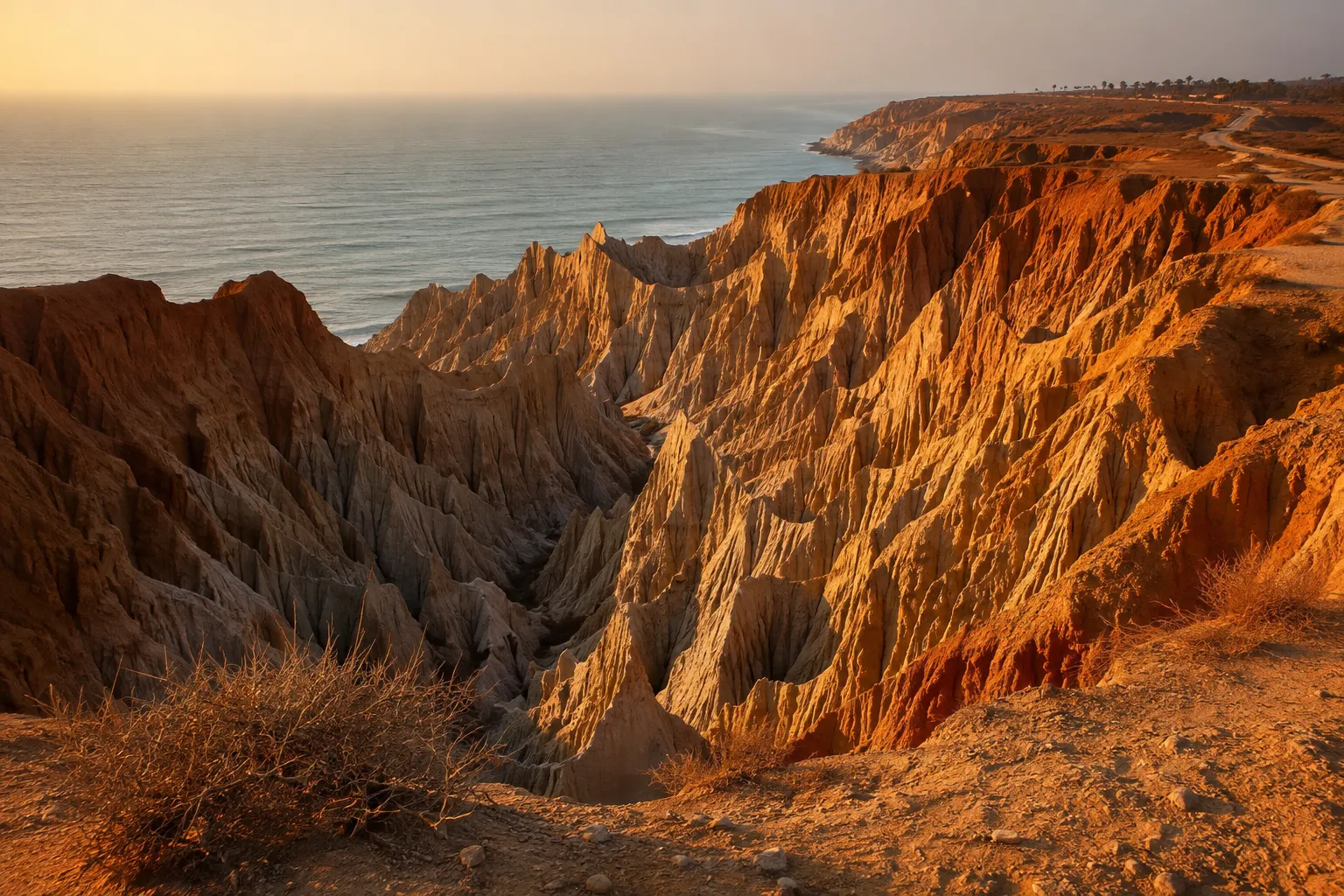
- Landscape first: Gravel plains, dune fields, inselbergs, dry riverbeds and a wild Atlantic coastline.
- Transboundary scale: Contiguous with Skeleton Coast National Park; together the two protected areas cover close to 50,000 km².
- Management: A December 2019 partnership between the Angolan government and African Parks.
- Wildlife reality: Low densities. Sightings take patience, distance and good light.
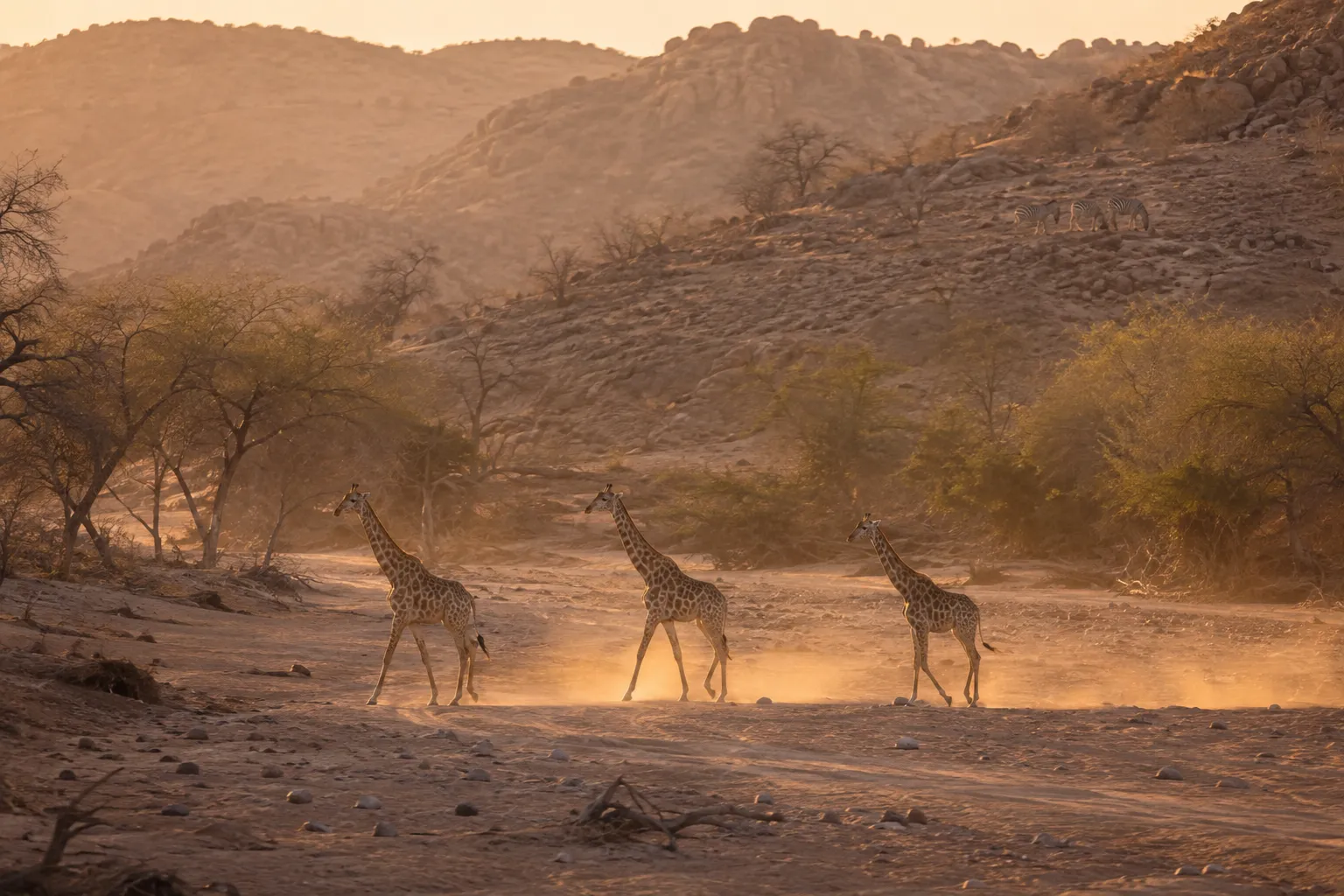
- Conservation story: Angolan giraffe returned in 2023 with 14 animals translocated from Namibia, followed by further translocations in 2024.
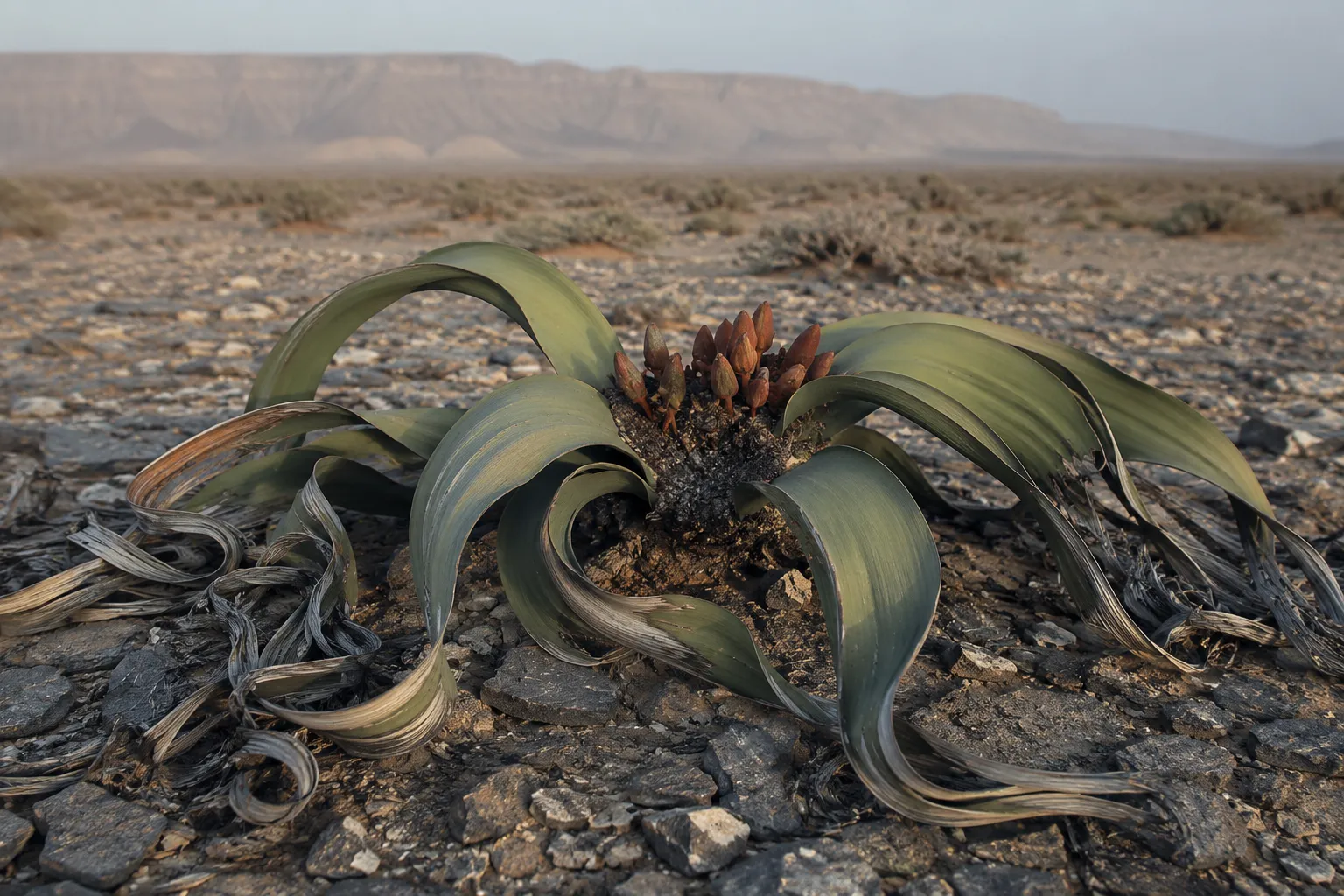
- Botanical star: A stronghold of Welwitschia mirabilis, a desert plant that can survive for centuries.
- People: Kuvale and Himba communities live in and around the landscape.
- Access: Self-sufficient 4x4 travel, ideally two vehicles or a local guide. Not a place for a rental sedan.
- Timing: Dry season, roughly May to October, is the better window.
What is Iona National Park Angola?
Iona National Park is a desert wilderness in south-west Angola, gazetted as a protected area long before Angola’s civil war and now the country’s largest national park at around 15,150 square kilometres. Its identity is geological and botanical as much as it is about animals: this is the northern end of the Namib, frequently described as the world’s oldest desert.
What that means on the ground is variety, not monotony. Within a single day’s driving you can cross:
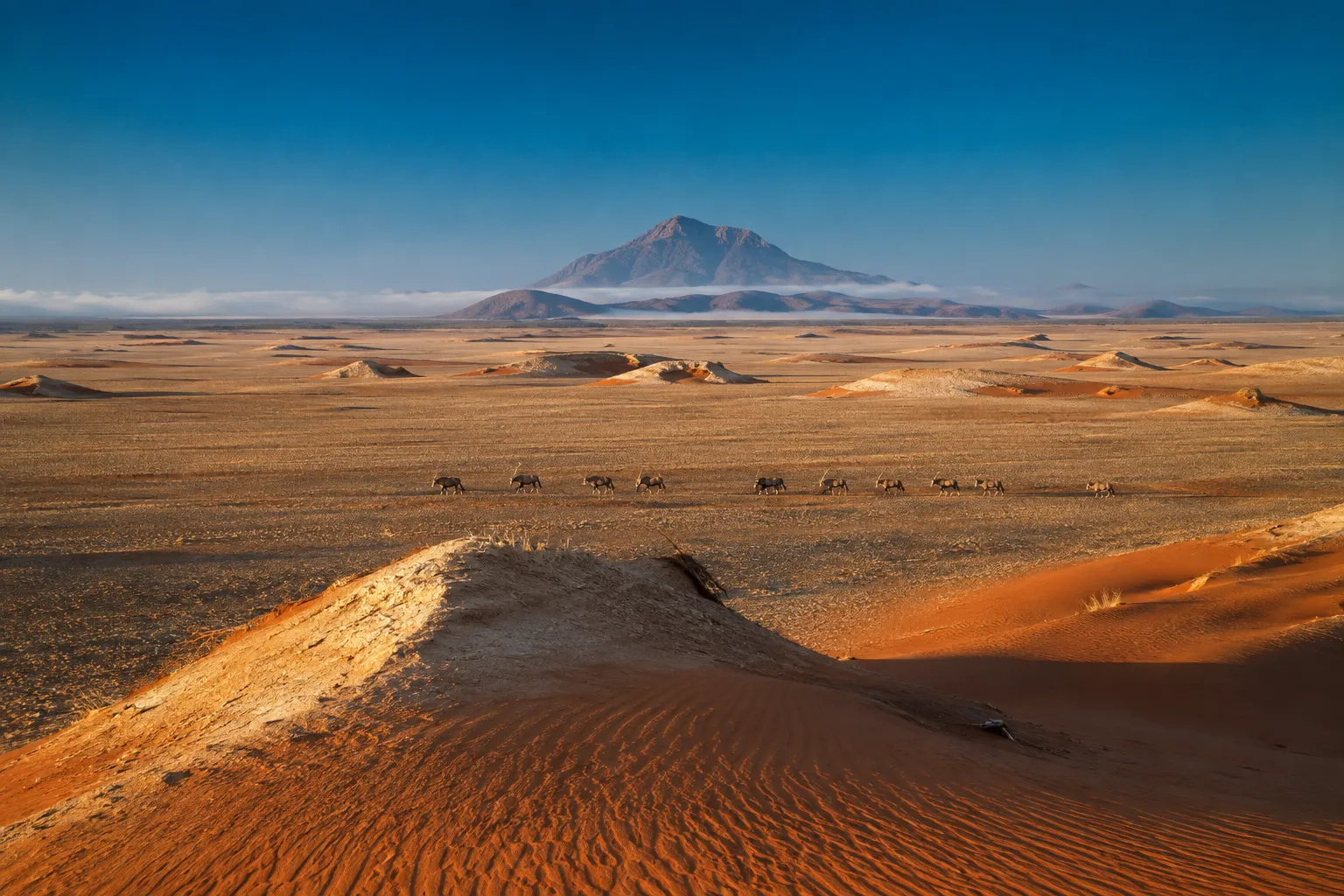
- Gravel plains so flat and open that a springbok is visible from kilometres away
- Dune fields where sand meets bare rock in hard geometric lines
- Inselbergs, isolated mountains rising abruptly from the plain
- Ephemeral river courses whose underground water supports lines of green in an otherwise bare landscape
- A raw Atlantic coast where cold Benguela Current fog rolls inland and feeds plants and insects that get almost no rain
Iona rewards travellers who find scale, silence and geology thrilling. If your trip hinges on ticking off the Big Five, this is not the park for you.
The other half of Iona’s story is human. Kuvale herders and Himba communities live in and around this landscape, moving cattle and goats between grazing and water. Their presence is not a fringe detail. Balancing livestock, water access and wildlife recovery is one of the central management challenges here, and it is the kind of thing you should discuss respectfully with a local guide rather than photograph from a moving vehicle.
Where is Iona National Park located?
Iona sits in Namibe province, in Angola’s far south-west corner, between the Atlantic Ocean and the escarpment that climbs toward the Huíla highlands. Its southern limits reach toward the Cunene River, which forms Angola’s border with Namibia.
That border position is what makes Iona globally significant. Directly across the river lies Skeleton Coast National Park, and the two areas form one continuous stretch of protected Namib. Combined, they safeguard close to 50,000 square kilometres, giving desert-adapted species room to move across an area larger than many countries.
The nearest useful base is the coastal city of Namibe (the provincial capital and port), and the nearest highland hub is Lubango. For orientation and city-level practicalities, see the Namibe travel guide and the Lubango guide, which covers the Serra da Leba pass and the Tundavala escarpment on the inland approach.
What animals can you see at Iona National Park Angola?
Expect desert specialists in low numbers spread over enormous distances. The realistic sightings list is oryx (gemsbok), springbok, Hartmann’s mountain zebra and ostrich, with Angolan giraffe now back in the landscape. Predators including cheetah and leopard are present but very rarely seen.
A practical breakdown:
| Species | Likelihood of seeing it | Where to look |
|---|---|---|
| Oryx (gemsbok) | Good, with patience | Open gravel plains, dry river margins |
| Springbok | Good | Plains and lightly vegetated flats |
| Hartmann’s mountain zebra | Moderate | Rocky slopes, mountain foothills |
| Ostrich | Moderate | Wide open plains |
| Angolan giraffe | Low, improving | Riverine corridors with trees |
| Cheetah / leopard | Very low | Anywhere, usually a stroke of luck |
| Endemic reptiles and insects | High if you look down | Dune slopes, gravel, fog zones |
The reintroduction of giraffe is the headline conservation news. In 2023, 14 Angolan giraffe were translocated from Namibia to Iona, restoring a species that had been absent from the park, with further translocations in 2024.
Two habits will transform your trip. First, look small: Namib deserts are extraordinary for endemic reptiles, tenebrionid beetles, lichens and fog-dependent plants, and a slow walk near your vehicle often beats an hour of driving. Second, look early and late, when animals move and the light makes them visible against pale ground.
What wildlife is endangered at Iona National Park Angola?
Iona’s most vulnerable assets are its large mammals recovering from decades of loss, plus its slow-growing desert flora. Angola’s civil war years brought heavy poaching and a collapse of wildlife numbers across the country, and southern Angola’s desert populations were badly hit.
Current conservation priorities in the park include:
- Angolan giraffe, a reintroduced population still small and closely monitored
- Cheetah and leopard, both under continent-wide pressure and dependent on huge home ranges
- Hartmann’s mountain zebra, a desert-adapted subspecies with a limited global range
- Welwitschia mirabilis, extremely slow-growing and easily destroyed by vehicles driving off track
One rule matters more than any other here: never drive off established tracks. Tyre scars in gravel desert can remain visible for decades, and a single detour can kill a Welwitschia older than most European cathedrals.
When is the best time to visit, and what’s the weather like?
The dry season, roughly May to October, is the better window for Iona. Tracks are more reliable, temperatures are more manageable, and animals concentrate around limited water.
The climate is a genuine coastal desert, which surprises first-time visitors:
- Coast: Cool, often grey, with fog banks driven by the cold Benguela Current. It can feel more like a chilly Atlantic morning than Africa.
- Inland: Hot, bright and very dry by day, with sharp temperature drops after sunset.
- Nights: Cold enough in the dry-season months to want a proper sleeping bag and a warm layer.
- Rain: Scarce and unpredictable. When it does fall, usually in the hotter months, sandy riverbeds can flood fast and tracks can become impassable.
The decision rule is simple: choose June to September if you want the most reliable driving conditions and cooler daytime temperatures, and avoid the peak of the hot months unless you have serious desert experience and a well-tested vehicle. For a nationwide month-by-month view, see the guide to the best time to visit Angola.
How do you get to Iona National Park from Luanda?
There is no short version. Iona lies more than a thousand kilometres from Luanda, so realistic access means either a long southbound drive or a domestic flight to the south followed by 4x4 travel.
The three standard approaches:
- Fly then drive. Take a domestic flight from Luanda to Namibe or Lubango, then arrange a 4x4 with a driver or a Namibe-based operator. This saves several days. Confirm current schedules directly with the airline, since domestic frequencies change.
- Drive the coast road south. Luanda to Benguela and Lobito, then on to Namibe. It is a multi-day journey with reasonable tarmac for much of the way, and it works well as part of a broader southern Angola road trip.
- Drive via the highlands. Luanda to Lubango, then down the Serra da Leba pass to the coast. Longer, more scenic, and it lets you combine Iona with Tundavala and the Huíla highlands.
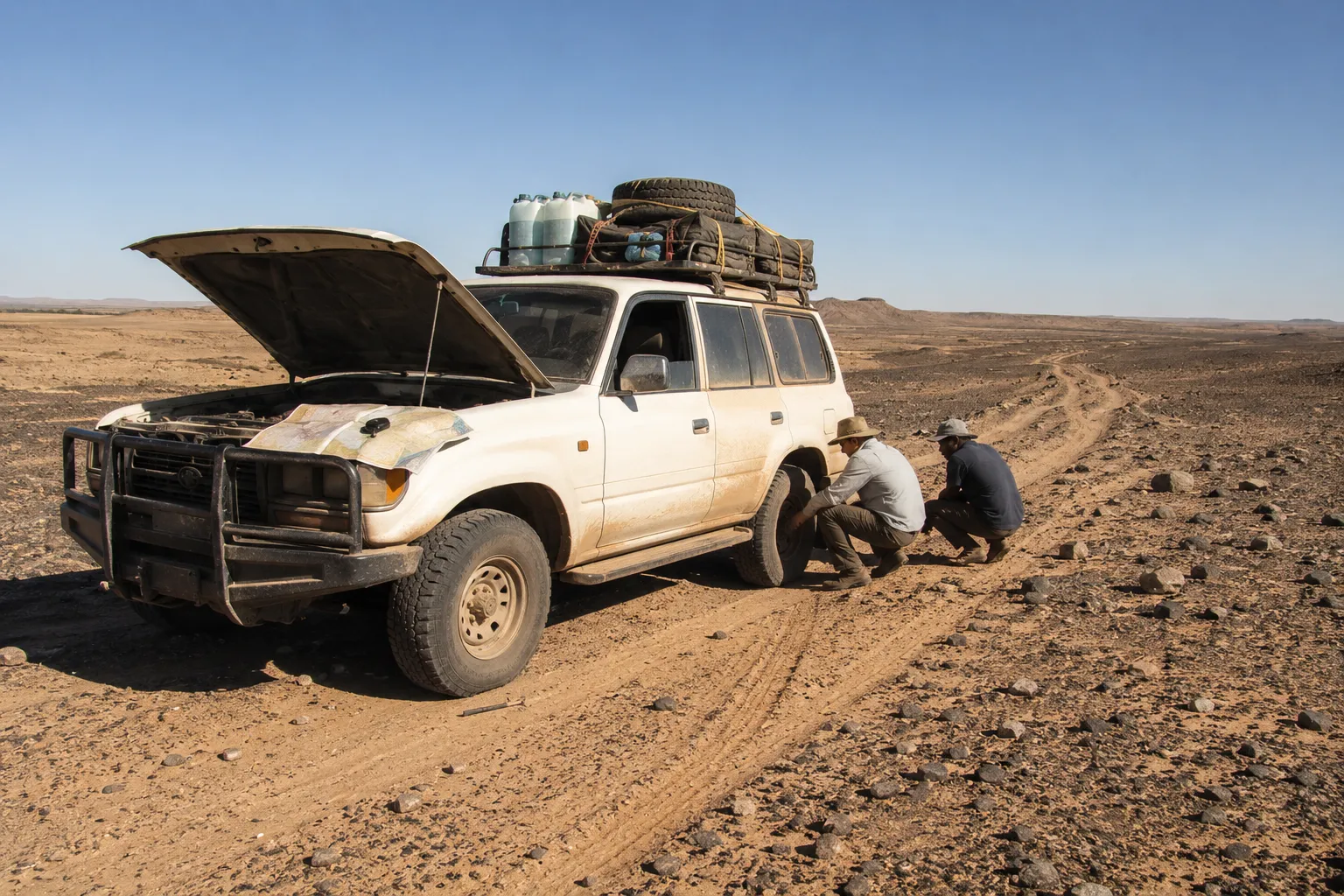
From Namibe, the final leg into the park is unsealed and demands a high-clearance 4x4. Sand, corrugation, rock and soft riverbed crossings all appear. Vehicle choice is not a preference here, it is a safety requirement, and the Angola car rental and driving guide explains what to insist on before you sign anything.
Non-negotiable vehicle prep:
- Long-range fuel capacity plus jerrycans, calculated on worst-case consumption in sand
- Two spare wheels, a working compressor, tyre repair kit and a proper jack
- Recovery gear: tow strap, shovel, sand tracks
- Satellite communicator or satellite phone. Mobile coverage cannot be assumed
- Water for several days beyond your planned itinerary
- Offline navigation plus a paper backup
Common mistake: planning fuel from town to town on a map without accounting for sand driving, detours and idling. Consumption in soft sand can be dramatically higher than on tarmac.
Do you need a guide to visit Iona National Park Angola?
Formally, arrangements can change, so permissions and any guiding requirements should be confirmed with the park management or a Namibe-based operator before you travel. Practically, most travellers should take a guide or travel in a convoy of two vehicles, regardless of what the rules require.
Take a guide if any of the following apply:
- You have no previous remote desert or sand-driving experience
- You are travelling in a single vehicle
- You do not speak Portuguese
- You want to visit Kuvale or Himba communities respectfully and with permission
- You want a realistic chance of finding wildlife across a landscape this large
Independent travel is defensible only with two properly equipped vehicles, satellite communication, genuine self-recovery capability and a filed route plan. For context on how guided travel works elsewhere in the country, the overview of safari in Angola is a useful comparison point.
Is Iona National Park Angola safe to visit?
The main risks at Iona are environmental and logistical rather than criminal: breakdown, dehydration, getting stuck, and being far from help. Angola’s south-west is generally calm, and remote desert areas are not associated with the petty crime pressures found in bigger cities.
Two specific points deserve plain treatment:
- Landmine legacy. Angola’s civil war left contamination in parts of the country. Large-scale clearance has taken place over decades, but the standing advice for rural travel anywhere in Angola is to stay on established tracks and paths and not to wander into uncleared ground.
- Isolation. There is no realistic expectation of rapid rescue. Carry medical supplies, know your evacuation options, and make sure your travel insurance covers remote-area medical evacuation and off-road driving.
Before booking, check the current guidance issued by your own government’s travel advisory, and confirm ground conditions with the park management or an operator in Namibe. Health basics for Angola, including yellow fever entry requirements and malaria precautions, should be checked with an official health authority in the year you travel, since requirements change.
Can you camp at Iona National Park, and are there hotels nearby?
Camping is the way most visitors experience Iona, but arrangements are informal and should be agreed in advance with the park management or your operator rather than assumed. Do not expect serviced campsites with ablutions, power and firewood.
What that means in practice:
- Inside the park: Plan for fully self-sufficient camping. Carry all water, all fuel, a means of cooking that does not rely on collecting scarce desert wood, and pack out every scrap of rubbish.
- Formal accommodation: The nearest hotels and guesthouses are in the city of Namibe, with more choice again in Lubango. Both work as a base for stocking up, sleeping in a bed before and after, and arranging vehicles or guides.
- Booking reality: Availability inside or immediately around the park changes as management develops tourism facilities. Verify what exists at the time of your trip instead of relying on older blog posts.
Edge case worth planning for: fog on the coastal strip can make canvas and bedding genuinely damp overnight. A groundsheet, a warm sleeping bag rated lower than you expect, and a way to dry gear in the morning sun all pay off.
How much does it cost to visit Iona National Park Angola?
Any specific park fee should be confirmed directly with the park management or a Namibe-based operator, because published figures go out of date quickly. What can be said honestly is that Iona is an expensive destination not because of entry costs but because of logistics.
Your budget is driven by:
- International flights to Luanda, plus a domestic flight south if you skip the drive
- 4x4 hire, ideally a well-equipped expedition vehicle rather than a basic SUV
- Fuel, which is the single biggest variable and rises steeply with sand driving
- Guide or operator fees, if you use one (strongly recommended)
- Park permissions, whatever applies at the time of travel
- Supplies, bought in Namibe or Lubango: water, food, spare parts
- Travel insurance with remote medical evacuation and off-road cover
Cost-saving decision rule: if you are two or three people, a guided vehicle with a driver from Namibe is often better value than solo 4x4 hire once you factor in the deposit, the risk of damage, and the real chance of a costly recovery. If you are a group of four to six splitting a shared expedition vehicle, self-drive with a local guide riding along becomes competitive.
What should you pack for Iona National Park?
Pack for a cold-coast desert with big daily temperature swings, no shops and no shade. The classic packing error is assuming hot weather only and arriving with no warm layer.
Clothing and personal kit
- Long sleeves and long trousers in light, breathable fabric for sun protection
- A genuinely warm fleece or down layer plus a windproof shell for coastal fog and cold nights
- Wide-brimmed hat, high-factor sunscreen, lip balm, quality sunglasses
- Buff or scarf for dust
- Closed shoes with a stiff sole for rock and thorn
Camping and safety
- Sleeping bag rated colder than you think you need, plus a sleeping mat
- Head torch with spare batteries
- Comprehensive first aid kit, rehydration salts, personal medication
- Water containers with clear daily rationing per person
- Satellite communicator, offline maps, paper map and compass
For getting the most out of the place
- Binoculars. In low-density desert, they matter more than a long lens
- A hand lens for lichens, insects and small succulents
- Dust-proof camera storage and multiple charging options
How does Iona differ from Angola’s other national parks?
Iona is Angola’s desert park, defined by scale and emptiness, while the country’s better-known parks offer denser vegetation, easier access and more predictable wildlife viewing. If you only have time for one and want animals, Iona is the wrong choice. If you want landscape and wilderness, nothing else in Angola compares.
| Park | Landscape | What it is best for | Access difficulty |
|---|---|---|---|
| Iona (Namibe) | Northern Namib desert, dunes, coast | Scale, solitude, Welwitschia, conservation story | High. Expedition 4x4 |
| Kissama / Quiçama | Coastal savanna and woodland near Luanda | Easiest wildlife day trip from the capital | Low to moderate |
| Cangandala (Malanje) | Miombo woodland | Giant sable antelope conservation | Moderate, restricted |
| Bicuar (Huíla) | Inland savanna and woodland | Off-radar bush landscapes | Moderate to high |
For a fuller picture of how these fit together on an itinerary, see the overview of Angola’s national parks.
Choose Iona if you have five days or more in the south, a suitable vehicle, and you value emptiness over animal counts. Choose a park closer to Luanda if you have a short trip, no 4x4, or you are travelling with people who need reliable comfort.
Conclusion: plan it properly, then go slowly
Iona National Park Angola is one of Africa’s most underrated wilderness areas, and also one of its least forgiving. The park delivers space, silence, ancient plants, desert-adapted wildlife and a conservation recovery story that is still being written. What it does not deliver is convenience.
Your next steps:
- Pick your window. Aim for the dry season, roughly May to October, and cross-check with the best time to visit Angola.
- Decide guided or self-drive. If you are a single vehicle or a first-timer in desert terrain, hire a guide or an operator based in Namibe.
- Sort the vehicle before anything else. Confirm fuel range, spares, recovery gear and tyres in writing.
- Confirm current arrangements. Ask the park management or a Namibe-based operator about permissions, fees and camping in the year you travel.
- Check advisories and health requirements. Consult your own government’s travel advisory and an official health authority for current entry and vaccination rules.
- Build a route with slack. Two or three days inside the park, with buffer days in Namibe and Lubango, beats a rushed dash.
Travel here with self-sufficiency, humility about the landscape and a light footprint, and Iona will give you something very few destinations still can: genuine emptiness, properly earned.
Free help from our team in Angola
Want to explore Iona National Park?
Iona is remote desert with no signposted roads. Tell us your dates and we arrange a 4x4 with an experienced driver, a guide and where to sleep in Namibe.
- Local team in Angola
- No obligation, nothing to pay
- Reply by email or WhatsApp
Want to keep this guide? We email you the key points with a link to every section.
Frequently asked questions
Is Iona National Park worth visiting?
Yes, if you are drawn to desert landscapes, geology, botany and remote travel. It is not worth visiting for a conventional safari, because wildlife densities are low and sightings are unpredictable.
How big is Iona National Park?
Roughly 15,150 square kilometres, making it Angola's largest national park. Together with the adjoining Skeleton Coast National Park in Namibia, the transboundary area covers close to 50,000 square kilometres.
Who manages Iona National Park?
Management is a partnership between the Government of Angola and the conservation NGO African Parks, entered into in December 2019.
Were giraffe really reintroduced to Iona?
Yes. In 2023, 14 Angolan giraffe were translocated from Namibia to Iona, restoring a species that had been absent, with further translocations in 2024.
Can you visit Iona without a 4x4?
Realistically, no. Access tracks require a high-clearance 4x4 with recovery gear, long fuel range and water reserves. A two-wheel-drive vehicle is unsafe here.
What is Welwitschia mirabilis and where do you see it in Iona?
It is a slow-growing desert plant with two long leathery leaves that fray with age, capable of surviving for centuries in near-rainless conditions. Iona is a stronghold. Look on gravel plains and fog-influenced ground, and never drive off track to reach one.
Do Himba people live in Iona National Park?
Kuvale and Himba communities live in and around the Iona landscape, herding livestock. Visits should be arranged through a local guide with prior permission, and photographs should only be taken with clear consent.