Quick answer
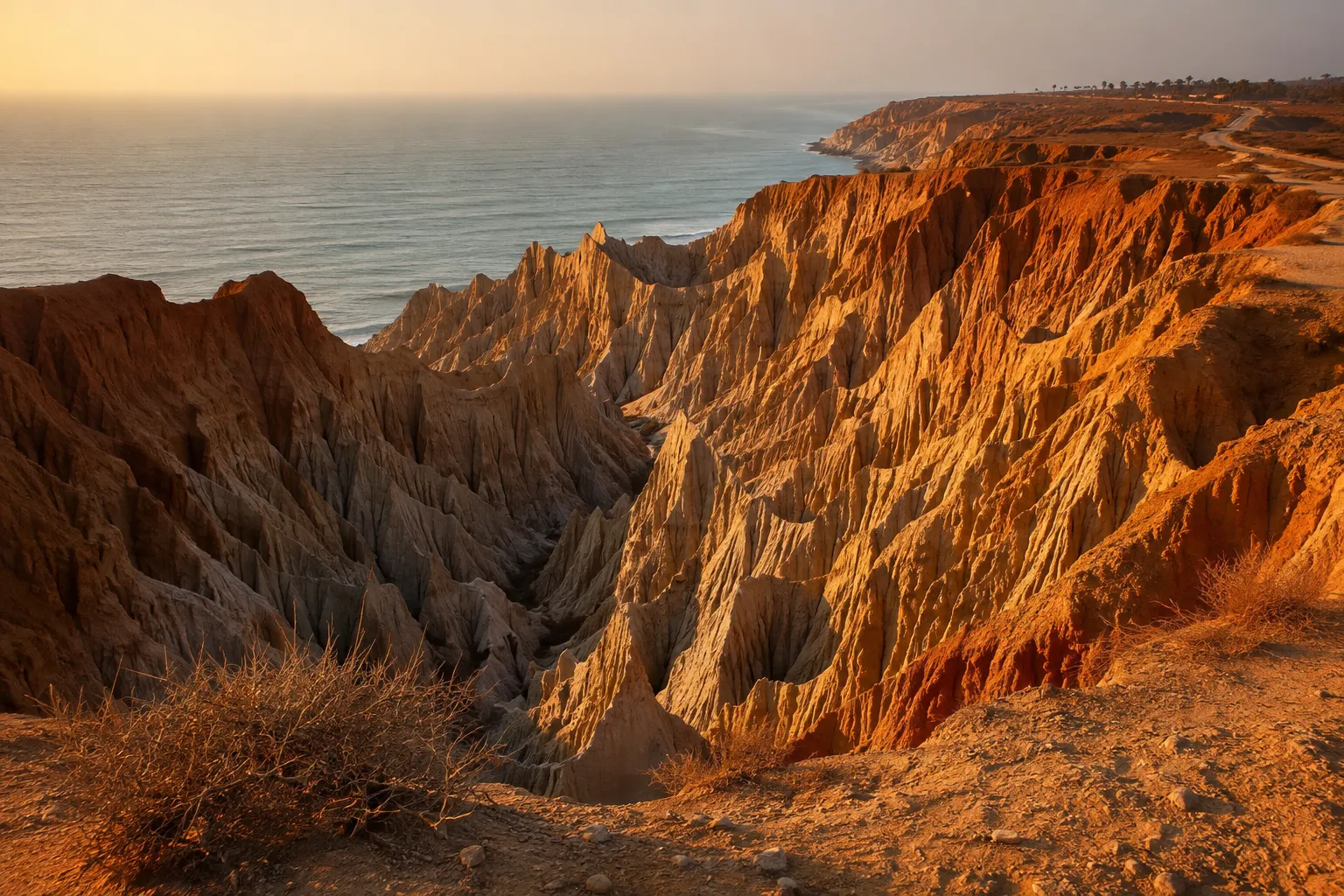
Miradouro da Lua is an eroded cliff landscape about 40 km south of Luanda, in the municipality of Belas, on the coastal road towards Barra do Kwanza. Wind and rain have carved soft sedimentary rock into ridges and gullies that look oddly lunar, hence the name “Viewpoint of the Moon”. It is a short roadside stop, not a full day out, and most visitors stay 30 to 60 minutes. One thing you need to know before you go: in late April 2026 Angola’s Ministry of Tourism closed the site temporarily for around six months so the ravine could be stabilised, so confirm the current status before you drive out.
Key takeaways
- Location: Belas, Luanda Province, roughly 40 km south of central Luanda on the road towards Barra do Kwanza. Drive time is usually 40 to 60 minutes, depending entirely on Luanda traffic.
- What it is: A cliff-edge viewpoint over badlands formed by erosion of soft sedimentary rock, with the Atlantic behind it.
- Time needed: 30 to 60 minutes. Treat it as one stop inside a half-day trip.
- Best light: Late afternoon into sunset, when the ridges glow red and orange.
- Cost: Free in principle, though a small kwanza parking or access fee is sometimes collected. Carry small notes.
- Facilities: Few to none. Bring your own water, snacks, sun protection and cash.
- Safety: The cliff edge is actively eroding. Stay well back, and park on firm ground away from the lip.
- Status in 2026: Closed from late April 2026 for containment and stabilisation works, announced as roughly six months. Verify before travelling.
- Combine with: Barra do Kwanza, Kissama National Park, or a boat afternoon at Mussulo.
What is Miradouro da Lua, and what does the name mean?
Miradouro da Lua is a natural viewpoint over a stretch of dramatically eroded coastal cliffs south of Luanda. Miradouro is Portuguese for viewpoint or lookout, and da lua means “of the moon”, so the name translates as Viewpoint of the Moon. Angolans and visitors alike use the nickname because the terrain below looks less like a beach and more like a crater field.
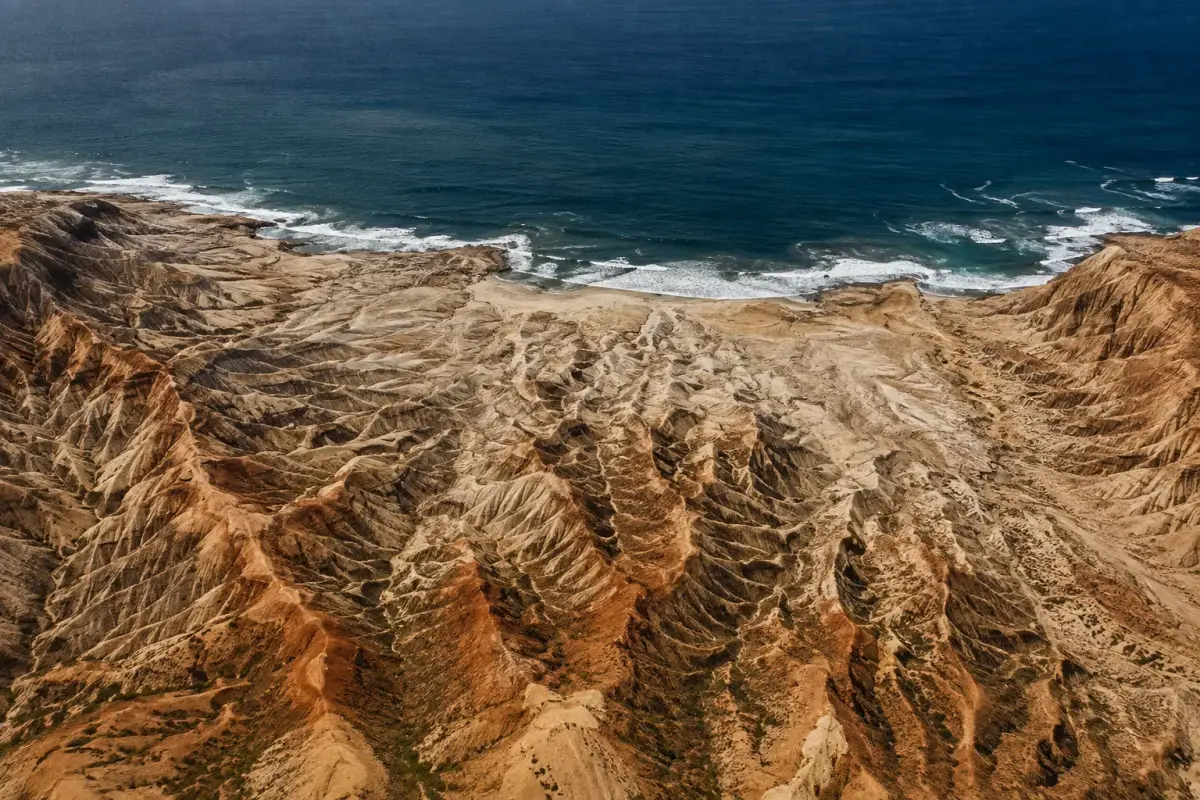
The geology is straightforward once you see it. The plateau here is made of soft sedimentary layers, mostly sands and clays, sitting above the Atlantic. Decades of rain runoff and salty wind have stripped the surface into a maze of sharp ridges, fins and steep gullies, the sort of formation geologists call badlands. There is no volcano, no meteorite crater, no mystery. Just water and wind doing patient work on rock that cannot resist them.
Nobody comes here for the size of the view. They come because the shapes are strange, the colours change by the minute, and it is the closest thing to another planet within an hour of a capital city.
It is also, by Angolan standards, genuinely popular. Reporting in early 2024 described Miradouro da Lua as the most visited tourist site in the country, receiving an average of around 5,000 visitors per month. That tells you two things: it is easy to reach, and you will rarely have it entirely to yourself at sunset.
Where is Miradouro da Lua located?
Miradouro da Lua sits in the municipality of Belas, Luanda Province, roughly 40 km south of central Luanda along the coastal road heading towards Barra do Kwanza, where the Kwanza River meets the ocean. The viewpoint is right beside the road on the seaward side, so you do not hike to it. You pull over and you are there.
A few orientation points that help:
- The road south from Luanda passes the Mussulo peninsula area and then opens into dry, scrubby coastal terrain.
- Miradouro da Lua is on your right as you drive south, with the plateau dropping away towards the Atlantic.
- Continuing south on the same road brings you to Barra do Kwanza and, beyond it, the entrance region for Kissama National Park.
Because it lies on a single well-known coastal route, most drivers in Luanda know it by name. If you are using a hired car or taxi, saying “Miradouro da Lua, Belas” is usually enough.
Is Miradouro da Lua open right now?
Check before you go. At the end of April 2026, Angola’s Ministry of Tourism announced that Miradouro da Lua was closed to the public so that improvement, containment and stabilisation works on the ravine could begin, with an estimated duration of six months. The stated aims were to protect an important natural heritage site, reduce the effects of erosion, and improve safety conditions for visitors.
What that means in practice for a traveller planning a trip:
- A six-month estimate starting in late April 2026 points to a possible reopening around late 2026, but construction timelines slip. No confirmed reopening date has been published.
- Ask your hotel, driver or tour operator in Luanda for the current situation the day before you plan to drive out. Local knowledge beats any website here, including this one.
- If it is still closed, respect the closure. The whole point of the works is a ravine that has become unstable.
- The rest of the coastal route south, including Barra do Kwanza and Kissama, is a separate matter and not covered by this closure.
Decision rule: if you have only one free afternoon in Luanda and the viewpoint is confirmed closed, put that time into a Mussulo boat trip or the city’s waterfront instead. Do not gamble on the drive.
How do you get to Miradouro da Lua from Luanda?
You have four realistic options, and the right one depends on how confident you are driving in Luanda and whether you want other stops on the same run. Drive time is commonly 40 to 60 minutes one way, but Luanda’s traffic can double that during rush hour, so leave the city before 15:00 if you want sunset light with a buffer.
| Option | Best for | Watch out for |
|---|---|---|
| Self drive (rental) | Photographers who want to control timing | Luanda traffic, unlit roads after dark, parking on soft ground |
| Hotel car with driver | First-time visitors, comfort, no navigation stress | Agree the waiting time and route in advance |
| Metered or app taxi | Budget-conscious solo travellers | Getting a ride back; arrange for the driver to wait |
| Organised half-day tour | Combining Miradouro da Lua with Barra do Kwanza or Kissama | Fixed schedule may not match golden hour |
A few practical notes from the road:
- Do not plan to find a taxi at the viewpoint. There is no rank, no queue and often no phone signal you can rely on. Whoever brings you should wait.
- A normal sedan handles the main coastal road fine in dry conditions. A higher-clearance vehicle is more comfortable if you plan to continue to Kissama or off the tarmac. Our notes on renting a car in Angola cover documents, insurance and what to inspect before you drive away.
- Driving back into Luanda after dark is doable but busy. Build in extra time.
- For a broader shortlist of what pairs well with this route, see our guide to day trips from Luanda.
Is there an entrance fee, or is it free?
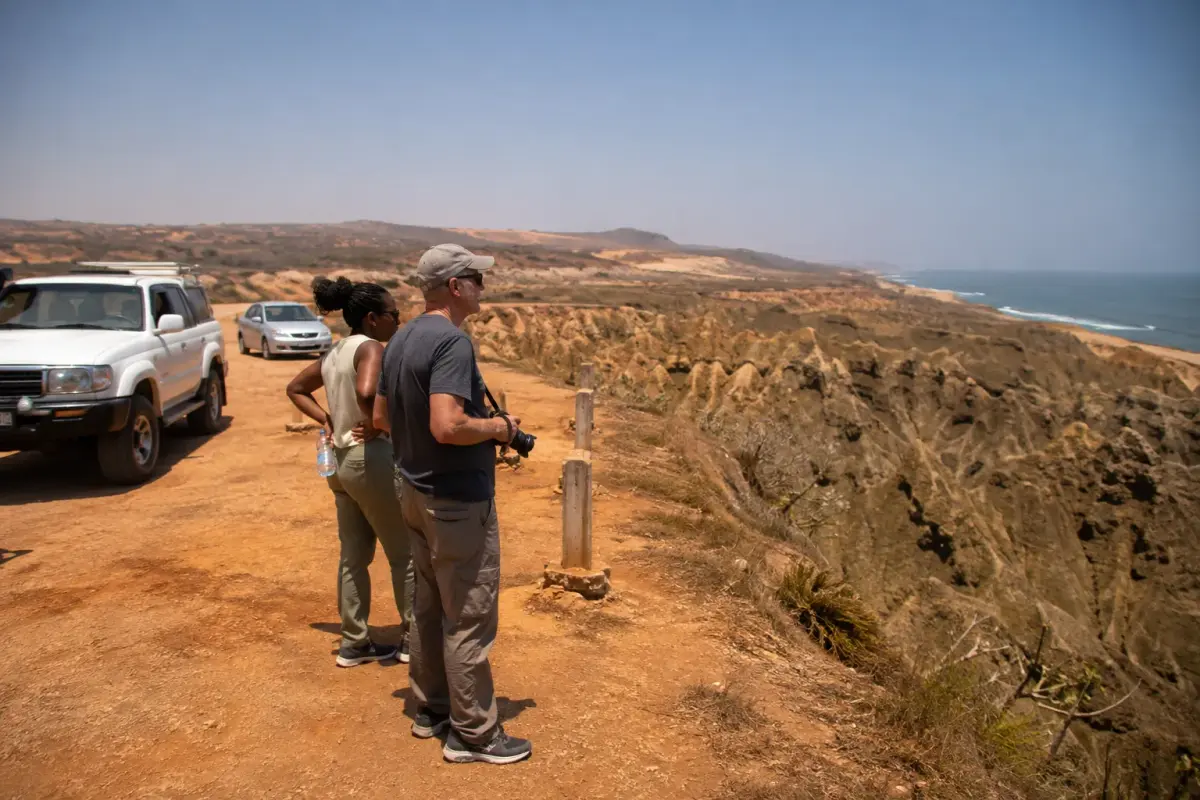
Miradouro da Lua has historically been a free roadside viewpoint, but a small fee in kwanza is sometimes collected for parking or access at the pull-in area. Amounts vary and are not fixed in any published tariff, so treat it as a minor cost rather than a budget item.
How to handle it without friction:
- Carry small kwanza notes. Card payment is not a thing here, and nobody will have change for a large note.
- If someone asks for a parking fee, it is usually a modest amount for watching your vehicle. Paying it is the path of least resistance.
- Ask your driver what is normal before you arrive. They will know the going rate better than any guide.
- Do not assume a fee means facilities. It does not.
What can you see, and how long should you stay?
You see a broad amphitheatre of eroded cliffs: parallel ridges, knife-edge fins, deep gullies and dry channels running down towards the Atlantic, in tones from pale cream through ochre to deep rust. Behind and beyond it, the ocean. Most visitors spend 30 to 60 minutes, and that is honestly enough.
What fills that time:
- Walking a short stretch along the plateau to change your angle on the ridges. Different vantage points look like completely different places.
- Watching the colour shift as the sun drops.
- Photographs, which is the main reason most people come.
Common mistake: budgeting half a day at the viewpoint. There are no trails down into the gullies that a casual visitor should attempt, no visitor centre, no cafe. Build your afternoon around the drive plus one or two other stops, not around hours spent standing at the edge. If you are working with a tight city schedule, our three days in Luanda plan shows where a stop like this fits.
When is the best time to visit, and what about sunset?
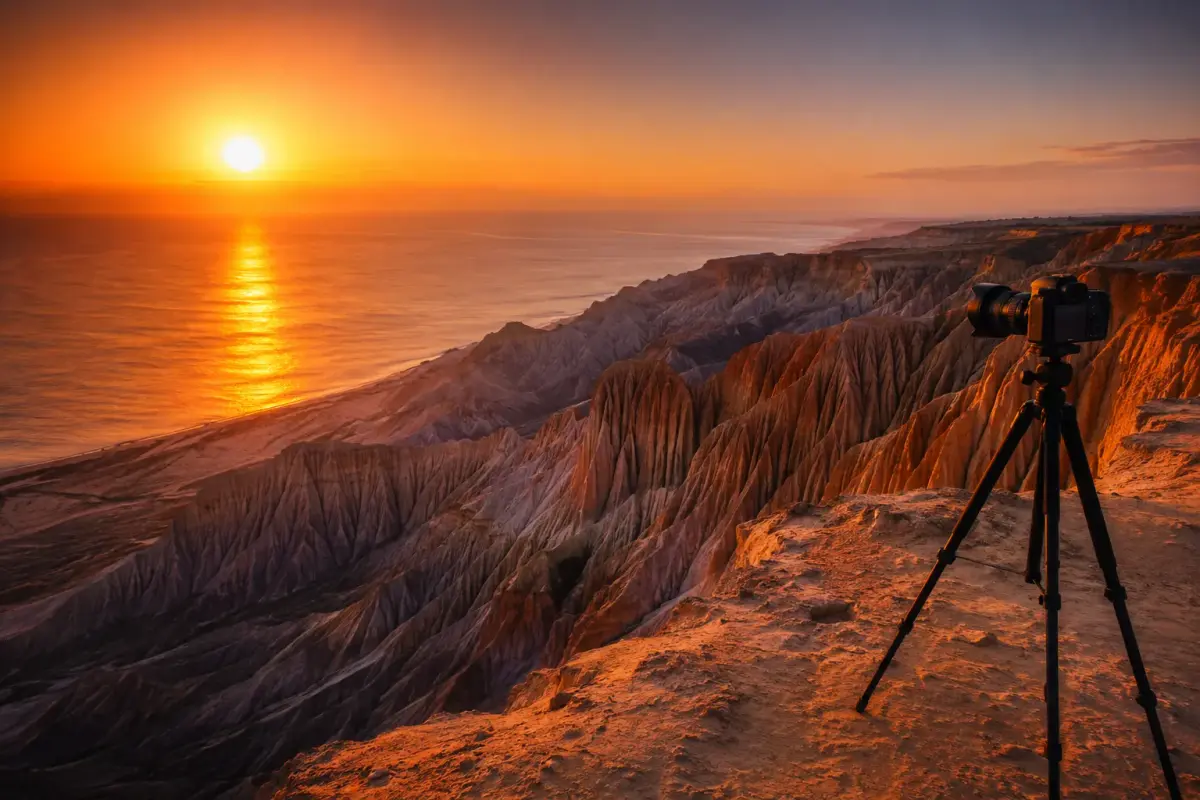
Late afternoon into sunset is the best time, without much competition. Low, warm light rakes across the ridges, exaggerating every fold, and the cliffs shift into red and orange. At midday the sun sits overhead, shadows collapse, and the whole scene flattens into a pale, washed-out grey.
Practical timing:
- Aim to arrive 60 to 90 minutes before sunset. That gives you soft late light, the golden peak and the afterglow.
- Early morning is the second-best option: cooler, quieter and with light coming from the opposite side. Fewer people, different mood.
- Seasonally, the dry, cooler months from roughly May to October generally bring clearer, easier road conditions in this part of Angola. During the rains from around November to April the light can be more dramatic but access and footing are worse, and erosion is at its most active.
- Coastal haze is common. It softens contrast, which can be beautiful or frustrating depending on your taste.
Edge case: if you drive out for sunset, plan the return trip in the dark before you leave. Do not linger on an unlit cliff edge trying to find your car.
How do you get the best photos?
The best photos here come from side light, not front light, and from getting low or finding a vantage point where the ridges layer into each other. A wide lens captures the scale of the badlands; a short telephoto isolates the ridge patterns, which is often the stronger image.
A working checklist:
- Arrive early enough to scout. Walk 100 metres along the plateau before you commit to a spot.
- Shoot the ridges as pattern, not just as a panorama. Repeating fins and gullies read beautifully in tight crops.
- Include something for scale if you can, a vehicle on the road or a person standing safely back from the edge.
- Bracket your exposures. The contrast between glowing rock and shaded gullies is brutal.
- Protect your gear from dust. Fine reddish dust gets everywhere. Change lenses inside the car.
- Stay behind the edge for every shot. No frame is worth stepping onto undercut ground.
- Ask before photographing people, including anyone collecting parking fees.
For more on shooting Angola’s landscapes and etiquette around photography in the country, see our Angola photography guide.
Is Miradouro da Lua safe to visit?
The main hazard here is not crime, it is the cliff itself. Erosion has weakened the edge, ground that looks solid can be undercut from below, and that instability is precisely why the ravine stabilisation works were commissioned in 2026. Stay well back from the lip, keep children close and hold onto them, and never sit or lean on the outer edge for a photo.
Other sensible precautions:
- Park on firm ground, well away from the drop. Soft shoulder plus vehicle weight is a bad combination.
- Wear closed shoes with grip. The surface is loose and dusty.
- Do not visit alone after dark. Come with a driver or in a group, and leave once the light goes.
- Keep valuables out of sight in the vehicle, the same habit you would use anywhere in Luanda.
- Before any trip to Angola, read your own government’s travel advisory for current safety and health guidance, and check what your travel insurance says about self-driving.
Miradouro da Lua versus Angola’s other viewpoints
Miradouro da Lua is the most accessible dramatic landscape near Luanda, but it is not the country’s most spectacular viewpoint. If you are choosing between them, this is the honest ranking:
| Viewpoint | Where | Why go | Time needed |
|---|---|---|---|
| Miradouro da Lua | Belas, about 40 km south of Luanda | Lunar badlands, easiest big landscape from the capital | 30 to 60 min |
| Tundavala Gap | Huila, near Lubango | Vast escarpment drop, arguably Angola’s best view | Half day from Lubango |
| Serra da Leba pass | Huila, Lubango to Namibe | Iconic hairpin mountain road | 2 to 3 hours |
| Cristo Rei, Lubango | Lubango city | Panorama over the highlands city | 1 hour |
| Kalandula Falls | Malanje | Enormous waterfall, completely different register | Full day |
Choose Miradouro da Lua if you are based in Luanda with a spare afternoon and no time to fly south. Choose Tundavala or Serra da Leba if you have a longer itinerary and want the country’s headline scenery. They are not substitutes for each other.
Facilities and what to bring
There are few or no facilities on site: no visitor centre, no toilets you should count on, no restaurant, no reliable shade. Occasional informal vendors may be present, but plan as if nothing is available.
Pack for a short desert-edge stop:
- Water, more than you think, plus a snack
- Small kwanza notes for a possible parking fee
- Sun hat, sunglasses, high-factor sunscreen
- Closed, grippy shoes
- A light windbreaker, since the coastal wind can be strong
- Camera, spare battery, lens cloth for dust
- A torch or phone light if you stay for sunset
- Wet wipes or hand sanitiser, because there is nowhere to wash
What to combine it with for a half-day trip
Because the viewpoint takes under an hour, pair it with at least one other stop on the same coastal road. Three combinations that work well:
- Miradouro da Lua plus Barra do Kwanza. Continue south to where the Kwanza River meets the Atlantic, with fishing, birdlife and riverside lodges. An easy, relaxed half day.
- Miradouro da Lua plus wildlife. Push further south to Kissama National Park, the closest national park to the capital. This turns into a long full day, so start very early and see the viewpoint on the way back for the good light.
- Miradouro da Lua plus a beach afternoon. Combine it with a boat trip to Mussulo island for water, seafood and calm lagoon swimming, then catch the cliffs at golden hour.
Conclusion
Miradouro da Lua gives you a genuinely odd, genuinely photogenic landscape less than an hour from a capital city, for the price of a tank of fuel and a small parking fee. The catch is that it is brief. Go in with the right expectations, arrive in the last hour of daylight, and build the rest of your afternoon around the road south.
Your next steps:
- Check the current status of the site with your hotel or driver, given the 2026 stabilisation works.
- Book transport with waiting time included, or sort out car rental in Angola if you want full control of your timing.
- Pick your pairing: Barra do Kwanza for an easy half day, Kissama National Park for wildlife, or Mussulo for a beach afternoon.
- Leave Luanda by mid-afternoon, pack water and small notes, and plan the drive home in the dark.
- Read your own government’s travel advisory for Angola before you travel, and confirm your insurance covers self-driving.
Free help from our team in Angola
Want a driver to Miradouro da Lua?
The viewpoint lies on the coast south of Luanda. Tell us when you want to go and a driver or guide from our own team takes you there, combined with Kissama or the coast if you like.
- Local team in Angola
- No obligation, nothing to pay
- Reply by email or WhatsApp
Want to keep this guide? We email you the key points with a link to every section.
Frequently asked questions
What does Miradouro da Lua mean?
It is Portuguese for "Viewpoint of the Moon". The name refers to the eroded ridges and gullies below the lookout, which people compare to a lunar surface.
How far is Miradouro da Lua from Luanda?
Roughly 40 km south of central Luanda, in the municipality of Belas, on the coastal road towards Barra do Kwanza. The drive typically takes 40 to 60 minutes depending on traffic.
Is Miradouro da Lua open?
It was closed at the end of April 2026 for ravine containment and stabilisation works, announced as roughly six months. Confirm the current status locally before driving out.
How much does it cost to visit Miradouro da Lua?
There is no official published entrance fee. A small kwanza amount is sometimes collected for parking or access, so carry small notes.
How long should I spend at Miradouro da Lua?
Thirty to sixty minutes covers it comfortably, including walking to a couple of vantage points and shooting the light. It is a stop, not a destination.
Is Miradouro da Lua worth visiting?
Yes, if you are in Luanda with a free afternoon and you like landscape photography. It is the most striking natural scenery within an hour of the capital, and reporting in 2024 called it the most visited tourist attraction in Angola, with around 5,000 visitors per month.
Can I walk down into the gullies?
No. The rock is soft and actively eroding, there are no maintained trails for visitors, and the cliff edge itself is unstable. Stay on the plateau, well back from the lip.