Angola hands photographers something rare: a country roughly the size of Western Europe with barely any Instagram saturation. You can shoot one of Africa’s largest waterfalls at sunrise, drive through a Mars-like canyon by lunch, and photograph fishermen on a colonial-era promenade by sunset, often without another tourist in the frame.
This is a working guide to angola photography, focused on where to shoot, when the light is best, how to get access, and what to watch out for. I’ve paired each spot with a practical tip so you can plan a real itinerary, not just a mood board.
Quick Answer
The best photography spots in Angola are Kalandula Falls, Miradouro da Lua, Serra da Leba, Tundavala, the Namibe desert, Luanda’s Marginal and Fortaleza de São Miguel, Mussulo island, and Kissama National Park. The dry season (May to October) gives the cleanest light and easiest access, though the falls are more dramatic in the shoulder months of April and November. Most locations require no formal permit for personal work, but always ask before photographing people and avoid military, government, and airport buildings.
Key Takeaways
- Dry season (May to October) is best for landscapes, wildlife, and travel logistics; shoulder months (April, November) give fuller waterfalls.
- Kalandula Falls, Serra da Leba, and Tundavala are the country’s landscape icons.
- Miradouro da Lua and the Namibe desert deliver otherworldly, low-competition frames.
- Luanda rewards patient street and architecture photography; be discreet.
- Always ask before photographing people; avoid pointing lenses at government buildings, ports, and the airport.
- A 50 mm equivalent plus a wide-angle and a 70-200 mm zoom covers most situations.
- Budget roughly €150,€350 per day for a private driver-guide setup; group tours run higher.
- Personal photography rarely needs a permit; commercial or drone work usually does.
Best Places to Photograph in Angola
Angola’s most photogenic locations cluster around three regions: the northern falls country around Malanje, the southern highlands and desert around Lubango and Namibe, and the Atlantic coast from Luanda down to Benguela. Here’s a quick overview before we go spot by spot.
| Location | Region | Best For | Best Light |
|---|---|---|---|
| Kalandula Falls | Malanje | Landscape, long exposure | Early morning |
| Miradouro da Lua | Near Luanda | Landscape, abstract | Late afternoon |
| Serra da Leba | Huíla | Landscape, aerial-style | Early morning |
| Tundavala | Huíla | Cliffs, dramatic vistas | Sunset |
| Namibe desert | Namibe | Dunes, minimalism | Sunrise, sunset |
| Luanda Marginal | Luanda | Street, architecture | Blue hour |
| Mussulo | Near Luanda | Coastal, lifestyle | Golden hour |
| Kissama NP | Bengo | Wildlife | Early morning |
For deeper destination context, see our guides to Angola attractions and travel to Angola.
Kalandula Falls: Angola’s Landscape Icon
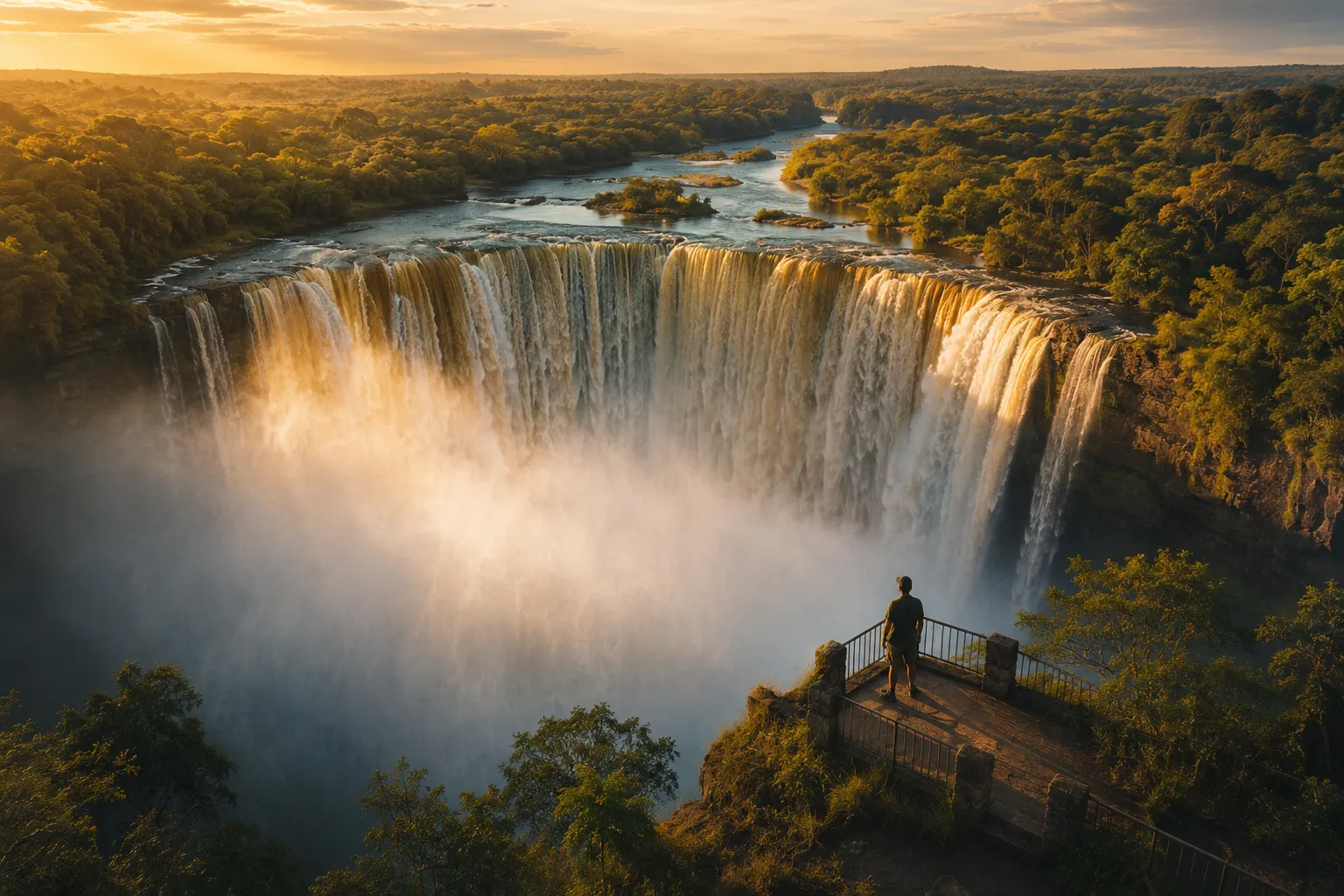
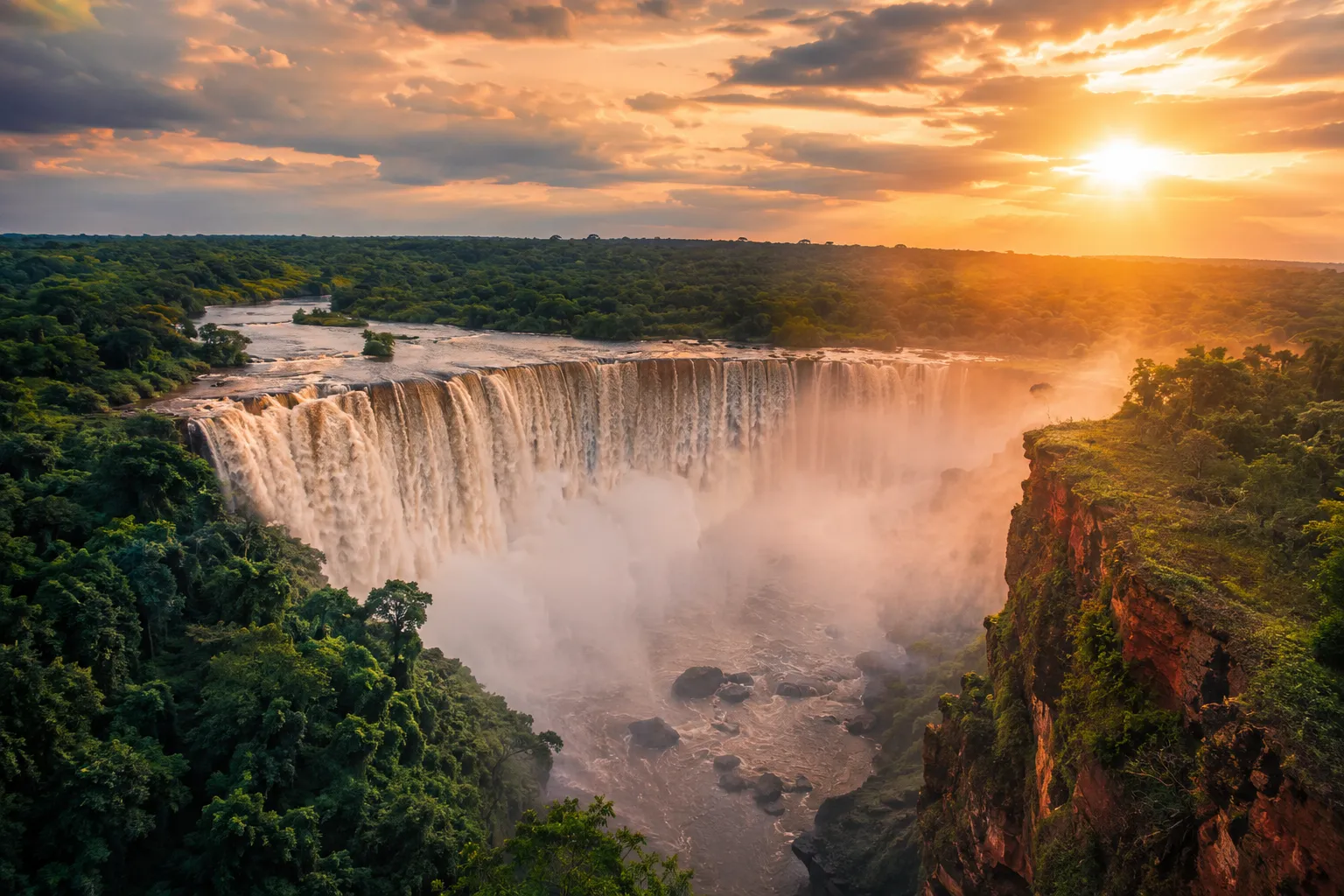
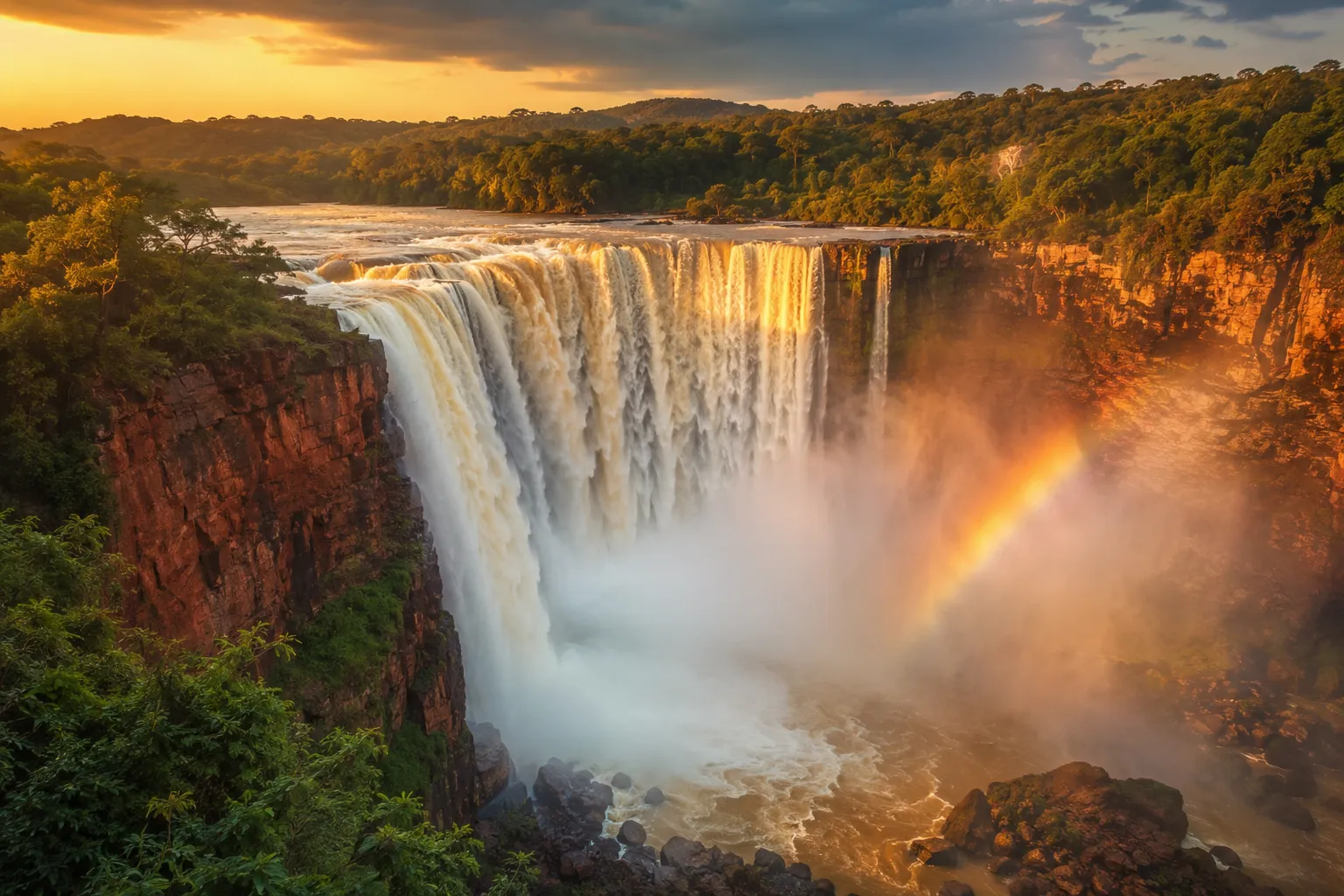
Kalandula is one of Africa’s largest waterfalls by volume, a 400-meter-wide horseshoe carved into red cliffs and green forest. It’s the single most rewarding landscape stop in the country.
- What makes it photogenic: The scale, the ochre rock, and the rainbows that form in the mist most mornings.
- Best light: Sunrise, when the sun rises behind the falls and lights up the spray from below.
- Access: Roughly 400 km east of Luanda via Malanje. The old colonial-era Hotel Kalandula sits on the cliff edge, giving you a plunge-pool viewpoint. A muddy trail descends to the base, worth the sweat.
- Quick tip: Bring a polarizer and a 6-stop ND. Long exposures of 1-2 seconds turn the mist into silk without erasing texture. See the Kalandula Falls guide for road conditions.
Miradouro da Lua: The Moon Landscape
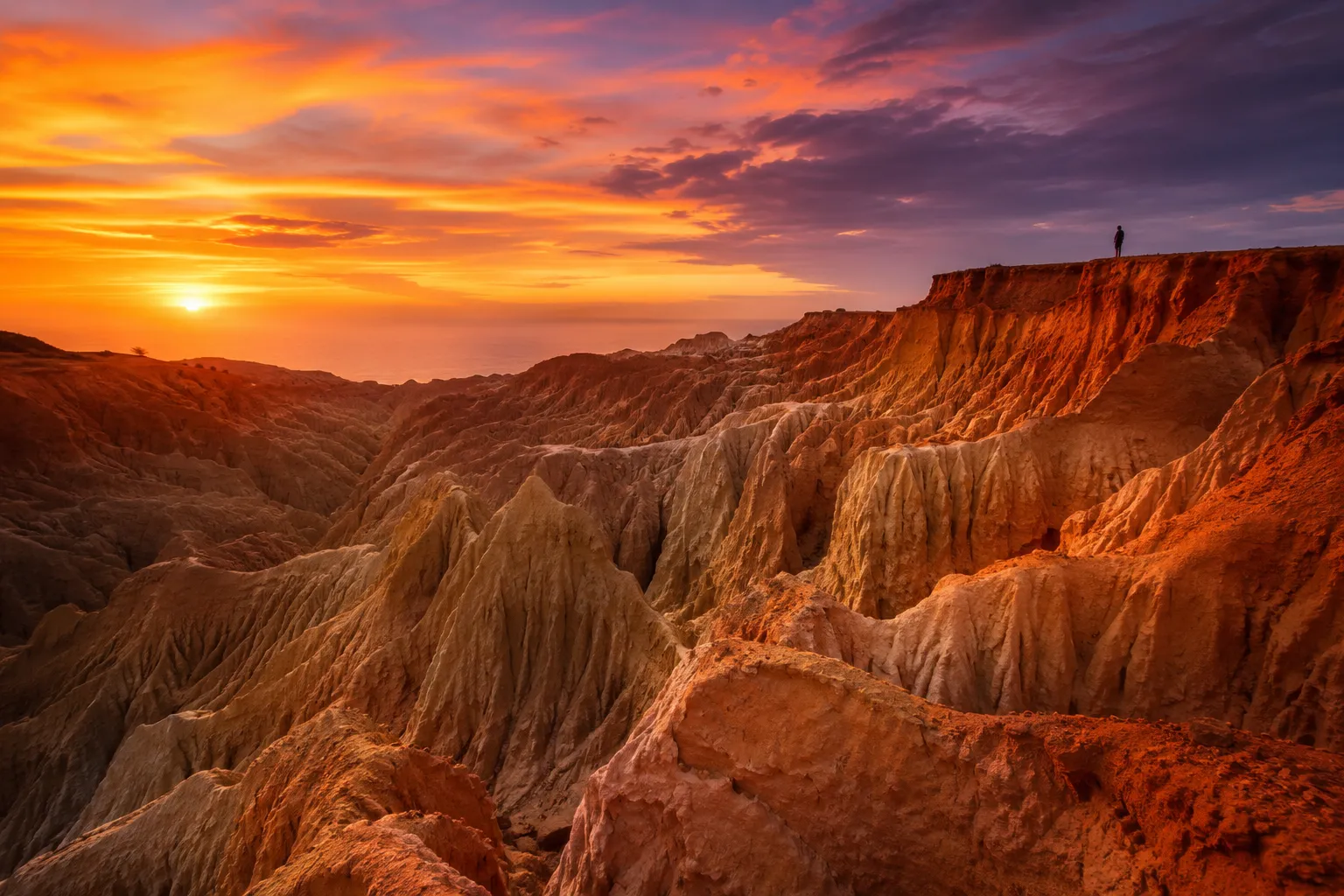
About 40 km south of Luanda along the coast road to Cabo Ledo, the Miradouro da Lua is a wind-eroded canyon of white and rust-colored cliffs that genuinely looks lunar.
- Best light: Two hours before sunset. Side-light rakes across the ridges and pulls out every erosion line.
- Access: Easy day trip from Luanda by car. No entrance fee, no permits.
- Quick tip: Skip the main viewpoint and walk 200 meters along the cliff for cleaner foregrounds without the guardrail.
Serra da Leba and Tundavala
The Huíla highlands near Lubango are Angola’s drama capital. Serra da Leba is a switchback mountain pass that photographs like an aerial shot from ground level. Tundavala is a 1,000-meter escarpment where the highlands drop straight into the coastal plain.
- Best light: Serra da Leba works best in early morning with valley mist. Tundavala peaks at sunset with warm light on the cliff face.
- Access: Both are within an hour of Lubango. See our Lubango and Huíla guide for logistics.
- Quick tip: For Serra da Leba, position yourself at the upper viewpoint and use a 70-200 mm to compress the hairpins. Wide-angle actually kills the impact.
The Namibe Desert and Iona National Park
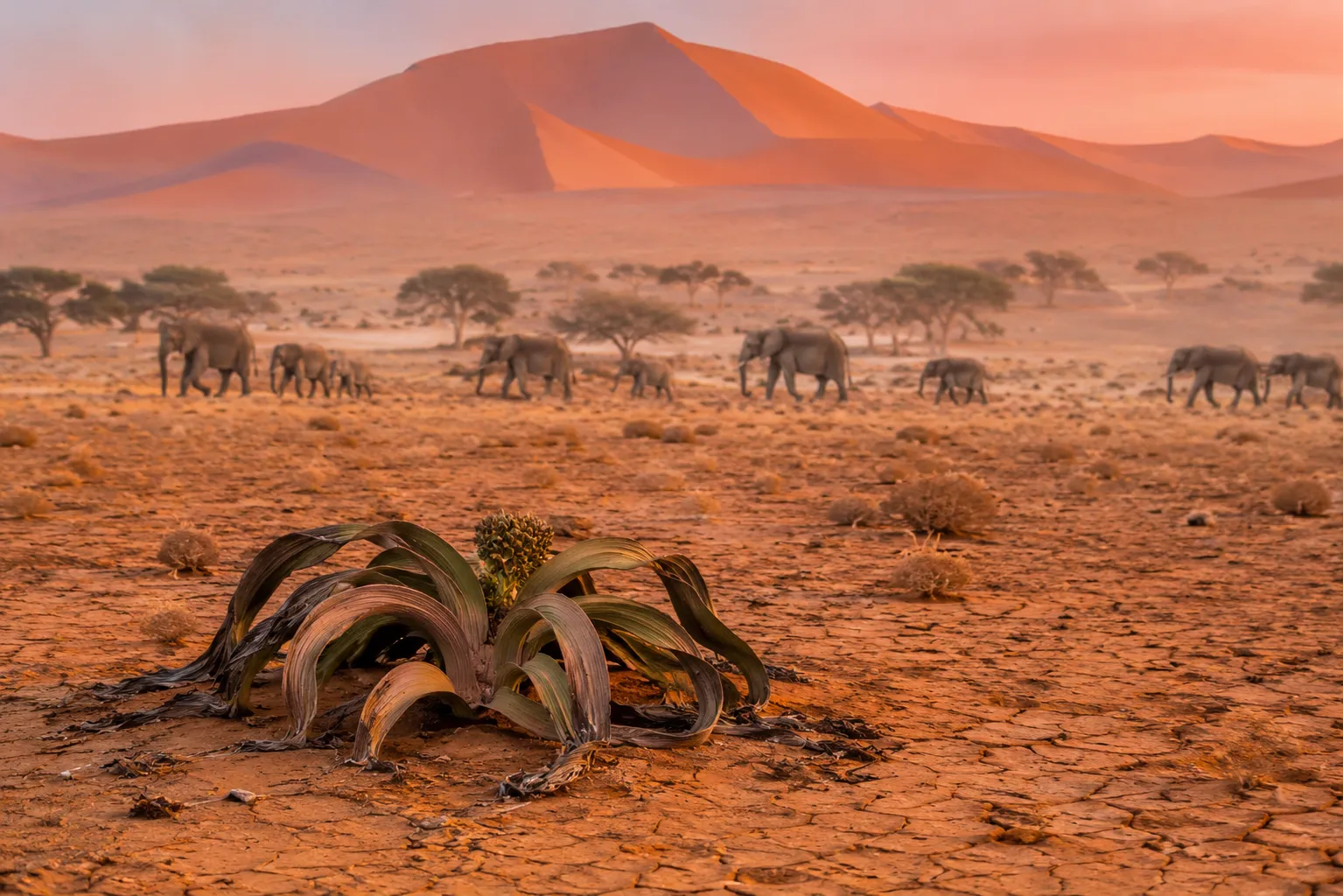
The Namib doesn’t stop at the Namibian border. It runs north into Angola, where it becomes even emptier. Iona National Park protects red dunes, ancient welwitschia plants, and a raw Atlantic coastline.
- Best light: First and last hour. Midday flattens the dunes.
- Access: Fly or drive to Namibe town, then 4x4 only. This trip really does need a guide.
- Quick tip: Frame welwitschia low and wide with dunes behind. These plants can be over 1,000 years old and photograph like alien sculpture.
When Is the Best Time to Visit Angola for Photography?
The dry season, May through October, is the best window for angola photography. Skies are cleaner, roads are passable, wildlife concentrates near water, and humidity is lower on the coast. The trade-off: waterfalls run lower, and the light can get hazy in September and October from savanna burning.
- May, June: Ideal all-round. Falls still strong, greenery still present, cool nights in the highlands.
- July, August: Peak dry, best for wildlife and desert; expect cooler mornings inland.
- November, December: Shoulder. Storm clouds add drama, but roads deteriorate.
- January, March: Wet season. Kalandula at maximum flow but access is hard.
For a full seasonal breakdown see best time to visit Angola.
Angola Photography During Rainy Season vs Dry Season
Dry season is easier; rainy season is more dramatic. In the dry months you get reliable light, dust-free air on the coast, and drivable red-earth roads. In the wet months (November to April) waterfalls thunder, skies build enormous cumulus stacks, and the landscape goes emerald green.
- Choose dry season if you’re mixing wildlife, road trips, and general travel.
- Choose rainy season if you’re a landscape specialist willing to sit out storms for one perfect frame at Kalandula.
How to Get Permits for Photography in Angola
For personal, non-commercial photography, you generally don’t need a permit at tourist sites. Commercial shoots, drones, and filming in national parks are a different story and typically require written authorization from the relevant ministry or park authority. Rules change, so verify before you fly.
- Drones: Legally sensitive. Assume you need prior approval and never fly near airports, ports, government buildings, or oil infrastructure. Verify the current 2026 rules with the Angolan civil aviation authority before travel.
- National parks: Standard entry fees apply; commercial work needs park authority sign-off.
- Commercial shoots: Contact the Ministry of Culture, Tourism and Environment via your fixer or tour operator.
What Camera Gear Do I Need for Angola Wildlife Photography?
For Angolan wildlife, especially in Kissama and Iona, you want reach and dust protection. A 100-400 mm (or 150-600 mm) is the workhorse. Wildlife densities here are lower than in Botswana or Kenya, so long glass matters more than speed.
Recommended kit:
- Full-frame or APS-C body with weather sealing
- 24-70 mm for landscapes and environmental portraits
- 100-400 mm or longer for wildlife
- Polarizer and 6-stop ND filter
- 2 extra batteries (charging can be inconsistent outside cities)
- Rocket blower and sensor swabs (red dust gets everywhere)
- A soft, sealable bag for humidity at the falls
Leave the heavy tripod at home unless you’re serious about long exposures. A light travel tripod is enough.
Is It Safe to Do Photography in Angola as a Tourist?
Yes, with normal urban caution and awareness of what not to photograph. Angola has seen major stability improvements since the war ended in 2002, and tourism-friendly reforms have expanded since 2023. Petty theft is the main risk in Luanda; the countryside is generally calm.
Sensible rules:
- Don’t flash expensive gear in Luanda traffic or crowded markets.
- Never photograph military, police, government buildings, ports, oil facilities, or the airport. This is taken seriously.
- Cabinda has stricter travel advisories; check your government’s guidance before including it.
- Watch for remnant landmines in remote rural areas; stay on established paths.
For up-to-date safety and travel advice, consult the WHO and your own foreign ministry, and see our overview: is Angola safe.
Angola vs Botswana Photography Comparison
Angola and Botswana attract different photographers. Botswana is a mature safari destination with dense wildlife, established camps, and premium pricing. Angola is a mixed-genre destination, landscape, culture, coast, and some wildlife, with far fewer tourists and rougher logistics.
- Choose Botswana if wildlife is your only priority and you want lodge-based ease.
- Choose Angola if you want variety, empty frames, colonial architecture, and dramatic geology alongside some wildlife.
Realistic expectation: Angola isn’t a Big Five destination in the Botswana sense. Kissama is recovering, not competing with the Okavango.
Luanda Street Photography Tips and Tricks
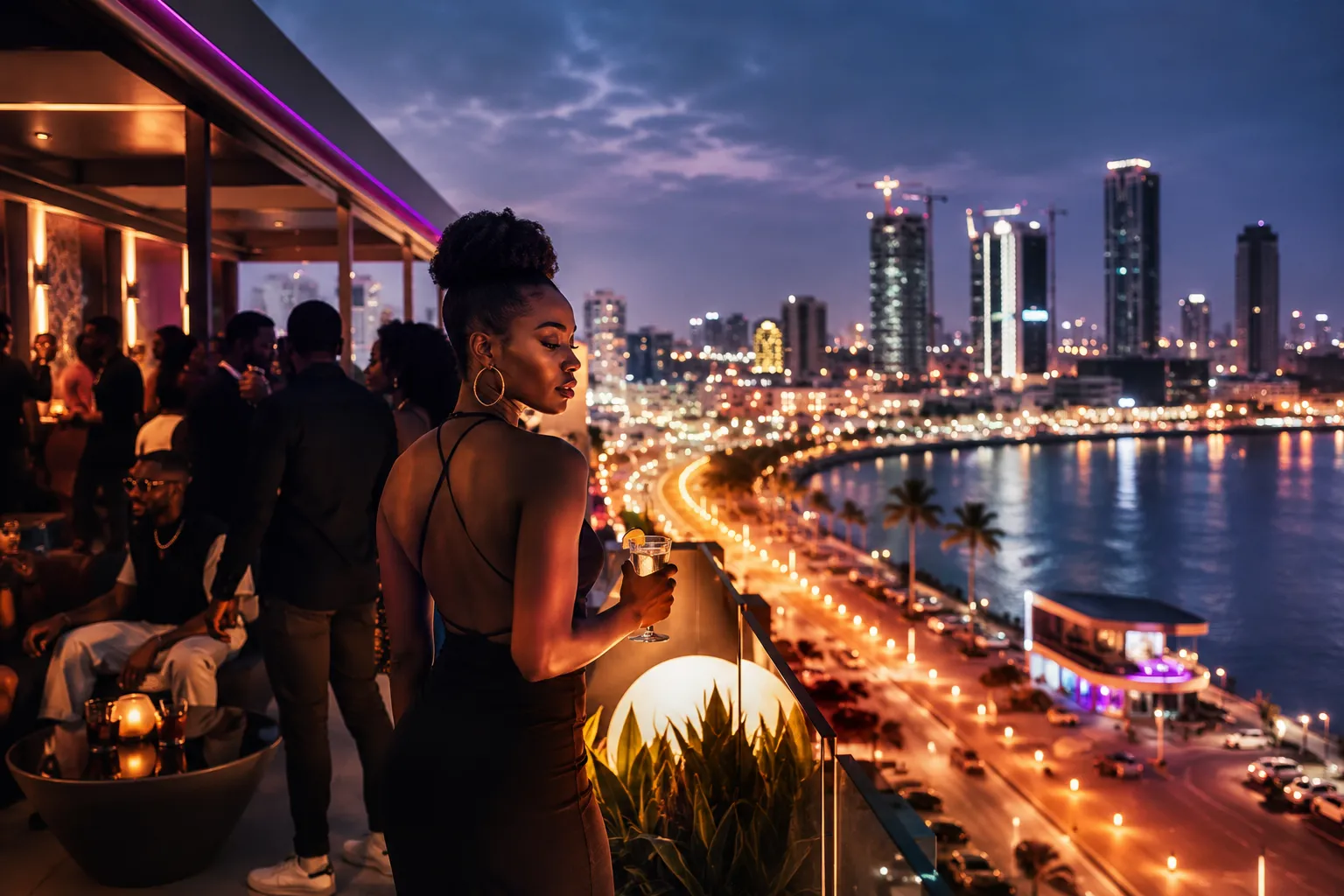
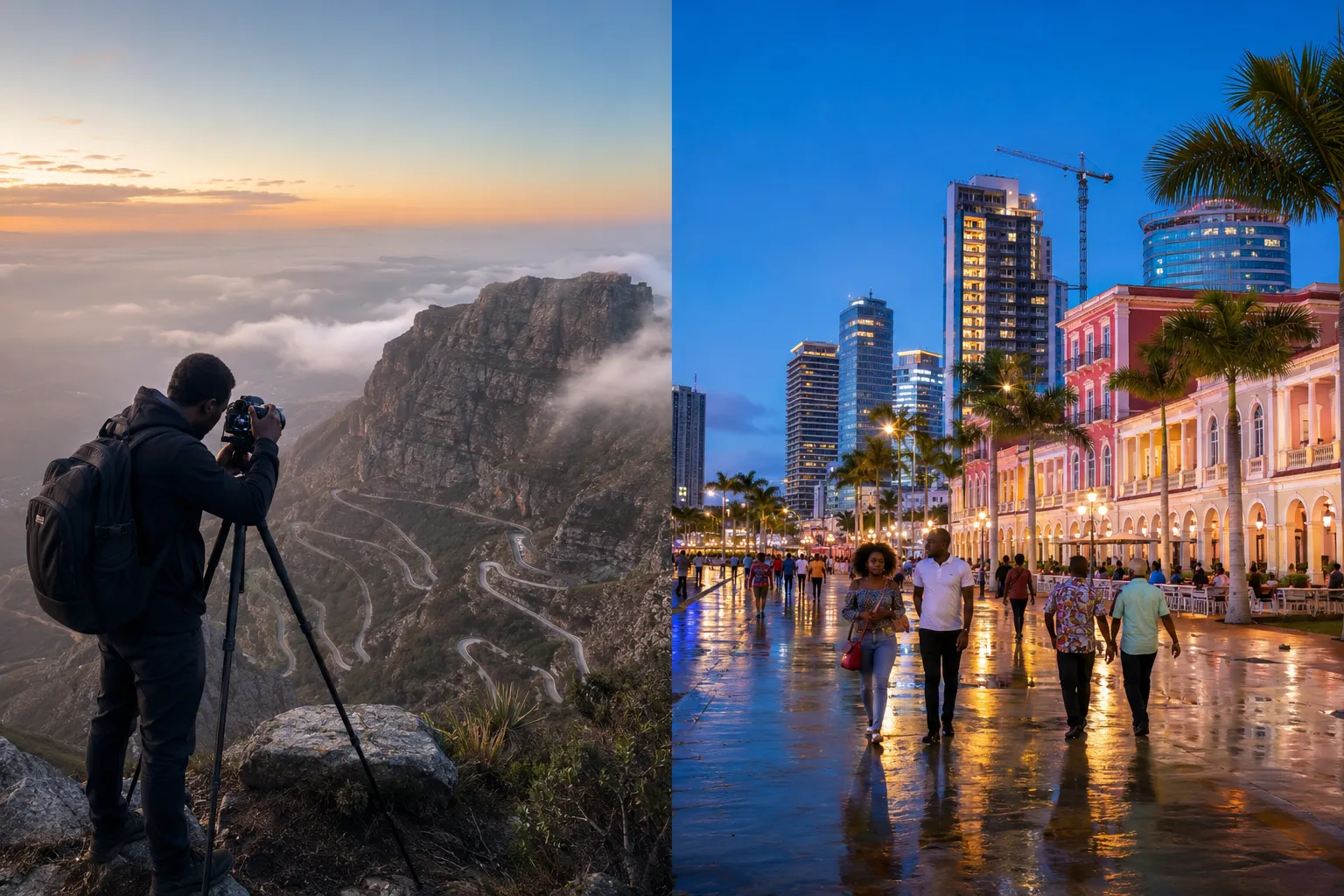
Luanda rewards patience and discretion. The Marginal promenade at blue hour, the pastel colonial center of Baixa, and the rooftops around Ilha do Cabo are the anchor spots. Street photography here works best when you slow down, sit in one place, and let scenes come to you.
- Shoot from cafés along the Marginal; you get elevation and a legitimate reason to be there.
- The Fortaleza de São Miguel gives sweeping views of the bay, especially good at sunset.
- Rooftops of hotels like the Epic Sana or the Skyna often allow guests up for drinks.
- Small camera, short lens (35 mm or 50 mm), no big backpack.
- Portuguese helps. A quick “posso tirar uma foto?” opens doors that a raised camera closes.
More context in the Luanda destination guide.
Best National Parks in Angola for Landscape Photography
For pure landscape, Iona (Namibe) and Bicuar (Huíla) are the standouts. For a wildlife-plus-landscape mix within reach of Luanda, Kissama is the practical choice.
- Iona: Dunes, welwitschia, and Atlantic cliffs. Remote, needs a proper 4x4 expedition.
- Kissama: Restocked with elephants and other species via Operação Arca de Noé in the early 2000s. Best for accessible wildlife day trips from Luanda. See Kissama National Park.
- Bicuar: Rewilding in progress; savanna and woodland scenery.
- Cangandala and Luando: Home to the endemic palanca negra gigante, Angola’s national symbol.
Mussulo and the Coast
Mussulo is a long sandy peninsula and lagoon system just south of Luanda, reachable by short boat transfer. It’s the go-to for coastal lifestyle photography: fishing boats, palm groves, warm shallow water, and colorful beach kiosks.
- Best light: Late afternoon toward Luanda’s skyline for silhouettes; morning for calm turquoise water.
- Quick tip: Charter a small boat and shoot from the water back toward the city. See Mussulo for boat logistics.
Further down the coast, Benguela and Lobito offer colonial architecture, the Baía Azul, and the historic Benguela railway. Praia Morena at sunset is a classic frame.
How Much Does a Photography Tour in Angola Cost?
Angola isn’t cheap. Luanda regularly ranks among the most expensive cities in the world for expats, and that filters into tourism pricing. Expect ballpark figures like these (verify current 2026 rates with operators):
- Private driver-guide with 4x4: roughly €150,€350 per day
- Group photo tour (10-14 days): typically €3,500,€7,000 excluding international flights
- Domestic flights (TAAG): budget €150,€300 one-way for internal legs
- Mid-range hotels: €80,€200 per night outside Luanda; higher inside
Best Budget-Friendly Photography Locations in Angola
If budget matters, focus on locations reachable from Luanda by road. You skip the domestic flights, which are the biggest cost driver.
- Miradouro da Lua and Cabo Ledo: day trip, no permit, no fee
- Fortaleza de São Miguel and the Marginal: free, plus Luanda’s museums
- Mussulo: cheap boat transfer, full day of shooting
- Kissama National Park: entry fee plus a shared vehicle
- Kalandula: the cheapest big-landscape trip if you go overland from Malanje
The premium spots, Iona, Tundavala, Serra da Leba, are more affordable in a shared group tour than solo.
Do I Need a Professional Guide for Photography in Angola?
For most of the country, yes. Angola is not a self-drive-friendly destination for first-timers. Signage is limited, Portuguese is essential, road conditions vary, and access to remote areas like Iona requires local knowledge. A driver-guide unlocks shots you’d never reach alone.
You can go solo in Luanda and to Miradouro da Lua. For Kalandula, the south, and any national park, hire a guide or join a small-group tour.
What Are Common Photography Mistakes in Angola?
The most common mistakes I see are underestimating distances, ignoring the light window, and being careless with people and sensitive buildings.
- Underestimating distances: Luanda to Kalandula is a full day each way.
- Shooting midday: The equatorial sun crushes color. Plan sunrise/sunset.
- No backup power: Bring a power bank and a car inverter.
- Photographing without asking: Rude and, in some cases, risky.
- Pointing lenses at the wrong buildings: Police will intervene.
- Skipping insurance: Gear damage and medical evacuation cover matter here.
Can You Photograph People in Angola Without Permission?
No, and honestly you shouldn’t want to. Angolans are often welcoming when approached, and portraits made with consent are always stronger. Learn a few Portuguese phrases: “Bom dia, posso tirar uma foto?” goes a long way.
- Offer to send the photo (get a WhatsApp number).
- Don’t pay for portraits in casual settings; it changes the dynamic. In markets, a small purchase is a fair exchange.
- Never photograph children without a parent’s clear okay.
- Traditional ceremonies may be off-limits or require a village elder’s permission.
For cultural context, see culture of Angola.
Photography Etiquette and Off-Limits Subjects
A short checklist for staying out of trouble:
- Always ask before photographing people, especially in markets and villages.
- Never photograph: military installations, police, government ministries, presidential residences, ports, oil terminals, and the airport (Dr. António Agostinho Neto International).
- Be discreet with drones. Assume they’re not welcome unless you have written authorization.
- Respect religious sites. Ask before shooting inside churches and mosques.
- Watch bag placement in Luanda traffic. Smash-and-grab through car windows happens.
Conclusion: Plan Your Angola Photography Trip
Angola rewards photographers who plan well and stay flexible. Build your trip around the dry season, hire a driver-guide for anything beyond Luanda, respect the etiquette around people and sensitive buildings, and give yourself enough days to actually work the light at Kalandula, Tundavala, and Miradouro da Lua.
Next steps:
- Verify current visa and vaccination requirements via official sources.
- Lock in a driver-guide or small-group tour for the regions you can’t easily self-drive.
- Book domestic TAAG flights early if you’re mixing north (Malanje) and south (Namibe).
- Read our travel to Angola and Angola attractions pillars for deeper prep.
Golden hour calculator
Sunrise, sunset and the finest photo light for each destination.
Times in Angolan time (UTC+1, no daylight saving), calculated astronomically and accurate to within a few minutes; cloud cover and terrain (mountains!) determine the real light. Need inspiration? Explorethe finest beaches andthe Miradouro da Lua.
Free help from our team in Angola
Planning a photography trip?
Tell us what you want to shoot and when. We plan the route around the best light, with a driver who stops where you need and a guide who knows the permits.
- Local team in Angola
- No obligation, nothing to pay
- Reply by email or WhatsApp
Want to keep this guide? We email you the key points with a link to every section.
Frequently asked questions
Do I need a visa for Angola in 2026?
Most Western passport holders can now enter visa-free for short tourist stays or use the e-visa system, following reforms since 2023. Rules change; verify the current requirements via the official Angolan e-visa portal and the Serviço de Migração e Estrangeiros before booking. See [Angola visa](/angola-visa/).
Is yellow fever vaccination required?
Yellow fever vaccination is generally required for entry into Angola, and malaria prophylaxis is strongly recommended. Confirm with an official travel-health source or the WHO before departure.
Can I fly drones in Angola?
Assume no unless you have written authorization. Airports, ports, oil facilities, and government buildings are strict no-fly zones. Verify the current civil aviation rules before you pack a drone.
How many days do I need for a photography trip?
Ten to fourteen days lets you combine Luanda, Kalandula, and the Huíla-Namibe south. A week is enough for Luanda plus one region.
What's the best single spot if I only have one day?
From Luanda, do Miradouro da Lua and Cabo Ledo in one afternoon. If you have a full day, Kissama for wildlife.
Is Angola good for a first-time Africa photography trip?
Only if you're comfortable with rougher logistics and lower wildlife density than East or Southern Africa. It's better as a second or third African trip when you want somewhere genuinely uncrowded.