Quick Answer
Nigerian passport holders still need a visa to enter Angola in 2026. Ordinary passport holders apply through Angola’s official eVisa portal or in person at the Angolan Embassy in Abuja, submit a short list of documents including a yellow fever certificate, and typically wait between 3 and 14 working days. Only diplomatic and official passport holders are visa-exempt under the February 2026 bilateral waiver signed by Nigeria and Angola.[2][6]

Key Takeaways
- Ordinary Nigerian passport holders need a visa for tourism, business, family or study travel to Angola.[3][10]
- Since 16 February 2026, holders of Nigerian diplomatic and official passports enjoy visa-free entry to Angola under a bilateral waiver.[2][6]
- Angola runs an official eVisa / pre-visa portal operated by the Migration and Foreigners Service (SME).[4][5][7]
- The Angolan Embassy in Abuja is the primary in-person route inside Nigeria.[8]
- Tourist visas must be used within 60 days of issue, are valid for 30 days of stay, and can usually be extended once by another 30 days.[15]
- Published fee ranges hover around USD 70 for a tourist visa and around USD 120 for a visa on arrival, but confirm current amounts with the mission or portal before paying.
- A yellow fever vaccination certificate is required for entry.
- Since March 2026, all commercial flights into Luanda land at the new Dr. Antonio Agostinho Neto International Airport (NBJ), not the old Quatro de Fevereiro.
Do Nigerian Citizens Need a Visa for Angola?
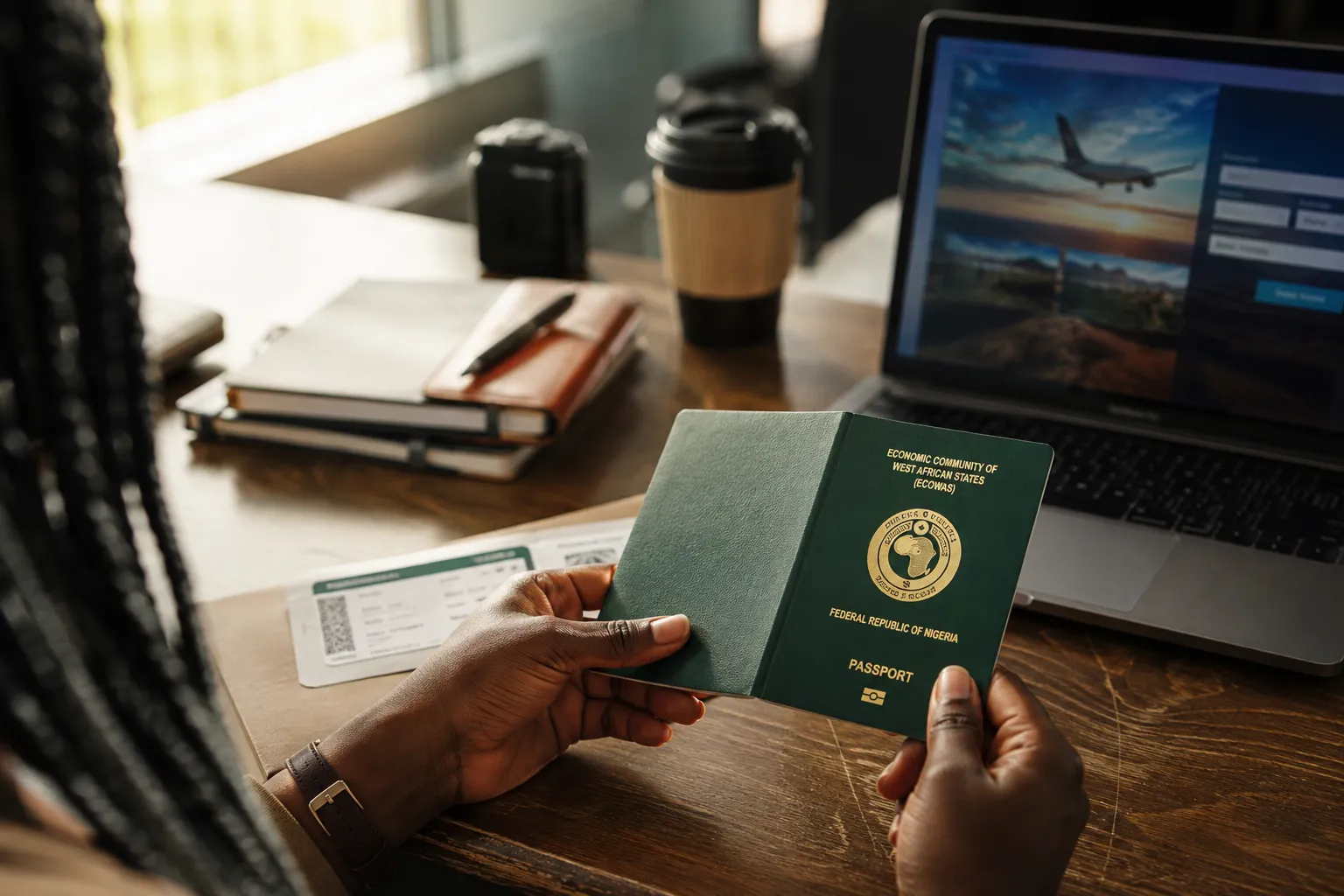
Yes. If you hold an ordinary Nigerian passport, you need a visa before travelling to Angola for tourism, business, family visits, study or work. Angola’s 2023 visa-free expansion covered 98 countries, but Nigeria was not included, and 2026 Nigeria-focused guidance still lists Angola as visa-required for Nigerians.[3][10][11]
The one exception is the February 2026 bilateral agreement between Nigeria and Angola. It waives the visa requirement for holders of diplomatic and official (service) passports only, to make government-to-government travel easier. Ordinary passport holders, which is almost everyone reading this, are not covered.[2][6]
For the general mechanics that apply to all nationalities, see the Angola visa guide. This article focuses on what is specific to Nigerian applicants.
Which Angola Visa Fits Your Trip?
Angola issues several visa categories through the SME. Pick the one that matches your actual reason for travel, because using a tourist visa for paid work or a formal business assignment can cause problems at the border.[4][7]
The most relevant categories for Nigerian travellers are:
- Tourist visa (visto de turismo): leisure trips, holidays, visiting friends, short cultural travel. Single entry, 30 days stay, extendable once.[15]
- Ordinary visa (visto ordinário): short private visits, including family or informal purposes not tied to business.
- Business visa (visto de negócios): meetings, negotiations, site visits, short-term commercial activity without a local employment contract. See our dedicated Angola business visa guide.
- Work visa, study visa, treatment visa, privileged visa: for longer or specific purposes, usually requiring sponsorship or an invitation from an Angolan entity.
Tourist vs. business visa in one line: A tourist visa is for leisure and family travel with proof of accommodation and return ticket. A business visa is for meetings and short assignments and needs an invitation letter from the Angolan company plus supporting corporate documents.
Where and How to Get an Angola Visa From Nigeria
There are two practical routes from Nigeria: the online eVisa/pre-visa portal, and in-person application at the Angolan Embassy in Abuja.[4][5][8]
Route 1: Online through the SME eVisa portal
Angola’s Migration and Foreigners Service runs the official portal at evisa.ao. You create an account, choose the correct visa category, fill in your personal details exactly as they appear on your passport, upload the required documents, and pay online. Once approved, you receive a pre-visa authorisation to present on arrival, or an eVisa attached to your passport data.[4][5][7][10]
Nigerian applicants generally find the eVisa route the most straightforward, because you avoid multiple embassy trips. For step-by-step screens and troubleshooting, see our Angola eVisa walkthrough.
Route 2: In person at the Angolan Embassy in Abuja
The Angolan Embassy in Abuja is the main consular mission for Nigeria and handles ordinary visa applications, document authentication, and questions the eVisa system cannot resolve.[8] A directory of Angolan missions worldwide lives on our embassies and consulates page.
You will typically:
- Book or walk in during consular hours (call ahead to confirm).
- Submit the completed application form and original supporting documents.
- Pay the visa fee in the currency the mission accepts on the day.
- Return to collect the passport after processing.
Is it faster to apply online or in person?
For most Nigerian tourists and business travellers, the online eVisa is faster and less painful than the embassy route, because you can submit from anywhere in Nigeria and track approval by email. The embassy route makes sense if your case is complex, if you need certified paperwork, or if the portal keeps rejecting your uploads.
Lagos vs. Abuja: does it matter where you apply?
The embassy is in Abuja, so in-person applicants from Lagos, Port Harcourt or Kano usually courier documents or travel to Abuja. Online applications work identically regardless of Nigerian city. If you are Lagos-based and prefer to avoid Abuja, the eVisa route is the obvious choice.

What Documents Do I Need for an Angola Visa Application in Nigeria?
Angola’s SME publishes a baseline document list, and Nigeria-specific guides add a few practical items that reduce the chance of rejection.[4][5][7][9][11]
Standard document checklist for Nigerian tourist applicants:
- Nigerian passport with at least 6 months validity and two blank pages.[15]
- Completed and signed visa application form.
- One recent passport-sized photograph on white background.
- Return or onward flight ticket (or reservation) showing entry and exit dates.
- Proof of accommodation in Angola: hotel booking confirmation or a host’s address with an invitation letter.
- Travel itinerary covering your dates in Angola.
- Yellow fever vaccination certificate (the International Certificate of Vaccination).
- Proof of funds: recent bank statements, typically the last 3 months.
- Visa fee payment receipt.
For business applicants, add an invitation letter from the Angolan company (with tax ID and address), a letter from your Nigerian employer, and, where relevant, your company’s registration documents.
1. Yellow fever certificate. Get vaccinated at an accredited Nigerian centre and keep the yellow booklet with your passport. See our Angola vaccinations and health guide for details.
2. Proof of accommodation for the entire stay, not just the first night. Free-cancellation hotel bookings covering all nights work well.
3. Bank statements that clearly show your name, stamped by the bank if requested. Screenshots from a mobile app are often not accepted.
How Much Is an Angola Visa From Nigeria?
Fees change and depend on visa type, entries, and whether you apply online or at the mission. As of 2026, publicly reported figures for Nigerian applicants hover in these ranges (verify the current amount with the SME portal or the embassy before paying):
| Visa type | Indicative fee (USD) | Where applied |
|---|---|---|
| Tourist / ordinary visa | around USD 70 | Embassy or eVisa |
| Business visa | varies, generally higher than tourist | Embassy or eVisa |
| Visa on arrival (where permitted) | around USD 120 | On arrival, with prior authorisation |
| Diplomatic / official passport | No fee (visa waiver) | N/A since Feb 2026 |
Budget for extra costs: yellow fever vaccination, passport photos, courier fees, and any bank charges on the USD payment. If you want a wider trip budget picture, our Angola trip cost guide breaks down accommodation and daily spend once you land.
How Long Does It Take to Get an Angola Visa From Nigeria?
Processing typically takes 3 to 14 working days for tourist and business visas, depending on the route and how complete your file is. The eVisa is often faster, but complicated cases (missing documents, unclear purpose of travel, name mismatches) can stretch to two weeks or more.
Plan to apply at least three weeks before departure. Remember two separate clocks:
- Processing time: the days between submission and approval.
- Validity for entry: most tourist visas must be used within 60 days of issue, so applying too early can also cause problems.[15]
If you are booking flights, wait until you have at least the pre-visa authorisation before paying for non-refundable tickets.
Can I Get an Angola Visa on Arrival, or Do I Need to Apply Beforehand?
For Nigerian passport holders, the safe answer in 2026 is: apply beforehand. Angola has a pre-visa / eVisa system where an online pre-approval is issued and the physical visa is granted at the border, but this still requires an online application before boarding.[4][5][7][10] Turning up in Luanda without any prior authorisation is not a reliable plan and airlines may deny boarding in Lagos.
Flying From Lagos or Abuja to Luanda
There are regional air links between Nigeria and Angola. TAAG Angola Airlines operates services connecting Lagos with Luanda, and other African carriers offer connecting options via hubs such as Addis Ababa, Nairobi or Johannesburg. Schedules change often, so book through an airline or trusted agent and confirm close to travel. For an overview of routing options, see our flights to Angola hub.
Important 2026 update: since March 2026, all commercial passenger flights in Luanda operate from the new Dr. Antonio Agostinho Neto International Airport (IATA code NBJ), which replaced Quatro de Fevereiro. Make sure your booking, transfer and pickup all reference the new airport. Our Angola airport guide has the current details.

Arriving in Luanda as a Nigerian Traveller
Immigration officers at NBJ will typically ask to see:
- Your passport with the eVisa or the pre-visa authorisation.
- Your yellow fever certificate.
- Return or onward ticket.
- Proof of accommodation.
- Sometimes proof of funds in cash or on card.
Answer questions clearly and consistently with what you wrote on the application. Small contradictions (different hotel, different host, different length of stay) are the most common reason for secondary questioning. Once you clear immigration, most travellers head into the city. Our Luanda city guide covers neighbourhoods, safety and getting around.
How Long Can I Stay in Angola With a Tourist Visa?
A standard Angolan tourist visa gives you 30 days of stay from the date of entry and is generally single-entry. It must be used within 60 days of issue. You can usually apply for one extension of another 30 days once you are in the country.[15]
If you are planning something longer than a couple of weeks, build in buffer days. Miscounting the 30-day allowance is a common source of overstay problems.
Extending or Overstaying Your Angola Visa
You can extend a tourist visa once, for up to another 30 days, at an SME office inside Angola. Apply before your current visa expires and bring your passport, current visa, proof of accommodation and funds, and any updated travel plans.[15]
Overstaying is a bad idea. Angola enforces fines and, in serious cases, deportation and future entry bans. If your return flight is cancelled or delayed past your visa expiry, go to an SME office immediately with the airline documentation and apply for an extension rather than waiting.
Common Reasons Angola Visa Applications Get Rejected
From the pattern of Nigerian applications, the most frequent rejection triggers are:
- Incomplete documents, especially missing accommodation proof or return tickets.
- Passport validity below 6 months or fewer than two blank pages.
- Name mismatches between the application, passport and supporting documents.
- Weak or inconsistent proof of funds.
- Missing yellow fever certificate.
- Using a tourist visa when the trip is clearly for work or paid activity.
- Poor-quality passport photograph (wrong background, sunglasses, low resolution).
Fix these before you submit, not after a rejection.
Do I Need Travel Insurance for an Angola Visa Application?
Travel insurance is not always a strict requirement listed on the SME portal for tourist visas, but it is strongly recommended and is sometimes requested at the border or when applying through third-party agents. A policy covering medical evacuation is particularly important given the cost of private healthcare and evacuation from Angola. Buy a policy that covers the full length of your intended stay plus a buffer.
Practical Tips From the Nigerian Side
A few things that make a real difference when applying from Nigeria:
- Bank statements: use official stamped statements from your bank, not app screenshots. Three months is a common ask; six months looks stronger for business applicants.
- Invitation letters: if you are visiting family, ask your host in Angola to include a copy of their ID or residency card and their full address and phone number.
- Proof of funds: if your salary is paid in naira, exchange rate volatility can make balances look small in USD. Show a healthy running balance rather than a single large deposit right before applying.
- Payments in USD: confirm with your Nigerian bank that your card can be charged in USD for the eVisa fee. Have a backup card.
- Yellow fever: get vaccinated at an accredited Nigerian centre well in advance (the certificate is valid for life, so this only needs doing once).
- Print everything: even if you have an eVisa, carry printed copies of the approval, hotel bookings and return ticket. Border checks are easier with paper.
Conclusion and Next Steps
For an ordinary Nigerian passport, the practical path in 2026 is: pick the correct visa category, apply on the official Angola eVisa portal (or in person at the Abuja embassy if your case needs it), get your yellow fever certificate sorted early, and give yourself at least three weeks before departure. Fees hover around USD 70 for tourist and USD 120 for the on-arrival route, but confirm current figures before paying.
Next steps:
- Check your passport validity and blank pages today.
- Book your yellow fever vaccination if you have not had one.
- Start the application on the Angola eVisa portal or read the general Angola visa guide.
- Firm up your itinerary and accommodation.
- Confirm your flight into the new Luanda airport and read up on your first stop with our Luanda guide.
Always cross-check current rules and fees with your government’s travel advisory (for example the US State Department or UK FCDO country pages if you rely on those in English) and with Angola’s official SME portal before you fly. Rules change, and the version you find on the day is the one that counts.
Free help from our team in Angola
A visa question as a Nigerian citizen?
Tell us your nationality, why you travel and when. We answer from the official rules on evisa.ao and tell you what applies to you. The Angolan embassy or the migration service (SME) always has the final say.
- Local team in Angola
- No obligation, nothing to pay
- Reply by email or WhatsApp
Want to keep this guide? We email you the key points with a link to every section.
Frequently asked questions
How much is an Angola visa from Nigeria in 2026?
Indicative published figures put the tourist visa at around USD 70 and the visa on arrival at around USD 120, but fees change. Always confirm the current amount on the official SME portal or with the Angolan Embassy in Abuja before paying.
How long is an Angola tourist visa valid for Nigerians?
The tourist visa must be used within 60 days of issue and gives you 30 days of stay from your date of entry. It can generally be extended once by another 30 days from inside Angola.
Where is the Angolan Embassy in Nigeria?
The Angolan Embassy is in Abuja and is the main consular mission for Nigeria, handling in-person visa applications and consular services.
Can I apply for the Angola eVisa from Lagos?
Yes. The eVisa portal is online and works from anywhere in Nigeria, including Lagos, Port Harcourt and Kano. You do not need to travel to Abuja to apply online.
Do Nigerians need a yellow fever certificate for Angola?
Yes. A yellow fever vaccination certificate is required for entry into Angola. Get vaccinated at an accredited Nigerian centre and carry the international certificate with your passport.
Is there visa on arrival in Angola for Nigerians?
Angola operates a pre-visa system where authorisation is obtained online in advance and the visa is issued at the border. It is not a walk-up visa on arrival, and you should not board a flight to Luanda without prior approval.
Can I extend my Angola visa once I am in the country?
Yes, tourist visas can usually be extended once by up to 30 days at an SME office inside Angola. Apply before your current visa expires and bring proof of accommodation, funds and updated travel plans.
What is the difference between the Nigeria and Angola visa waiver and a normal visa?
The February 2026 bilateral waiver applies only to diplomatic and official passports. If you hold an ordinary green Nigerian passport, you still need a visa or eVisa to enter Angola for tourism, business or family travel.