
Angola went from one of Africa’s toughest visas to one of its easiest. Since Presidential Decree 189/23 of September 2023, citizens of 98 countries do not need a visa at all for a holiday of up to 30 days [4]. So the first question about the e visa Angola is not how to apply, but whether you need one. This guide explains who does, and how the official portal works.
Quick Answer
The Angola e-visa is the online visa application of the Serviço de Migração e Estrangeiros (SME), at evisa.ao; the old address smevisa.gov.ao now redirects there [1]. You need it if your nationality is not on the tourist visa waiver list, or if you travel for business or other purposes. Tourists from the 98 waiver countries, including the US, UK, Canada, India, China, Australia and many EU countries, enter visa-free for up to 30 days per entry and 90 days per year [1][2][3]. The portal advertises processing within 72 hours and sends the visa by email [1].
Key Takeaways
- Check the waiver list first. 98 nationalities need no visa for tourism up to 30 days [1][4].
- Official portal: evisa.ao. Everything else is an agent or a look-alike [1].
- Account required: create an account before you can apply [1].
- Documents: passport valid 6 months, yellow fever certificate, flight and accommodation booking, proof of funds [1].
- Processing: 72 hours according to the SME; apply two to three weeks ahead [1].
- Tourism is not work: business, work and study need the right visa in advance [2].
For the full entry rules per situation, see our Angola visa requirements guide.
Who Needs an Angola e-Visa?
You need a visa arranged before travel when:
- your passport is not on the waiver list published on evisa.ao [1];
- you want to stay longer than 30 days per entry or 90 days per year;
- you travel for business, meetings or conferences;
- you plan to work, study or live in Angola [2].
You do not need an e-visa for a holiday of up to 30 days if your country is on the list. The SME portal names, among others, South Africa, Botswana, Mauritius, Namibia, Mozambique, Portugal, France, Germany, the United Kingdom, Italy, Brazil, the United States, Canada, Argentina, China, Japan, India and Australia [1]. The Dutch and British governments confirm visa-free tourist stays for their citizens [2][3].
We cover some passports in detail:
- Angola visa for US citizens
- Angola visa for UK citizens
- Angola visa for Indian citizens
- Angola visa for Nigerian citizens
Not sure? Try our visa checker and then confirm on evisa.ao.
e-Visa or Visa on Arrival?
Do not plan on a walk-up visa at the airport. Travellers on the waiver simply show their passport on arrival. Everyone else should have an approved visa before boarding, because airlines check documents at check-in and can refuse passengers without them [2].
What Documents Do I Need for an Angola e-Visa?
The official portal asks you to prepare clear, readable scans of [1]:
- Valid passport: the photo page, with at least 6 months of validity and blank pages.
- International yellow fever vaccination certificate.
- Proof of travel: a return flight booking and an accommodation booking in Angola.
- Proof of means: evidence that you can pay for your stay.
Business applications usually add an invitation letter from the Angolan host. Our Angola vaccinations and health guide explains the yellow fever vaccination, which should be given at least 10 days before arrival.
How to Apply on evisa.ao, Step by Step
The SME summarises the process in three steps: fill in, pay, receive [1]. In practice:
- Open evisa.ao and check the waiver list. If you are exempt for your trip, stop here.
- Register an account and activate it from the email you receive.
- Start the visa application and choose the right type for your trip.
- Fill in the form exactly as your passport reads.
- Upload your documents.
- Pay the processing fee with one of the payment methods on the portal. Save the receipt.
- Track the status in your account.
- Receive the visa by email if approved. Print it and carry a digital copy too.
How Much Does the Angola e-Visa Cost?
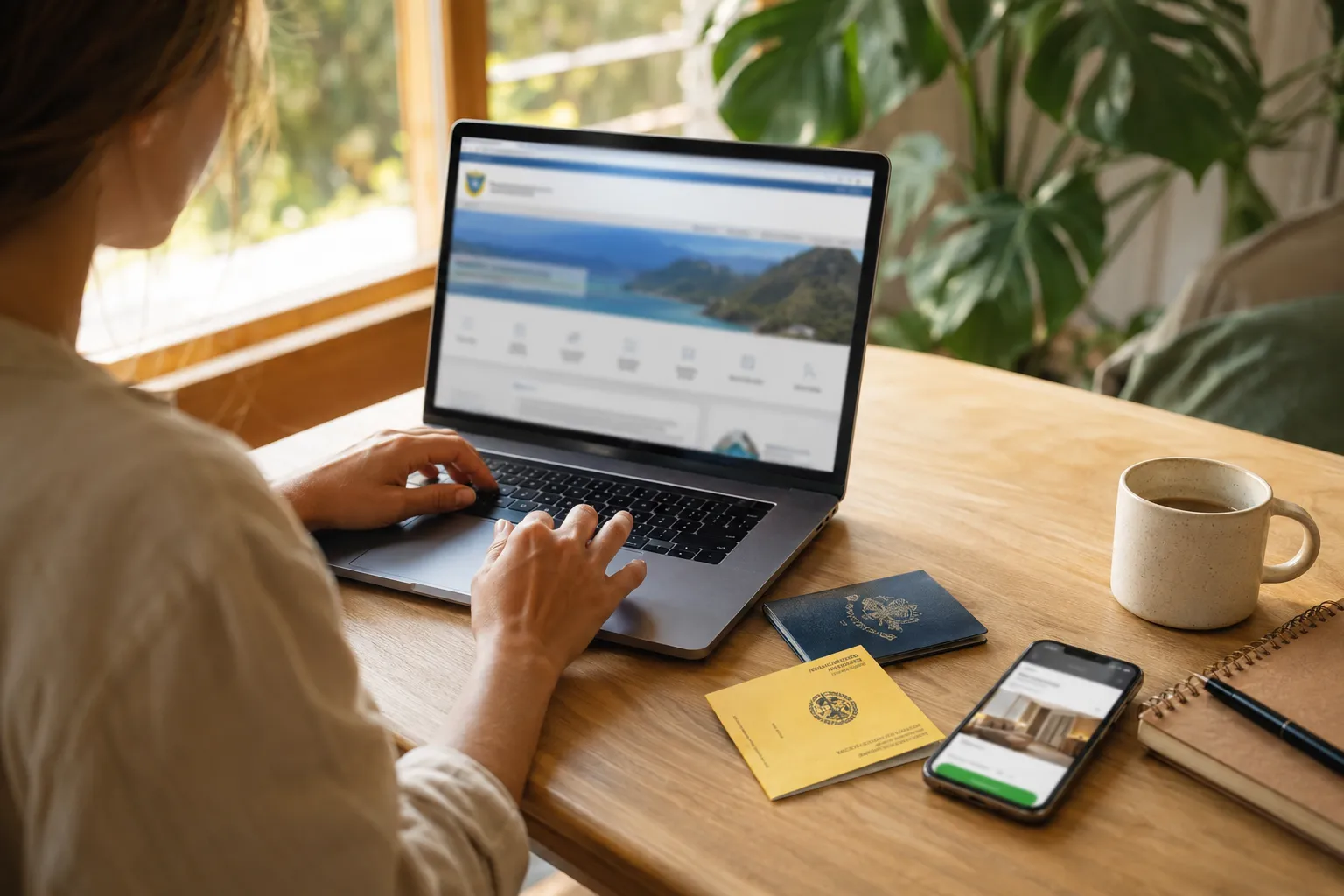
The fee is displayed on evisa.ao during the application and paid online. We do not print an amount: fees change, and older figures on agent websites are a common source of confusion. Visa-exempt tourists pay no visa fee. Private agents charge their own service fee on top of the government fee for the same form.
How Long Does the Angola e-Visa Take?
The SME portal advertises processing within 72 hours [1]. Missing or unclear documents slow that down, so apply two to three weeks before your trip and wait for approval before booking anything non-refundable. If your application stalls, check the status in your account and use the contact page on the portal.
Arriving in Angola

Most international flights land at Dr. António Agostinho Neto International Airport (NBJ) near Luanda. Have ready:
- your passport (6 months valid, blank pages);
- your printed visa, if you needed one;
- your yellow fever certificate;
- your return ticket and accommodation details.
Expect fingerprints and a photo at immigration. Our Angola airport guide covers the arrival and the transfer into town.
How Long Can I Stay, and Can I Extend?
Under the tourist waiver you can stay 30 days per entry and 90 days per calendar year [1]. With a visa, the permitted stay is the one stated on your visa. Do not overstay: the UK government warns of a daily fine of 15,000 kwanzas and possible trouble leaving or re-entering Angola [2]. If your plans change, contact the SME before your permitted stay ends.
What Can I Do on a Tourist Entry?
Holidays, sightseeing, beaches, wildlife and visiting friends. You cannot work, run a business or study on a tourist entry [2]. For meetings and conferences, read our Angola business visa guide. For ideas on what to see, start with our 7-day Angola itinerary.
Common Reasons Applications Get Delayed or Rejected
- Passport validity under 6 months.
- Unreadable scans or cut-off pages.
- Names or dates that differ from the passport.
- No yellow fever certificate.
- Bookings that do not match your travel dates.
- Applying too late for your travel date.
- Wrong visa type for the purpose of your trip.
If an application is refused, read the reason, fix it and apply again through your account.
Using an Agent Versus Applying Yourself
You do not need an agent. Many sites at the top of Google for “angola visa” are private companies that charge a markup, and some copy the look of a government site. The only official portal is evisa.ao [1]. Check the address bar before you enter card details.
Do I Need an Angola Visa if I Have a Schengen or US Visa?
Yes, if your nationality is not visa-exempt. Visas for other countries give no rights in Angola. What counts is your passport: check whether it is on Angola’s waiver list, and apply on evisa.ao if it is not.
Final Thoughts and Next Steps
For most holidaymakers, Angola is now visa-free for up to 30 days. The e-visa is for everyone else, and on evisa.ao it is a straightforward online process.
- Check your nationality on the waiver list at evisa.ao.
- Book your yellow fever vaccination at least 10 days before arrival.
- Not exempt? Gather your documents and apply two to three weeks before travel.
- Read your government’s travel advice for the latest safety guidance.
For the wider planning picture, our reasons to visit Angola and best time to visit Angola guides are good next reads.
Free help from our team in Angola
A question about the e-visa?
Tell us your nationality, why you travel and when. We answer from the official rules on evisa.ao and tell you what applies to you. The Angolan embassy or the migration service (SME) always has the final say.
- Local team in Angola
- No obligation, nothing to pay
- Reply by email or WhatsApp
Want to keep this guide? We email you the key points with a link to every section.
Frequently asked questions
Do I need an e-visa for Angola?
Only if your trip is not covered by the tourist visa waiver. Citizens of 98 countries, including the US, UK, Canada, Brazil, India, China, Australia and many EU countries, can visit Angola for tourism for up to 30 days per entry without any visa. Other nationalities, longer stays and business trips need a visa arranged in advance.
What is the official Angola e-visa website?
evisa.ao, run by Angola's Serviço de Migração e Estrangeiros (SME). The old address smevisa.gov.ao now redirects there. Any other site is a private agent or a look-alike.
How long does the Angola e-visa take?
The SME portal advertises processing within 72 hours. Apply two to three weeks before departure anyway, and do not book non-refundable travel before approval.
How much does the Angola e-visa cost?
The processing fee is shown on evisa.ao when you apply and paid online. We do not quote a figure because it changes. Tourists who fall under the visa waiver pay no visa fee.
Can I apply from any country?
Yes. The portal works online from anywhere. You create a personal account, fill in the form, upload documents and pay, and the visa is sent to you by email.
Can I work in Angola on a tourist e-visa or visa-free entry?
No. Tourist entry, with or without a visa, excludes work. Business trips need the right visa before you travel, and working or studying needs a long-stay visa.
Do children need their own visa?
If the family is not visa-exempt, yes: every traveller applies separately with their own passport. Children also need a yellow fever certificate.
What happens if I fly to Angola without the right documents?
The airline can refuse to board you at check-in. If you are not visa-exempt and have no approved visa, apply on evisa.ao before you travel.