Quick answer
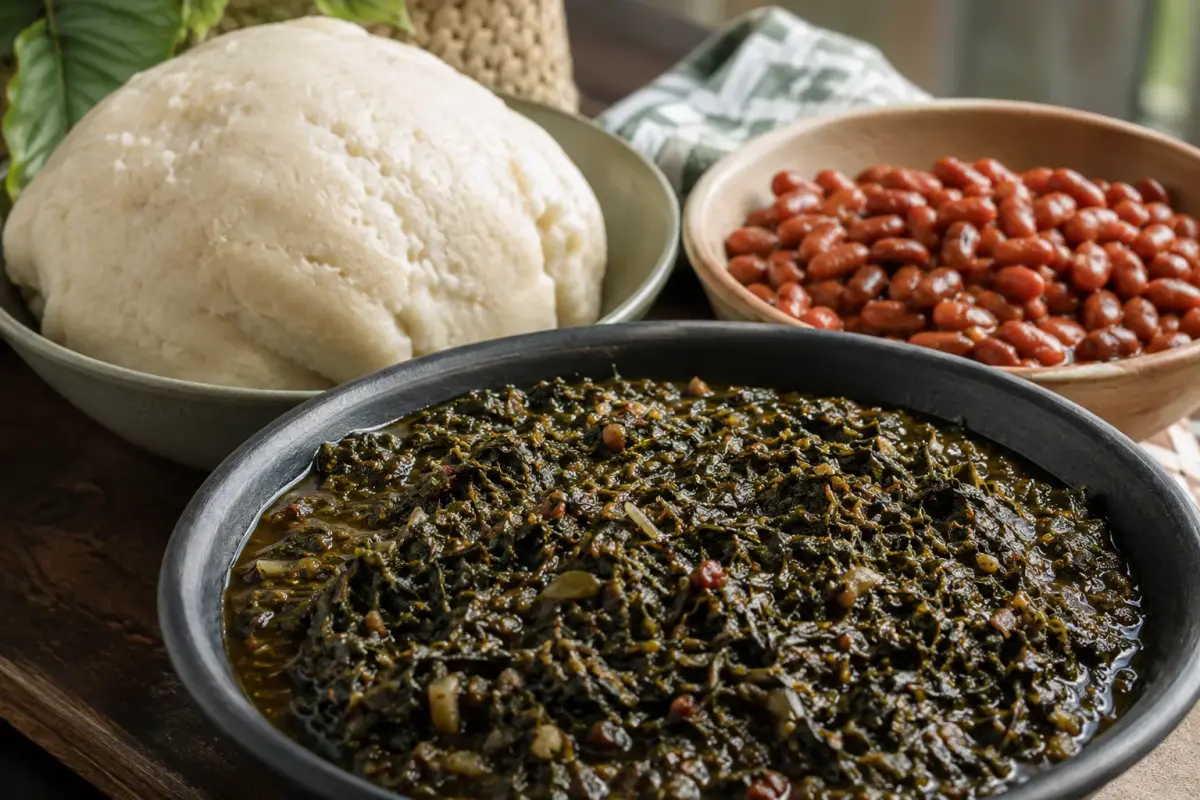
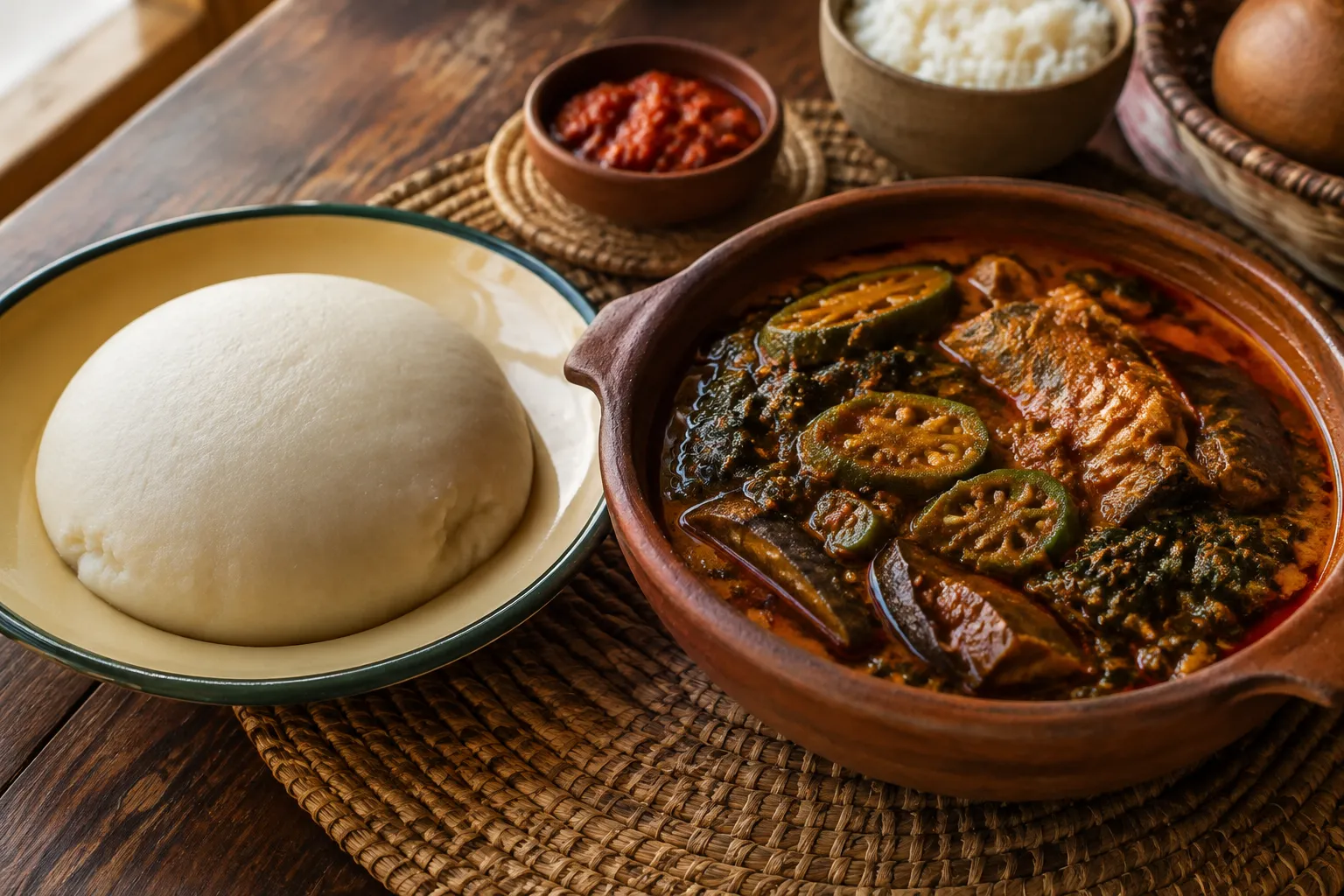
Funge and calulu are Angola’s defining food pairing: funge is a smooth, thick starch dough stirred from cassava or maize flour and water, and calulu is a rich stew of dried and fresh fish (or meat) simmered with palm oil, okra, aubergine and dark leafy greens. Funge is never eaten alone. You tear off a piece with your right hand, roll it, and use it to scoop up the stew. Order them together and you have eaten the way most Angolan families eat at home.
Key takeaways
- Funge is the starch, calulu is the sauce. They are two halves of one plate, not competing dishes.
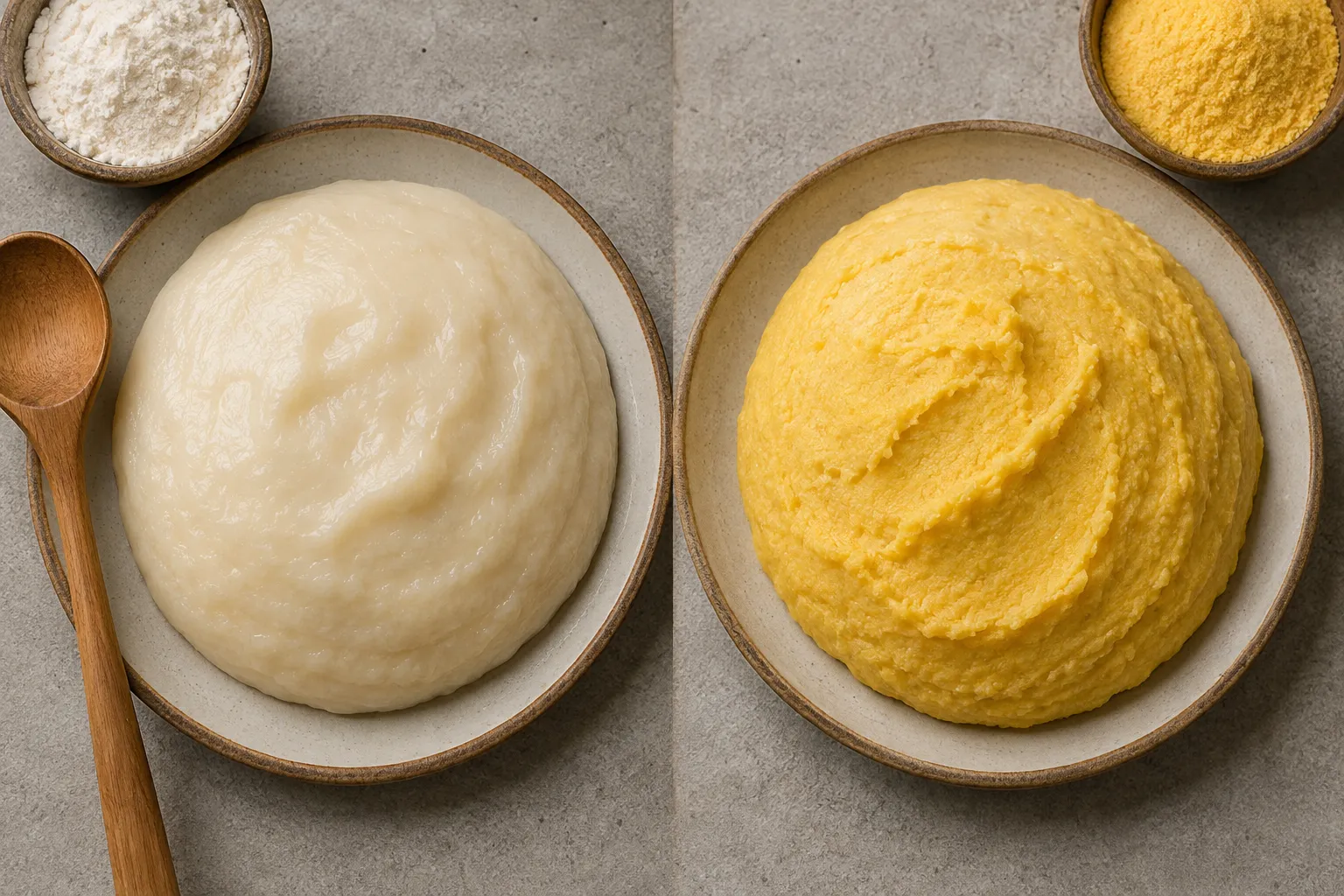
- Funge de bombo is made from cassava flour: pale, slightly tangy, faintly elastic. Pirao (also called funge de milho) is made from maize flour: yellower, softer, cornier in flavour.
- Dried fish is the soul of calulu. It gives the stew its salty, deep, almost smoky backbone, and it is the flavour that startles first-time eaters most.
- Palm oil (dende) gives calulu its red-orange colour and a distinctive fruity, slightly savoury weight.
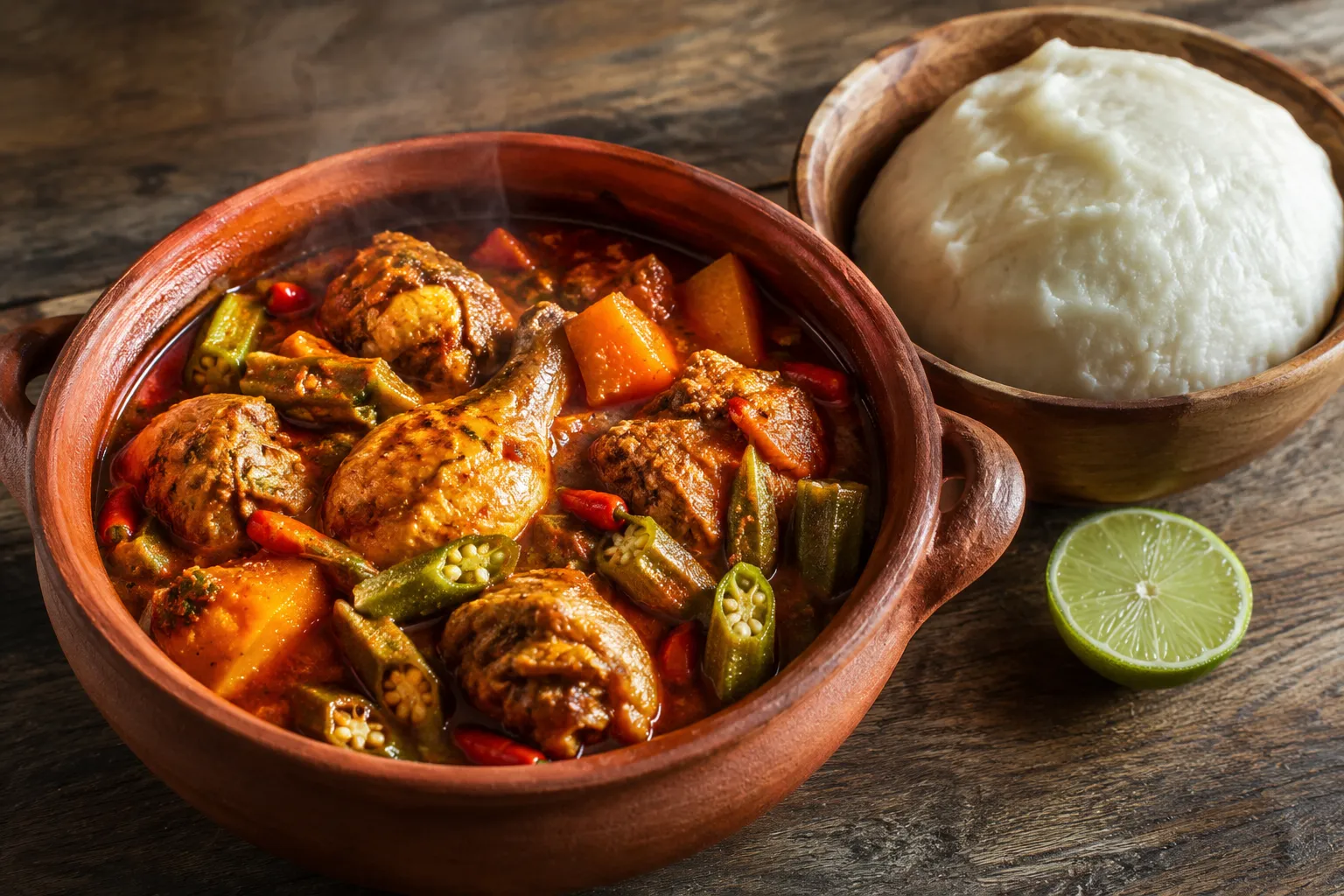
- Muamba de galinha is most often named Angola’s national dish, but calulu is just as emblematic. Both claims are honest.
- Many restaurants cook calulu only on certain days because it takes hours. Always ask before you plan a meal around it.
- Vegetarians should expect difficulty. The dried fish is structural, not a garnish.
- Learn three Portuguese words and ordering becomes easy: funge, calulu, sem carne.
What is funge and calulu, exactly?
Funge is a cooked dough of flour and water, stirred hard over heat until it becomes thick, glossy and smooth enough to hold its shape on a plate. Calulu is a stew, usually fish-based, that supplies all the salt, fat, acidity and vegetable depth. Neither dish makes sense without the other.
Think of funge as the plate, the spoon and the bread all at once. It is deliberately mild. That mildness is the point: it carries strong sauces without competing with them. When Angolans say they are having calulu for lunch, funge is assumed.
Funge de bombo vs pirao (funge de milho)
This is the single most useful distinction to learn before you order.
- Funge de bombo: made from cassava flour (bombo). Pale grey-white, denser, stretchier, with a mild sour tang from the fermented cassava. This is the classic partner for calulu, especially around Luanda and the north.
- Pirao / funge de milho: made from maize flour. Yellower, softer, sweeter and closer to a firm cornmeal porridge. More common in central and southern regions, and often preferred with meat stews.
If a menu just says funge, ask which one. A friendly “É de bombo ou de milho?” will usually get a straight answer and a small nod of approval.
What is the difference between funge and calulu?
Funge is a starch; calulu is a stew. Confusing them is the most common mistake visitors make when reading a menu.
| Funge | Calulu | |
|---|---|---|
| What it is | Thick starch dough | Vegetable and fish stew |
| Main ingredient | Cassava or maize flour | Dried fish plus fresh fish (or meat) |
| Flavour | Very mild, slightly tangy | Salty, savoury, deep, faintly bitter greens |
| Colour | Pale white or yellow | Red-orange from palm oil |
| Eaten alone? | No | Rarely, sometimes with rice |
| Cook time | Around 15 to 30 minutes | Often 1.5 to 3 hours |
Some restaurants serve calulu with rice instead of funge. That is normal and perfectly acceptable, but you will be missing the texture contrast that makes the traditional pairing work.
What do funge and calulu taste like?
Calulu tastes savoury and layered, with a salty depth from dried fish, a soft fruity richness from palm oil, a slight sliminess from okra, and a green, mineral edge from the leaves. Funge tastes of almost nothing, on purpose.
The dried fish is what surprises people. It is not subtle. If you have eaten Nigerian stockfish, Brazilian bacalhau or Southeast Asian dried shrimp, you already know the register: concentrated, pungent, and far more interesting than fresh fish alone. Angolan cooks usually combine dried fish with fresh fish so you get both the depth and the clean flakiness.
A common first reaction is that the kitchen has over-salted the pot. It has not. The dried fish is not a mistake in the seasoning, it is the whole architecture of the dish, and most people come round to it within a few mouthfuls.
Palm oil is the other surprise. Unrefined red palm oil has a thick, almost waxy mouthfeel and a flavour somewhere between carrot and butter. It is why calulu looks the way it does.
Funge and calulu ingredients
A typical household calulu uses a short, consistent set of ingredients, with plenty of family variation on top.
For calulu (fish version):
- Dried fish, soaked to soften and reduce salt
- Fresh fish, often a firm white sea fish
- Red palm oil (dende)
- Onion, garlic, tomato
- Okra
- Aubergine
- Dark leafy greens: sweet potato leaves or cassava leaves (kizaca)
- Sometimes green beans, pumpkin leaves, or a little chilli
- Salt, bay leaf, occasionally a splash of vinegar or lemon
For calulu de carne: the same base, with beef or dried and smoked meat replacing the fish. It is heavier and less pungent, and it is often the easier introduction for a nervous first-timer.
For funge: cassava flour or maize flour, water, a pinch of salt. That is genuinely it.
How do you make funge?
Funge is made by whisking flour into cold water, then pouring it into boiling water and stirring hard with a wooden spoon until it thickens into a smooth, lump-free dough. Total cooking time is usually 15 to 30 minutes, most of it stirring.
The standard home approach:
- Mix your flour with cold water to a thin, smooth slurry. Skipping this step is how lumps happen.
- Bring a pot of water to a rolling boil.
- Pour the slurry in while stirring continuously.
- Keep stirring over medium heat. The mixture will pull away from the sides and start to resist the spoon.
- Beat it against the side of the pot to smooth it out, then shape it with a wet spoon or a small bowl.
How long does it take? Around 15 minutes for maize funge, closer to 25 or 30 for cassava funge, which needs longer to lose its raw taste. Calulu takes far longer, which is exactly why restaurants batch it.
Can you make funge without cassava flour?
Yes. Maize flour makes pirao, which is a legitimate and widely eaten version, not a substitute. Outside Angola, cooks also use a cassava and maize blend, and fine white maize meal works well if cassava flour is unavailable. What does not work is wheat flour or cornstarch, which produce a gluey texture and none of the right flavour.
Common mistakes when cooking funge
- Adding dry flour straight to boiling water. Instant lumps. Always make a slurry first.
- Stopping stirring. Funge scorches on the bottom fast.
- Undercooking cassava funge. It tastes raw and chalky. Give it time.
- Too much water. You want a dough that holds a shape, not a porridge.
- Serving it cold. Funge stiffens as it cools and turns rubbery. Serve straight from the pot.
Is funge the same as polenta, ugali or fufu?
Funge is not polenta, though maize funge is a cousin. Polenta is cooked coarse maize, often enriched with butter or cheese and eaten with a fork. Funge is finer, plainer, firmer, and eaten with the hands as a scoop.
Across Africa the same idea appears everywhere under different names:
- Ugali (Kenya, Tanzania): maize, firmer and drier than funge, very close to pirao in spirit.
- Pap and sadza (South Africa, Zimbabwe): maize, softer, often eaten with a spoon.
- Fufu (West Africa): pounded cassava, yam or plantain, stretchier and heavier.
- Ubugali and nsima (Great Lakes, Malawi): maize or cassava, same function.
The decision rule for travellers: if you have happily eaten ugali or fufu, cassava funge will feel familiar. If you have only eaten polenta, expect something plainer and considerably firmer than you are picturing.
How do Angolans eat funge and calulu?
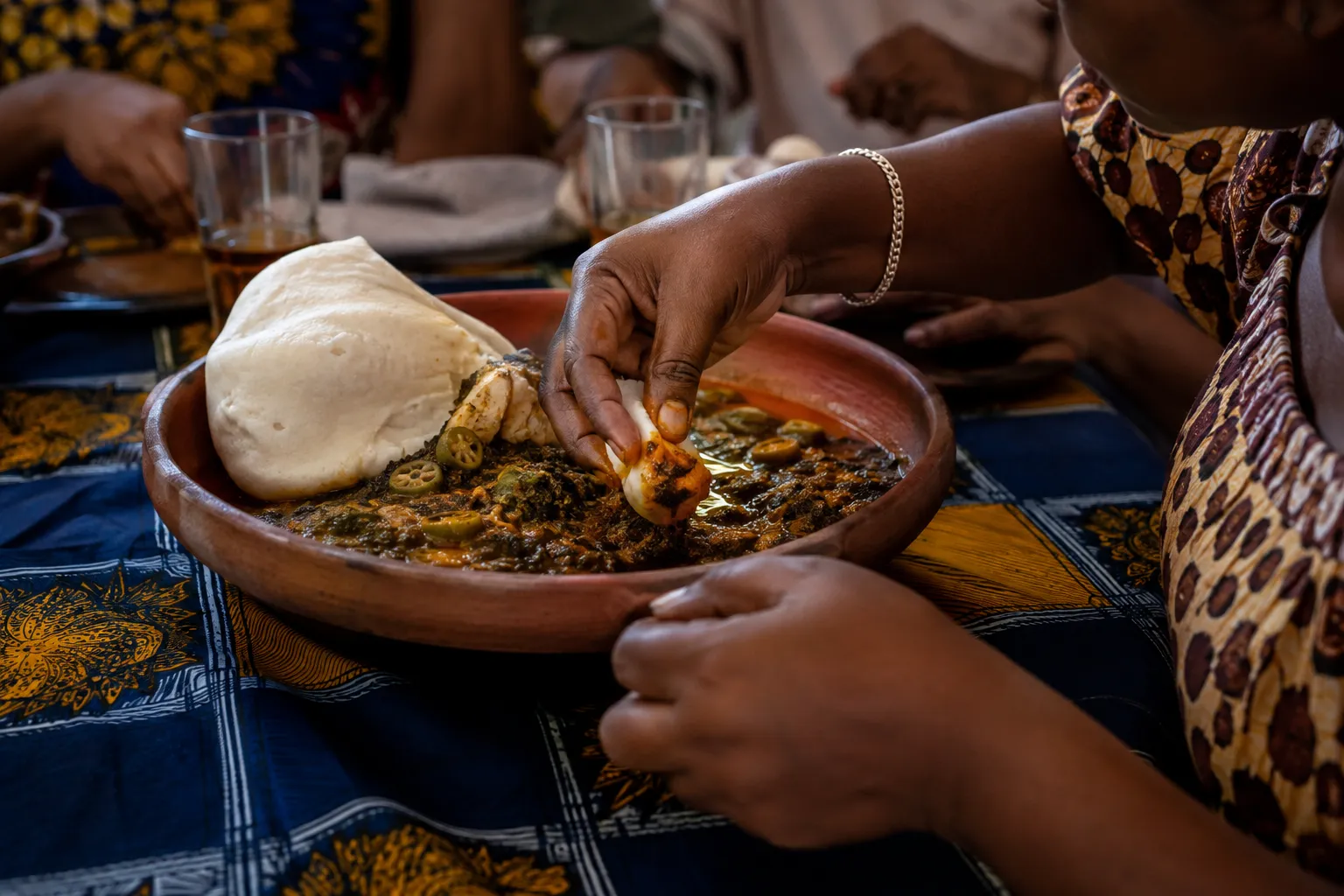
You eat funge with your right hand. Tear off a piece roughly the size of a walnut, roll it briefly between your fingers to compact it, press a small dent into it with your thumb, then use it to scoop stew from the shared or individual bowl.
A few practical points that will save you embarrassment:
- Right hand only. The left hand stays off the food. This matters in mixed and formal company.
- Do not double-dip a piece you have already bitten if you are sharing a communal bowl.
- Wash first. A bowl of water or a jug may be brought around before the meal. Use it.
- Cutlery is fine too. In restaurants in Luanda plenty of people eat funge with a fork and knife, and nobody will object if you do the same.
- Take fish bones seriously. Calulu is usually served bone-in. Go slowly.
For the wider set of table and greeting customs that surround a meal, our Angola culture and etiquette guide covers what happens before and after the food arrives.
What else appears on the table?
Funge and calulu rarely arrive alone. Expect one or more of the following alongside them.
- Kizaca: stewed cassava leaves, sometimes a side and sometimes folded into the calulu itself.
- Feijao de oleo de palma: beans cooked in palm oil.
- Gindungo: a fierce chilli condiment. Add a little, taste, then decide.
- Rice: frequently offered alongside funge, especially in restaurants.
- Fried plantain or sweet potato.
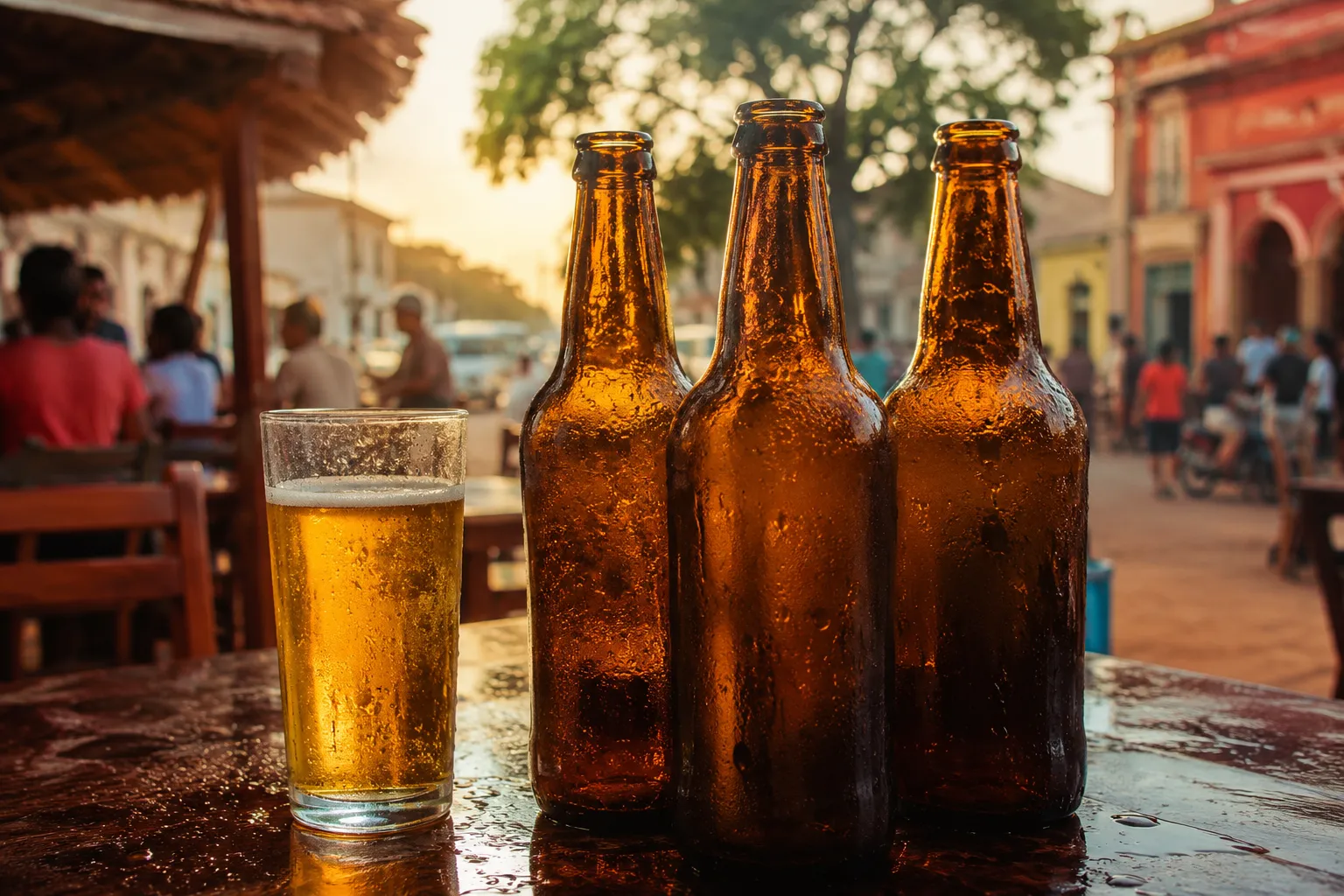
- Drinks: local beer, palm wine in some regions, or fresh fruit juice.
At a Sunday family lunch you may well see calulu and muamba de galinha on the same table, along with grilled fish if you are near the coast.
Why are funge and calulu important to Angolan culture?
These two dishes matter because they connect three histories on one plate: Bantu farming and cooking traditions, the Atlantic trade in dried and salted fish, and Portuguese colonial ingredients such as tomato and onion.
Calulu is the dish that appears at funerals, baptisms, weddings and Sunday lunches. It is slow food, cooked for a crowd, and its presence signals that the occasion matters. Cassava, meanwhile, is one of the most important crops in the country, which makes funge a genuine daily staple rather than a heritage curiosity.
On the “national dish” question, be honest with yourself and with anyone you talk to: muamba de galinha is the dish most commonly named as Angola’s national dish, but calulu is equally emblematic, and many Angolans will argue for it. There is no official ruling. Regional identity plays a big role, and you can read more about the country’s regional and ethnic diversity in our guide to the people of Angola.
Where can you eat authentic funge and calulu?
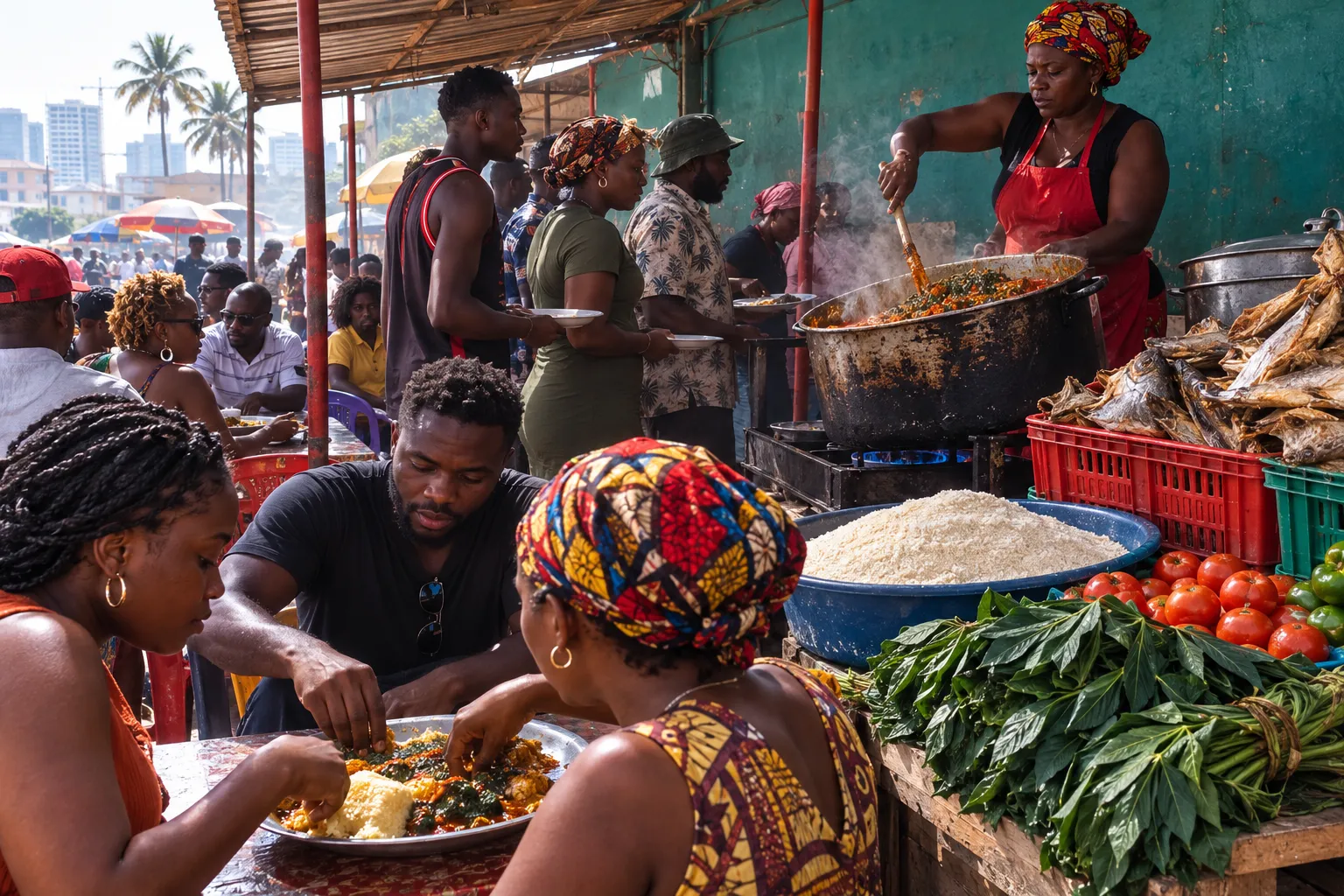
The most reliable calulu is home cooking, followed by small neighbourhood restaurants that advertise comida tradicional or comida angolana. Hotel restaurants often serve a milder, tidier version with less dried fish.
Practical strategy:
- Ask which day calulu is cooked. Because it takes hours, many places make it on set days rather than daily. This varies by venue and by region, so ask locally rather than trusting a fixed schedule.
- Go at lunch. Traditional stews are typically a midday meal, and by evening the pot may be gone.
- Look for markets and family-run places near the coast for the fish version.
- Say yes to invitations. A home-cooked calulu is a different dish from a restaurant one.
Our roundup of the best restaurants in Luanda is a good starting point if you want traditional cooking in the capital.
How to ask for it in Portuguese
Portuguese is the working language of ordering. A few phrases go a long way, and there is more context in our overview of language in Angola.
- Tem calulu hoje? Do you have calulu today?
- Que dias tem calulu? Which days do you have calulu?
- Com funge de bombo, por favor. With cassava funge, please.
- É muito picante? Is it very spicy?
- Sem peixe seco, é possível? Without dried fish, is that possible? (Expect a polite no.)
- Sou vegetariano / vegetariana. I am vegetarian.
Nutrition, in general terms
Broadly, funge is a high-carbohydrate, low-fat, low-protein food, and calulu supplies the protein, fat, minerals and vitamins. As a meal the combination is reasonably balanced, though heavy on starch and on palm oil.
What that means in practice:
- Funge is mostly starch. Cassava funge contains very little protein, so it depends on the stew.
- Calulu brings protein and calcium from fish, dried fish especially, iron and vitamin A from dark leafy greens, and fibre from okra and aubergine.
- Palm oil is calorie-dense and high in saturated fat, which is worth knowing if you are watching that.
- Sodium can be high because dried fish is salt-cured. Soaking reduces it, but the dish is naturally salty.
- Gluten-free by nature, which suits coeliac travellers, though cross-contamination in busy kitchens is always possible.
These are general nutritional characteristics rather than measured values, since portions and recipes vary enormously between households.
What should vegetarians expect?
Expect a challenge. Calulu is built on dried fish, and removing it does not leave a lighter version of the same dish, it leaves a different dish. Do not assume a kitchen can adapt it.
Your realistic options:
- Funge with kizaca (cassava leaves) or beans in palm oil, which can be genuinely good and is often available.
- Funge with a vegetable and okra stew if the kitchen is willing and not busy.
- Ask specifically about fish stock and dried fish, because “vegetable stew” often still contains both.
- Self-cater occasionally in cities where you can buy produce at markets.
Vegans should also watch for butter and egg in side dishes, and be clear that sem carne (without meat) does not imply without fish in everyday usage.
Conclusion
Funge and calulu are not difficult food. They are just unfamiliar food, and the unfamiliar parts, the dried fish, the palm oil, the eating with your hands, are precisely the parts worth leaning into rather than avoiding.
Your next steps:
- On your first day, ask a local which day calulu is cooked at a nearby traditional restaurant, then plan a lunch around it.
- Choose your funge on purpose. Try cassava funge with fish calulu first, then compare it with maize pirao.
- Eat one plate with your right hand. Ask for the water bowl, roll a small piece, and commit.
- Order calulu de carne as your fallback if the dried fish is too much on day one.
- Widen the net with our guide to Angolan food so you know what else to look for on the menu.
Eat it hot, ask questions, and let the person serving you tell you how their family makes it. That conversation is usually better than any review you were going to read.
Want to keep this guide? We email you the key points with a link to every section.
Frequently asked questions
Is funge and calulu the national dish of Angola?
Calulu with funge is one of Angola's most emblematic meals, but muamba de galinha (chicken in palm oil with okra) is the dish most often formally named as the national dish. Both are defensible answers.
Is funge the same as fufu?
No, though they are related in function. Fufu is usually pounded from boiled cassava, yam or plantain and is stretchier. Funge is stirred from flour and water and is finer and firmer.
Does calulu taste fishy?
Yes, deliberately so. The dried fish gives a salty, concentrated savoury depth. If you dislike strong fish flavours, order calulu de carne, the meat version, instead.
How long does calulu take to cook?
Usually between 1.5 and 3 hours, plus soaking time for the dried fish. That length is why many restaurants only prepare it on certain days.
Can I eat funge with a fork?
Yes. Eating with the right hand is traditional and common, but cutlery is completely normal in restaurants and nobody will think less of you for using it.
What is the difference between funge and pirao?
Funge de bombo is made from cassava flour and is paler and slightly tangy. Pirao, also called funge de milho, is made from maize flour and is yellower and softer. Both are eaten the same way.
Where can I eat funge and calulu outside Angola?
Look for Angolan and Lusophone African restaurants in Lisbon, Porto, Rio de Janeiro, Sao Paulo, Paris and Brussels, plus Angolan community events in cities with large diaspora populations. Availability changes constantly, so search locally rather than relying on old listings.