Quick Answer
A well-planned 7 day Angola itinerary covers Luanda (2 days), Kissama National Park (1 day), Kalandula Waterfalls and the Pedras Negras of Pungo Andongo in Malanje province (2-3 days), and a return leg to Luanda. Expect long drives on partly rough roads, so a private guide with a 4x4 is almost always smarter than self-driving. Budget roughly USD 1,800-3,500 per person for the week, excluding international flights.
Key Takeaways
- One week is enough to see Angola’s signature highlights near Luanda, but not the south (Lubango, Namibe, Iona).
- Fly into Luanda’s new airport, Dr. António Agostinho Neto International (NBJ), which has handled all scheduled commercial flights since March 2026. The old Quatro de Fevereiro (LAD) no longer takes passenger flights.
- Best time to go: May to October (dry season, cooler and better roads).
- Citizens of 98 countries, including most of the EU, the UK, the US, Canada and Australia, do not need a visa for tourism up to 30 days (since September 2023); other nationalities need an e-visa (verify with the official SME portal).
- Yellow fever vaccination is generally required to enter Angola; malaria prophylaxis is strongly recommended.
- Portuguese is the working language. Very little English is spoken outside upscale hotels in Luanda.
- The Angolan kwanza (AOA) is cash-heavy outside major hotels. Bring USD or EUR to exchange.
- Hire a local driver-guide for Malanje. The Luanda, Malanje road is mostly paved but long (about 400 km one way).
What are the must-see places to visit in Angola in one week?
The unmissable stops on a 7 day Angola itinerary are Luanda, Kissama (Quiçama) National Park, Kalandula Waterfalls and Pedras Negras de Pungo Andongo near Malanje. This loop gives you the capital’s colonial and coastal atmosphere, savanna wildlife close to the coast, and the country’s most photogenic natural wonders in the interior.
If you have more time, add Lubango and the Serra da Leba pass in the south, or the beaches of Benguela and Lobito on the coast. For a shorter trip, see our 5-day Angola itinerary; for a deeper dive, check the 10-day and longer overland routes.
Day-by-day 7 day Angola itinerary
Day 1: Arrival in Luanda
Fly into Luanda. TAAG Angola Airlines operates direct routes from Lisbon, São Paulo, Johannesburg and several African hubs. Most European travellers connect via Lisbon or Addis Ababa.
- Transfer to your hotel (25-45 min from the airport, depending on traffic).
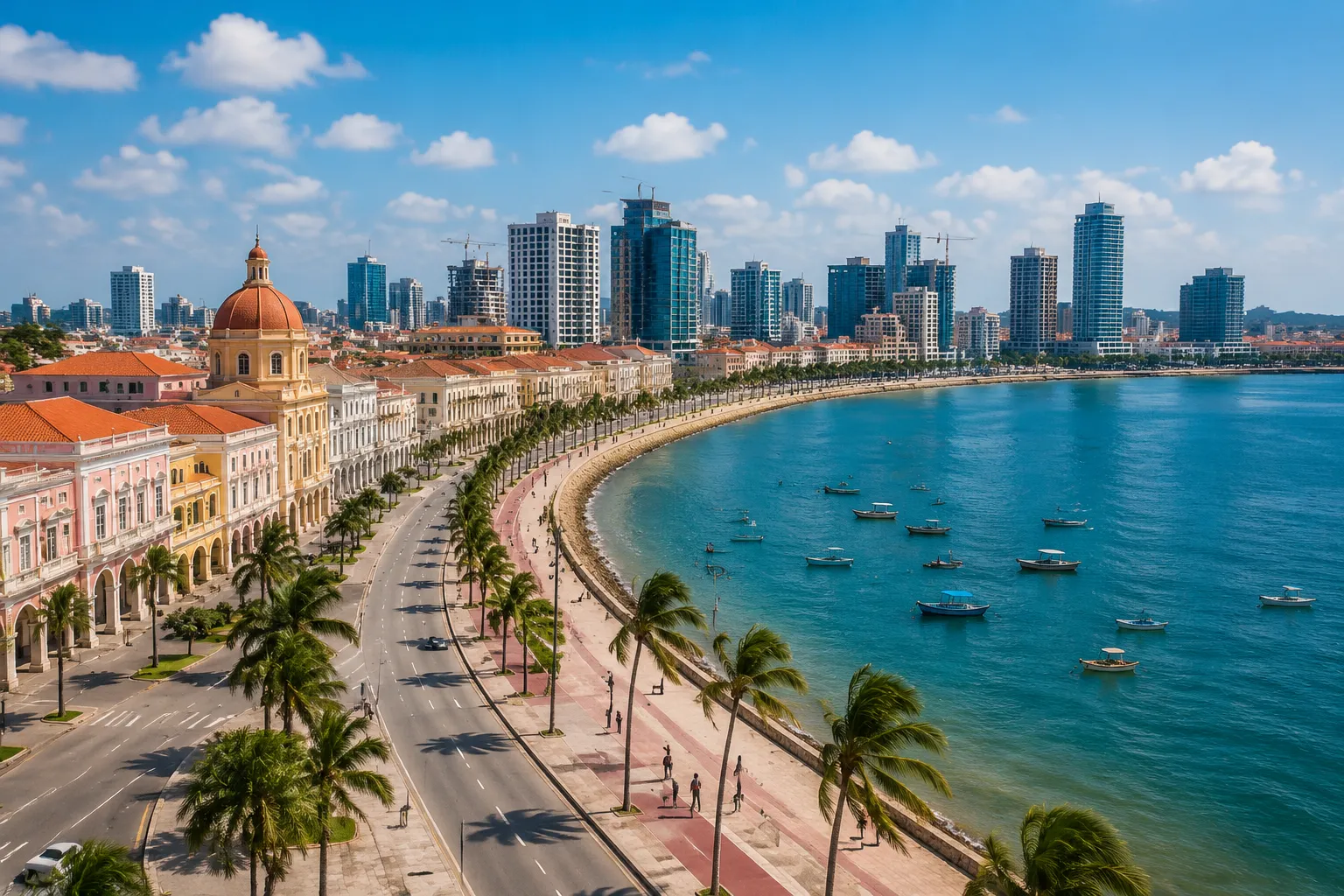
- Afternoon: walk the Marginal promenade along the bay, with the modernist skyline on one side and the Atlantic on the other.
- Evening: dinner on Ilha do Cabo (Ilha de Luanda), a long sandy spit lined with seafood restaurants.
Where to stay: mid-range at Hotel Presidente or Skyna Hotel; upscale at Epic Sana Luanda or Intercontinental. Book early, find hotel deals in Luanda here.
Day 2: Luanda city day
Spend a full day exploring the capital. See our full Luanda city guide for detailed neighbourhood tips.
- Fortaleza de São Miguel (16th-century Portuguese fort with sweeping bay views and the National Military Museum).
- Museu Nacional de Antropologia for context on Angola’s Bantu cultures.
- Lunch: try muamba de galinha (Angola’s national chicken dish) or fresh grilled fish.
- Afternoon: Miradouro da Lua (“Moon Viewpoint”), about 40 km south of the city, otherworldly eroded cliffs over the Atlantic.
- Optional: continue to Cabo Ledo for sunset if you leave early.
Day 3: Kissama National Park
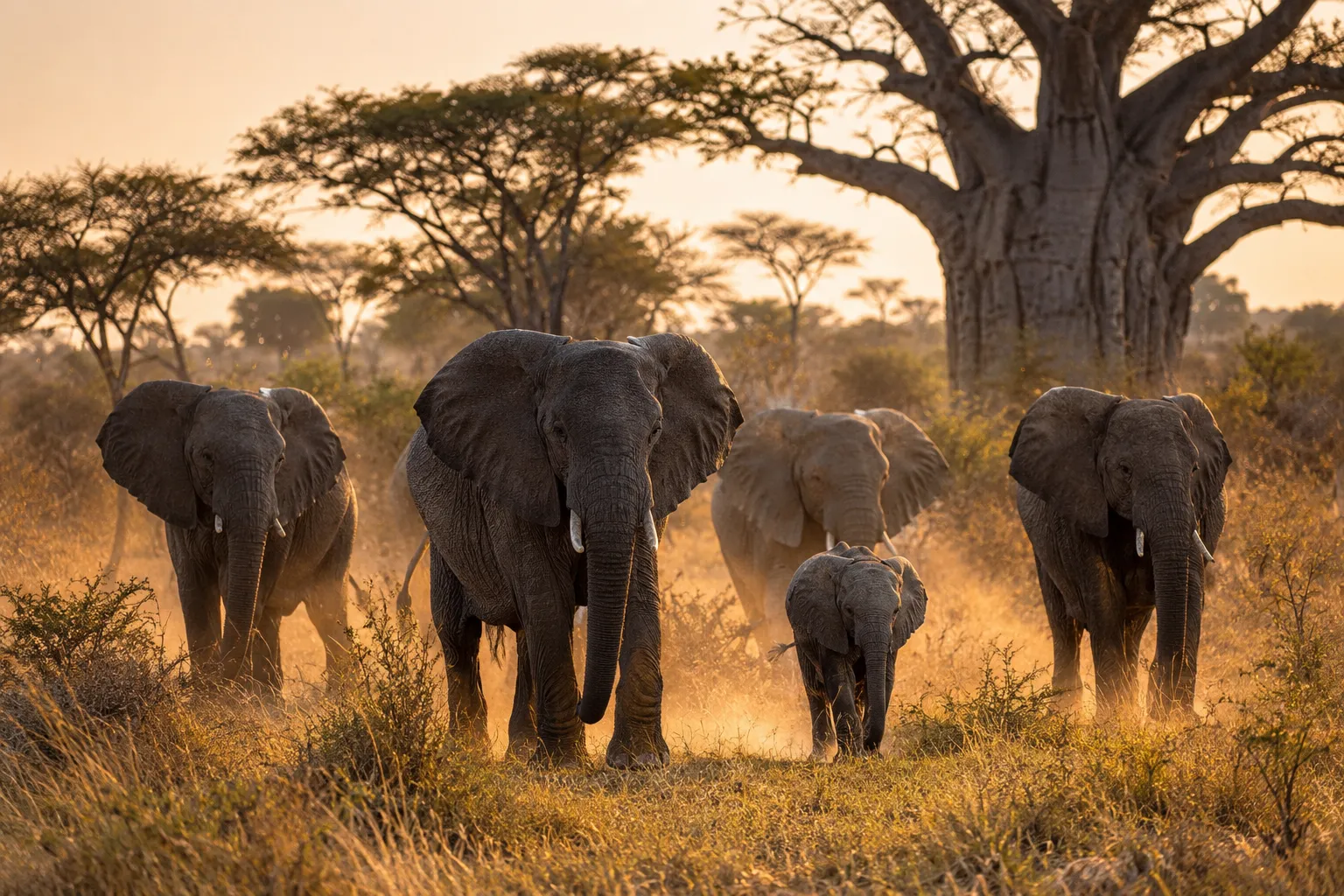
Drive south to Kissama (Quiçama) National Park, roughly 70 km from Luanda. It’s the most accessible park in the country and was famously restocked with elephants, giraffes and antelopes through Operação Arca de Noé in the early 2000s.
- Half-day 4x4 game drive with a park ranger.
- Overnight at Kwanza Lodge or a similar riverside camp on the Kwanza River. Simple but atmospheric.
Wildlife is more modest than in Kruger or the Serengeti, but the setting, baobabs, dry savanna, river estuary, is beautiful and completely uncrowded.
Day 4: Luanda to Malanje
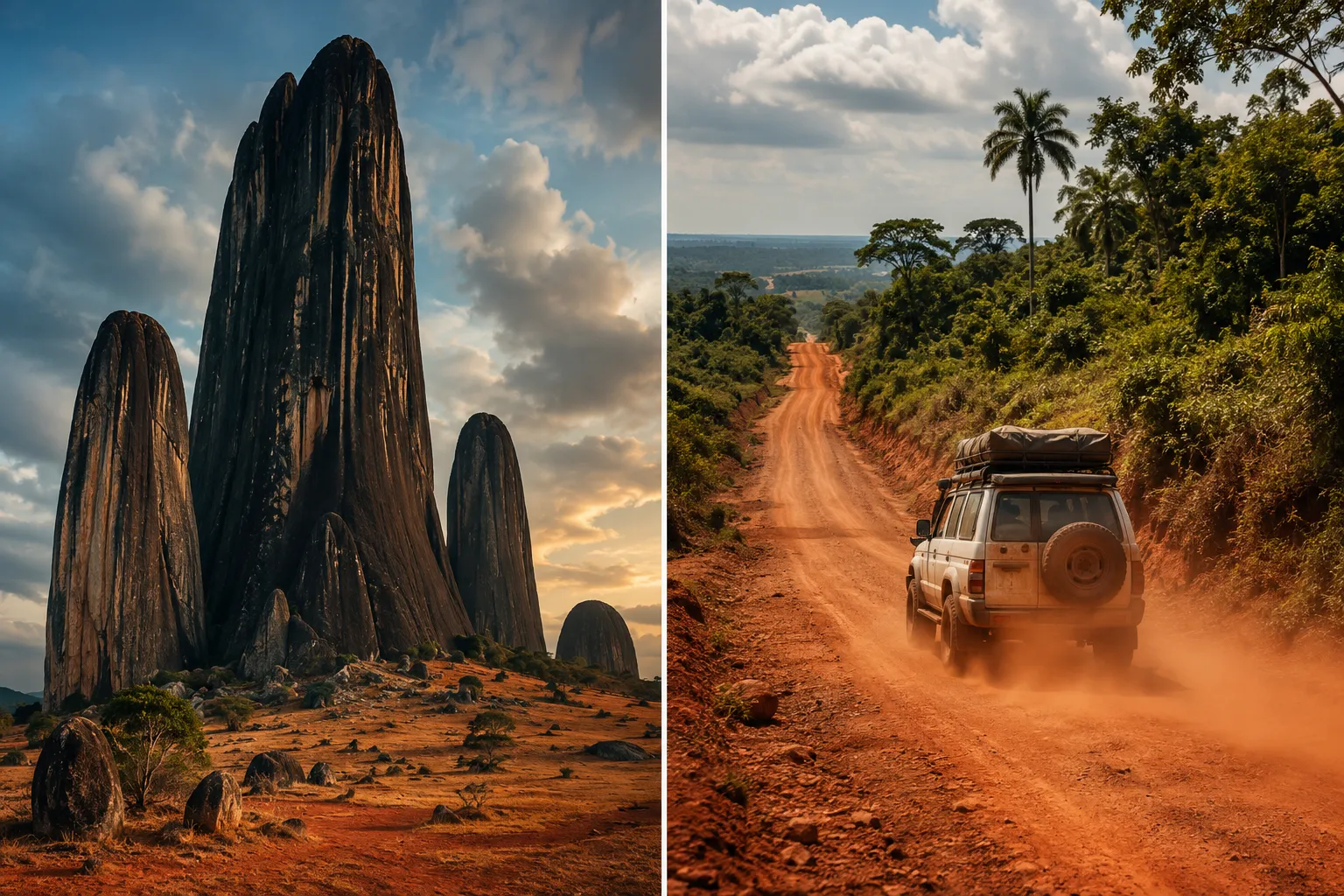
Long travel day. The N230 route to Malanje covers around 400 km and takes 6-8 hours with stops. Roads are mostly paved but potholed in sections, and truck traffic can slow you down.
- Early start (leave Luanda by 6:00).
- Lunch stop in N’dalatando (Kwanza-Norte).
- Arrive Malanje city by late afternoon.
- Overnight in Malanje: Hotel Palace Malanje or Hotel Ritz Malanje are the reliable choices.
Day 5: Kalandula Waterfalls
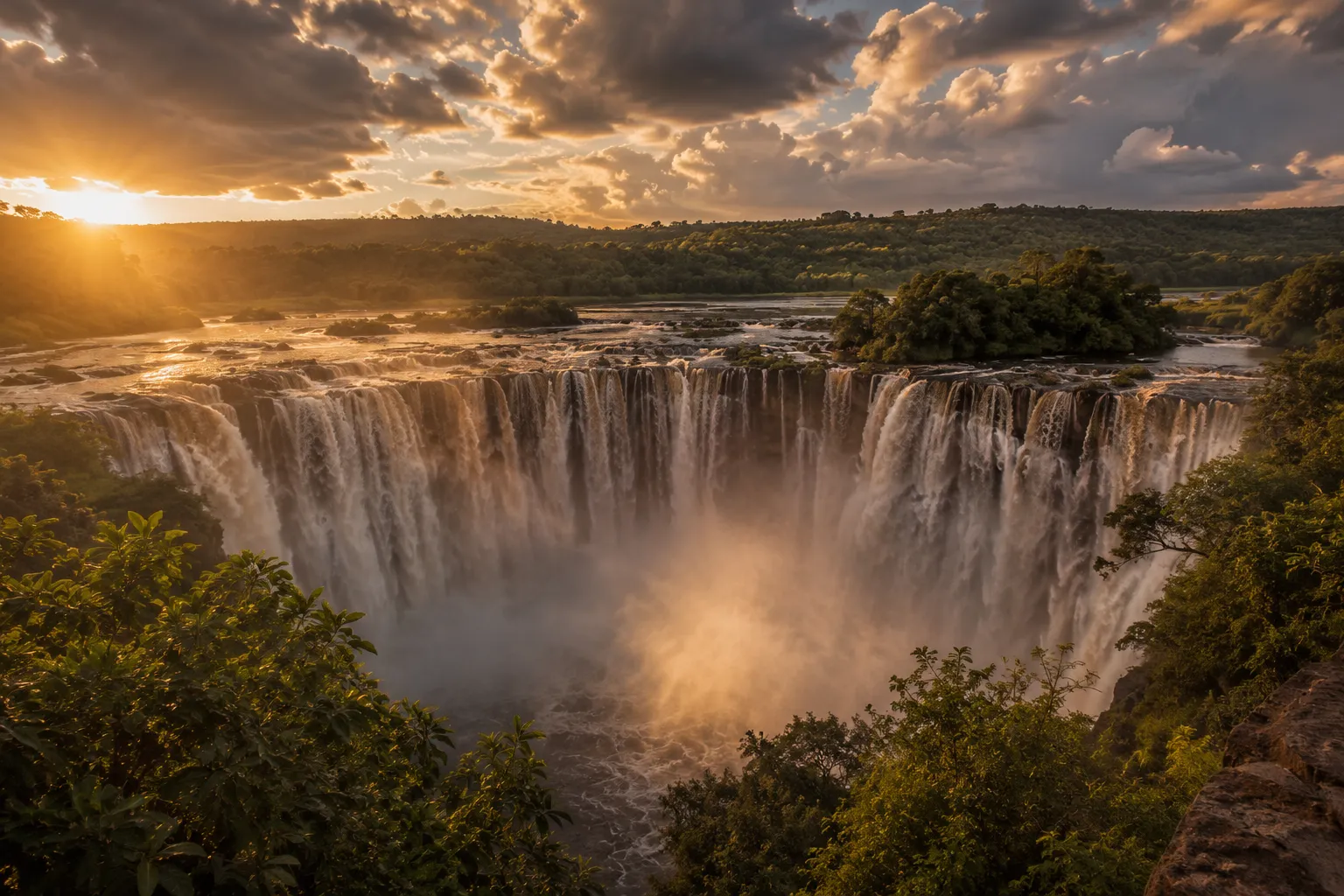
The star of your trip. Kalandula Waterfalls sit about 85 km northwest of Malanje city on the Lucala River. At around 105 metres high and 400 metres wide (verify current measurements), they’re among the largest waterfalls in Africa by volume.
- Drive to the falls (about 2 hours from Malanje, last stretch on dirt road).
- Viewpoint from the top and a short walk down for the classic wide-angle view.
- The Hotel Pousada Calandula sits directly opposite the falls, book ahead for a room with a view, or at least stop for lunch.
- Return to Malanje, or overnight at the Pousada for a sunrise view.
Day 6: Pedras Negras de Pungo Andongo
About 115 km southeast of Malanje city, the Pedras Negras (“Black Rocks”) are giant dark monoliths rising from the plain. According to local legend, they hold the footprint of Queen Njinga Mbandi, the 17th-century ruler who resisted Portuguese colonisation.
- Half-day visit with a local guide.
- Return to Malanje for a late lunch.
- Optional: if wildlife is your priority, add a detour to Cangandala National Park for a chance to spot the critically endangered palanca negra gigante (giant sable antelope), Angola’s national symbol. Sightings are rare and usually require advance arrangement with park authorities.
- Overnight in Malanje.
Day 7: Return to Luanda and departure
- Early start back to Luanda (6-8 hours).
- Late-afternoon flight home, or one more evening on Ilha do Cabo if your flight is next morning.
How many days do I need in Luanda?
Two full days is the sweet spot. Luanda is Angola’s cultural and historical anchor: you need one day for the Marginal, Fortaleza de São Miguel and Ilha do Cabo, and a second day for museums, Miradouro da Lua and a leisurely seafood meal. A third day only makes sense if you want to add a boat trip to Mussulo, the sandy peninsula-lagoon south of the city.
Is it safe to travel to Angola right now?
Angola is generally safe for tourists who take normal urban precautions, but travel advisories change. Petty crime (pickpocketing, phone snatching) happens in Luanda, especially after dark. The Cabinda exclave typically has stricter warnings due to occasional unrest. Rural landmine risk is very low on tourist routes but never leave marked paths in remote areas.
Always check the current advice from your government (for example the UK FCDO travel advice for Angola or the US State Department) before you book. See our detailed guide: is Angola safe?.
What’s the best time of year to visit Angola?
May to October is the dry, cooler season and by far the best window for a 7 day Angola itinerary. Roads are firmer, humidity is lower, and wildlife viewing in Kissama is easier because animals concentrate near water. The rainy season (November to April) makes dirt roads to Kalandula and Pungo Andongo much harder and occasionally impassable, though the falls themselves are at their most spectacular volume in March and April. More detail in our best time to visit Angola guide.
How much does a week in Angola cost?
Angola is not a budget destination. Luanda regularly ranks among the world’s most expensive cities for expats, and tourism infrastructure is limited, which keeps prices high.
| Budget level | Per person, 7 days (excl. int’l flights) |
|---|---|
| Backpacker (rare, tough) | USD 1,200-1,800 |
| Mid-range (guided, hotels) | USD 1,800-3,000 |
| Comfort/private tour | USD 3,000-5,500 |
| Luxury with domestic flights | USD 6,000+ |
Main costs: hotels (USD 100-250/night in Luanda), 4x4 with driver-guide (USD 200-350/day), park fees, meals (USD 15-40 per meal in Luanda), fuel and domestic transfers. Verify current prices at booking; the kwanza fluctuates.
Do I need a visa to visit Angola?
Since September 2023 (Presidential Decree 189/23), citizens of 98 countries, including most of the EU, the UK, the US, Canada and Australia, do not need a visa for tourism stays of up to 30 days. Other nationalities can use the e-visa via the official SME (Serviço de Migração e Estrangeiros) portal. Rules change often, so always verify on the official Angola e-visa portal before you book. Our full Angola visa guide covers the latest updates.
What’s the difference between visiting Luanda vs the countryside?
Luanda feels like a modern African capital: high-rises, traffic jams, luxury hotels, upscale restaurants, and steep prices. The countryside (Kwanza-Norte, Malanje) is the opposite: red-earth roads, small towns, basic guesthouses, warm hospitality, and dramatically empty landscapes. Both are essential to understanding Angola, skip one and you only get half the story.
Can you see Victoria Falls from Angola?
No. Victoria Falls sits on the Zambia, Zimbabwe border, roughly 1,000 km from Angola’s eastern border. It’s not accessible from an Angola itinerary. Angola’s own signature waterfall, Kalandula, is often called “Africa’s other great waterfall” and is a genuine highlight in its own right.
How do you get around Angola during a week trip?
For a 7-day loop, the practical options are:
- Private driver-guide with 4x4 (recommended). Best balance of safety, flexibility and local knowledge. Roughly USD 200-350/day including fuel.
- Organised group tour. A handful of local operators run scheduled Malanje trips, mostly from Luanda.
- Self-drive. Possible but tough. Signage is limited, Portuguese is essential, police checkpoints are frequent, and fuel stations are sparse outside main routes.
- Domestic flights. TAAG flies from Luanda to Malanje intermittently, check current schedules. Flying saves a day but adds cost.
Public transport (candongueiro minibuses) is not realistic for tourists on a tight schedule.
What should I pack for Angola in different seasons?
Dry season (May, October):
- Light layers (mornings and Lubango-area highlands can be cool).
- Long sleeves and trousers for evenings (mosquitoes).
- Sturdy walking shoes for Kalandula viewpoints and Pungo Andongo rocks.
- High-SPF sunscreen, sunglasses, wide hat.
Wet season (November, April):
- Lightweight rain jacket.
- Quick-dry clothing.
- Waterproof bag cover for cameras.
Year-round:
- Yellow fever vaccination certificate (mandatory at entry, verify).
- Malaria prophylaxis (consult your travel clinic).
- USD or EUR cash to exchange for kwanza.
- Universal adapter (Angola uses type C and F, 220V/50Hz).
- Portuguese phrasebook or a translation app; see Angola language basics.
Is 7 days enough time to see Angola properly?
Seven days is enough for the classic northern loop (Luanda, Kissama, Malanje) but not the full country. Angola is roughly 1.2 million km², larger than France, Germany and Spain combined. To add the south (Lubango, Serra da Leba, Tundavala, Namibe desert, Iona National Park) you realistically need 10-14 days and a domestic flight leg. Cabinda would be a separate trip.
What are common mistakes tourists make in Angola?
- Underestimating driving times. 400 km on Angolan roads is not 400 km on a European motorway.
- Skipping yellow fever documentation. You can be refused entry without it.
- Assuming card payments work. Bring cash. Card acceptance outside top Luanda hotels is patchy.
- Not speaking any Portuguese. Even 20 basic phrases transform your trip.
- Booking Kalandula as a day trip from Luanda. It’s not, you need at least one night in Malanje.
- Ignoring the visa timeline. Even e-visas can take days to process.
Where can you see wildlife in Angola?
The three realistic options on a one-week trip:
- Kissama National Park, elephants, giraffes, antelopes, buffalo. The most accessible.
- Cangandala National Park (Malanje), the endangered giant sable antelope. Requires arrangement.
- Luando Reserve (Malanje), the other stronghold of the giant sable, harder to access.
For the country’s biggest wildlife area (Iona National Park with welwitschia, oryx and desert coastline) you’d need to add the south. More on Angola’s national parks and wildlife.
How do you travel from Luanda to other regions?
- Luanda to Malanje: 400 km, 6-8 hours by road (N230). Occasional TAAG flights.
- Luanda to Kissama: 70 km, 1.5-2 hours by road.
- Luanda to Benguela/Lobito: 700 km by road, or 1-hour TAAG flight.
- Luanda to Lubango: best done by domestic flight (about 1h 30m).
- Luanda to Cabinda: flight only (overland requires transiting DR Congo).
Conclusion: Your next steps
A 7 day Angola itinerary is a rewarding introduction to one of Africa’s least-visited countries. You’ll leave with the Marginal skyline, Kissama’s baobabs, Kalandula’s spray and Pungo Andongo’s black monoliths burned into memory, and you’ll have barely seen 20% of what Angola offers.
Next steps:
- Verify your visa requirement on the official Angola e-visa portal.
- Book your yellow fever shot and consult a travel clinic about malaria prophylaxis.
- Confirm TAAG or connecting flights into Luanda.
- Reserve a private driver-guide early, the good ones book out months ahead.
- Read our companion guides on travel preparation for Angola and Angola’s top sights.
Boa viagem.
Free help from our team in Angola
Want this week in Angola planned for you?
Luanda, Kissama, Kalandula and Pungo Andongo in seven days only works with good transport. Tell us your dates and we arrange the drives, the guide and the hotels in between.
- Local team in Angola
- No obligation, nothing to pay
- Reply by email or WhatsApp
Want to keep this guide? We email you the key points with a link to every section.
Frequently asked questions
Is Angola open to tourists in 2026?
Yes. Angola has actively promoted tourism since easing visa rules in 2023. Verify current entry requirements before travelling.
Can I do Kalandula as a day trip from Luanda?
Not realistically. It's around 500 km one way. You need at least one overnight in Malanje.
What language is spoken in Angola?
Portuguese is the official language. Bantu languages (Umbundu, Kimbundu, Kikongo) are widely spoken. English is limited to major hotels.
Do I need travel insurance for Angola?
Yes, strongly recommended. Medical evacuation coverage is essential given limited healthcare outside Luanda.
Can I use my credit card in Angola?
Only at upscale hotels and some restaurants in Luanda. Bring USD or EUR cash and exchange for kwanza on arrival.
Is malaria a real risk?
Yes, throughout the country year-round. Take prophylaxis and use repellent. Consult a travel clinic 4-6 weeks before departure.