Here’s the short version most articles won’t tell you: no government on earth legally requires you to book an organised tour to enter Angola, and since the tourist e-visa rollout you can absolutely land in Luanda, grab a taxi, and figure it out as you go. But “legal” and “smart” aren’t the same thing. Whether angola tours are worth the money depends almost entirely on which parts of the country you want to see, how much Portuguese you speak, and how much of your holiday you’re willing to spend problem-solving instead of enjoying.
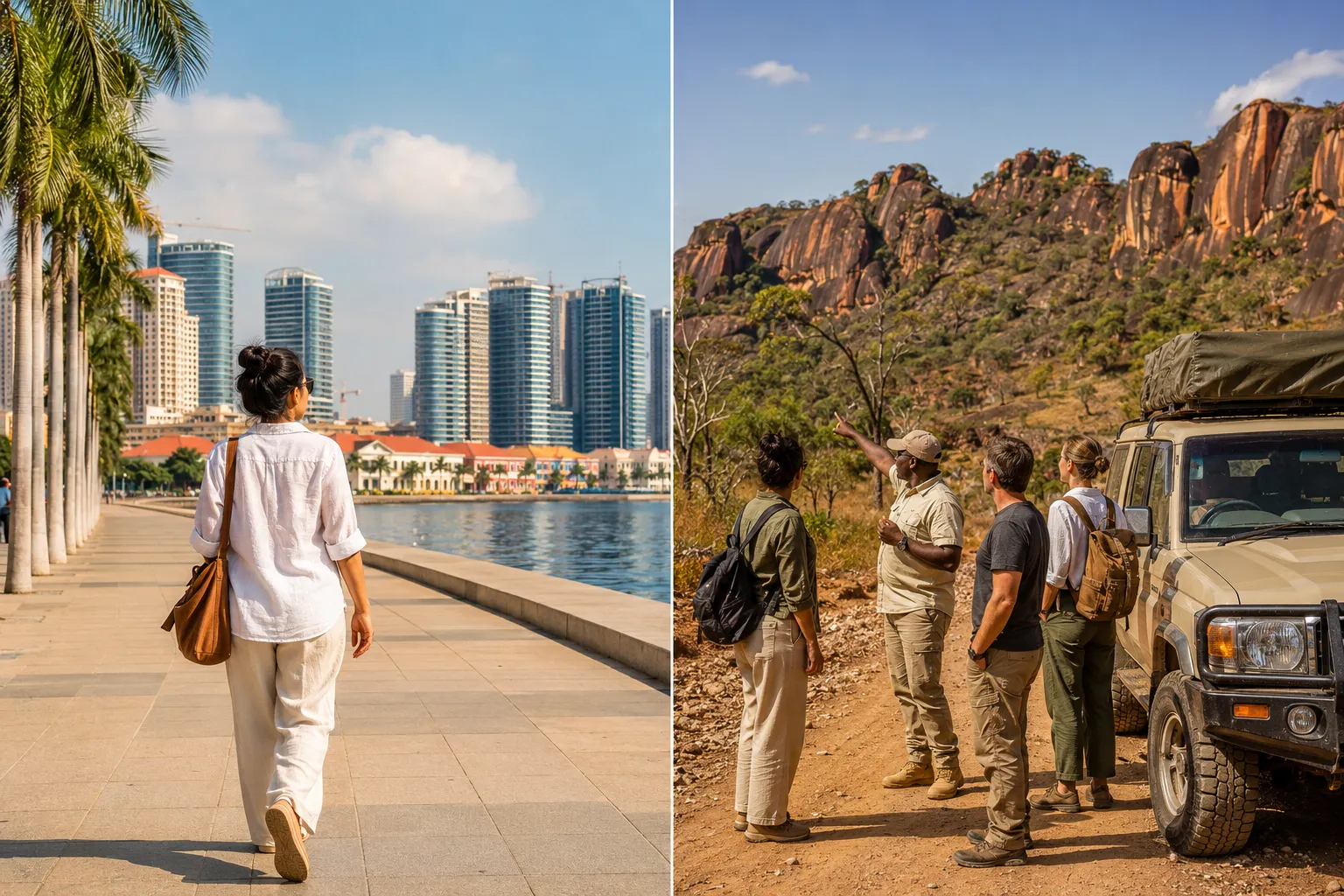
Quick Answer
You do not need a guide or tour to visit Angola. Luanda, the coastal cities (Benguela, Lobito, Namibe) and popular day trips like Mussulo or Miradouro da Lua are all doable independently in 2026, especially now that most Western nationalities can enter Angola visa-free for short tourist stays. However, for the interior (Kalandula, Malanje, Cangandala), the deep south (Iona, Serra da Leba, Tundavala) and any national park with wildlife, most first-time visitors have a much better trip with a driver-guide or a small-group tour, mainly because of Portuguese-only signage, unpredictable road conditions, fuel logistics, and lingering landmine risk off cleared tracks [1][3].
Key Takeaways
- No tour is legally required. No 2026 government advisory (UK, US, Canada, France, Portugal) mandates guided travel in Angola [1][2][3].
- Luanda and the coast are DIY-friendly. Hotels, taxis, day tours from apps, and Portuguese phrasebook = enough.
- The interior and south are not. Distances are huge, English is rare, and rural roads punish improvisers.
- Portuguese matters more than anything else. If you speak zero Portuguese, hire a driver-guide or join a group, full stop.
- Landmine risk is real but localised. Stay on cleared roads; a local guide knows which tracks are safe [1].
- Budget tours: from ~€80 for a Luanda day trip. Multi-day private tours: often €200,€400 per person per day. Small-group expeditions: €4,000,€8,000 for 10-14 days, flights excluded (verify with operators).
- Solo women, families and photographers usually get better value from a guide even in “easy” regions.
- You can mix it up. Independent in Luanda + a private driver-guide for the interior is the sweet spot for most readers.
Do I need a guide to travel in Angola?
No, you don’t need a licensed guide, an invitation letter, or a booked tour to enter Angola as a tourist in 2026. The visa reforms that started in 2023 opened the country to independent travellers for the first time, and the major foreign ministries (UK FCDO, US State Department, Global Affairs Canada) don’t require a guide either [1][2][3].
What they do warn about is more nuanced: petty crime in Luanda, weak medical infrastructure, poor road conditions, occasional civil unrest and the residual landmine risk in rural areas [1][2]. None of that is a legal barrier. It just changes the maths on whether you should travel with support, even if you don’t have to.
Choose independent if: you speak decent Portuguese, you’ve travelled in low-tourism countries before, and your trip is mostly Luanda plus coastal cities.
Choose guided if: any of the above is a “no”, or you’re heading into the interior or the south.
When you genuinely don’t need a tour
For a chunk of Angola, hiring a tour is overkill. If your trip is built around these, save the money:
- Luanda itself. Fortaleza de São Miguel, the Marginal promenade, Ilha do Cabo restaurants, Museu Nacional da Escravatura are all easily reached by taxi or ride-hail. See our 3 days in Luanda itinerary for a self-guided plan.
- Mussulo peninsula. Boat transfers are booked at the marina; day trips run constantly.
- Miradouro da Lua and Cabo Ledo. Doable as a hired-car day trip; several Luanda day trips work without a guide.
- Benguela and Lobito. Fly TAAG from Luanda, stay in a beachfront hotel, walk the promenades, eat grilled fish. Independent-friendly.
- Short business-plus-leisure trips. If you’ve got 2 or 3 spare days after a work trip, DIY is fine.
The common thread: paved main roads, hotel infrastructure, at least some English at reception, and short distances.
When a guide or tour is genuinely worth it
Once you leave the coastal corridor, the calculus flips. I’d book a driver-guide or a small-group tour for:
- Kalandula waterfalls and Malanje province. Long drive from Luanda, minimal signage, fuel stops matter. Read our Kalandula Falls guide before deciding.
- Cangandala and Luando reserve (palanca negra territory). Access permits and local knowledge required.
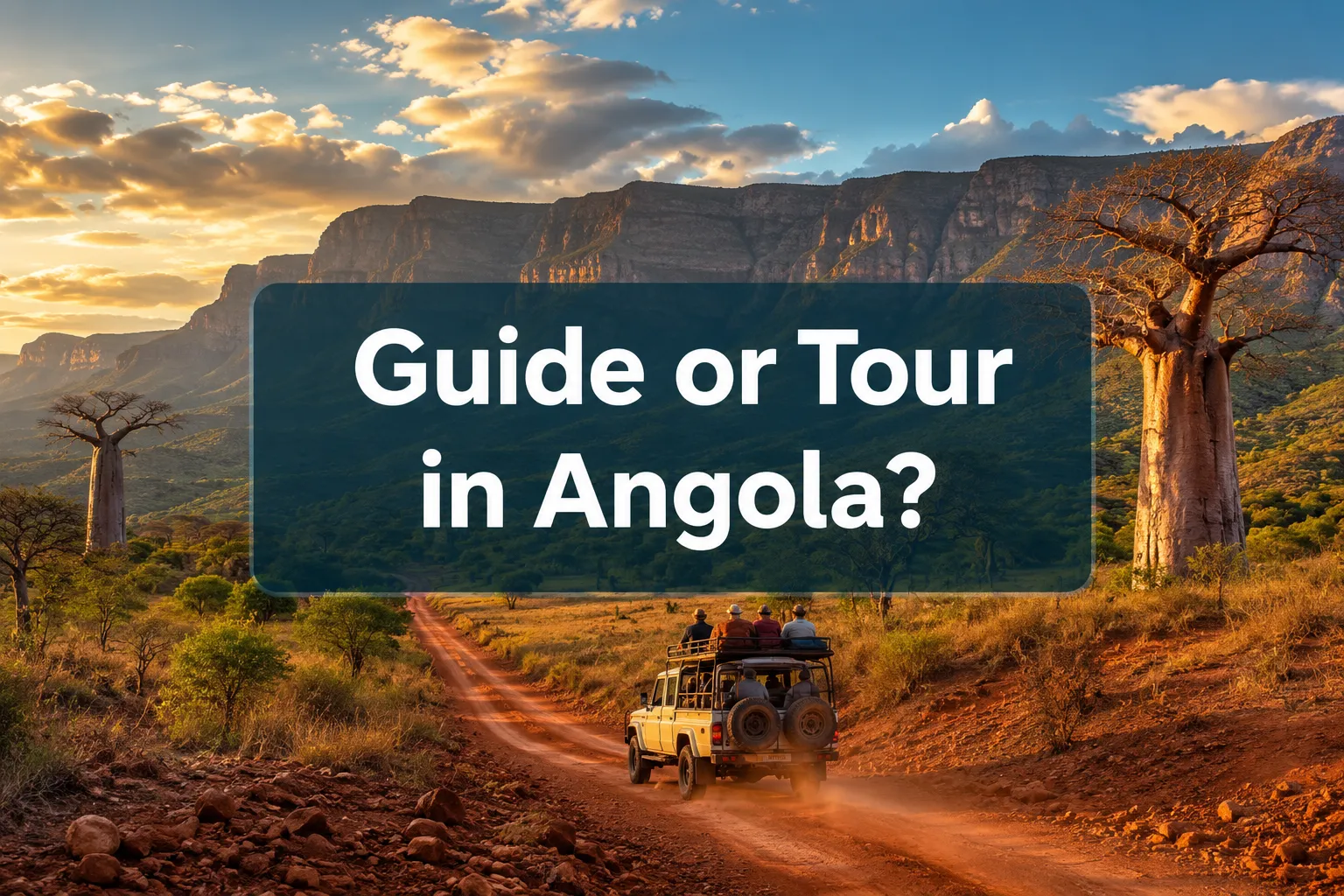
- The deep south: Lubango, Serra da Leba, Tundavala, Namibe desert, Iona National Park. Huge distances, remote fuel, and this is where a southern Angola road trip either sings or breaks down.
- Kissama National Park for wildlife. Self-drive is possible but a guide finds animals faster; see the Kissama National Park guide.
- Cultural access. Village visits, traditional music, semba/kizomba scenes and food markets open up dramatically with a local intermediary.
- Cabinda exclave. Higher advisory levels, sensitive; go with a reputable operator only [1].
“The value of a good Angolan guide isn’t the driving. It’s the fifteen phone calls they make before you even arrive so that the fuel station has diesel, the park ranger is expecting you, and the guesthouse owner comes back from her cousin’s wedding to open the door.”
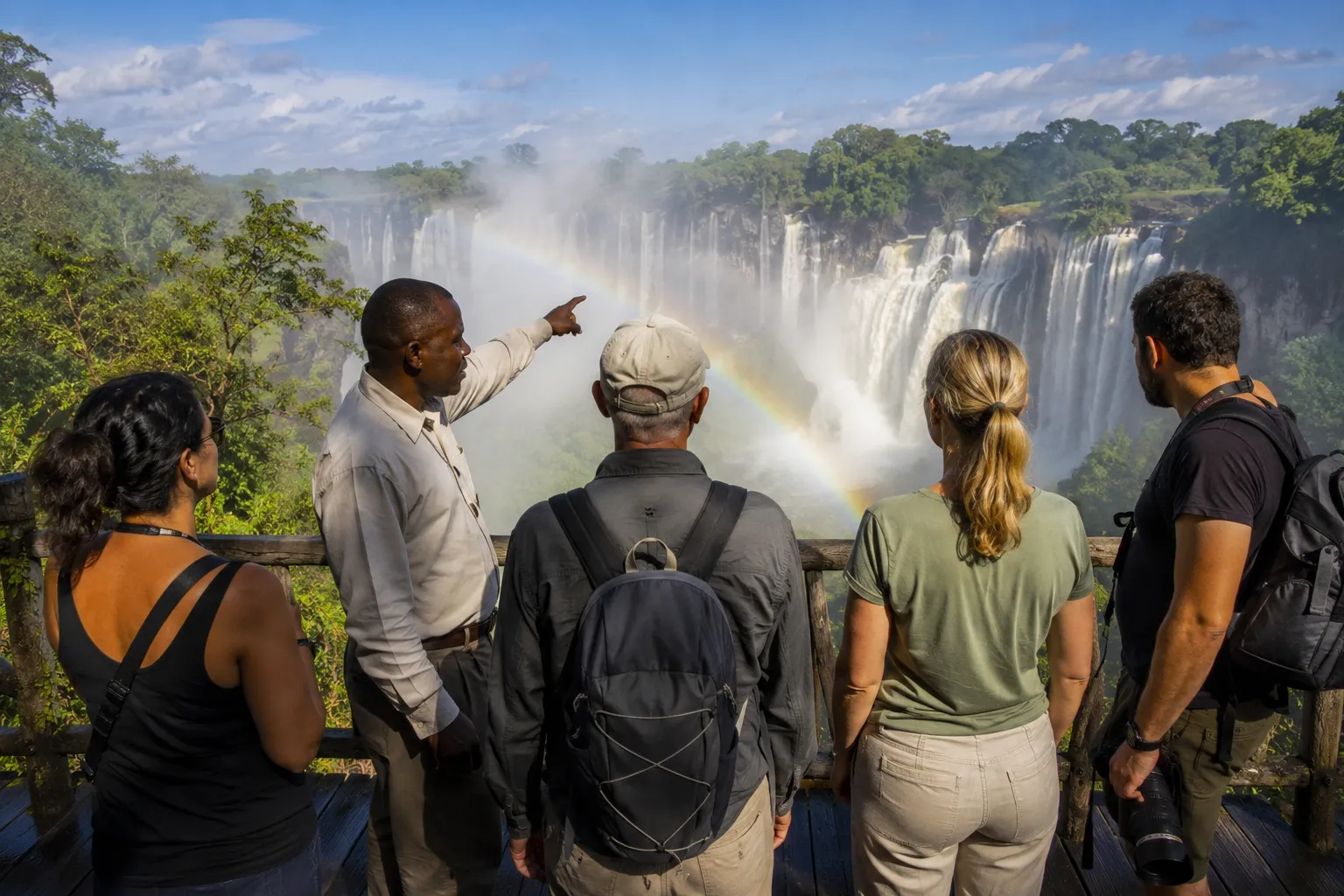
The main types of Angola tours
Not all “angola tours” mean the same thing. Broadly, you’ll see five formats:
- International small-group expeditions (10-16 days). Operators like Undiscovered Destinations, Native Eye, Lupine Travel, Kumakonda and similar Africa specialists run scheduled departures. Flights usually not included. Best for solo travellers who want company.
- Angolan ground operators / DMCs. Locally-owned agencies in Luanda that build private itineraries. You pay less than a Western operator and support the local economy, but expect Portuguese-heavy communication.
- Private driver-guide. One vehicle, one bilingual guide, your itinerary. The sweet spot for couples and families with a real budget.
- Day tours and city tours from Luanda. Marketplace platforms (GetYourGuide, Viator, Airbnb Experiences) list Luanda city tours, Mussulo day trips, Miradouro da Lua half-days. Perfect starter tours.
- Self-drive with support. Rent a 4x4, but have a local fixer on WhatsApp for permits, breakdowns and hotel bookings. See our car hire in Angola guide before choosing this.
How much do guided Angola tours cost?
Prices vary wildly, and any operator quoting a fixed 2026 rate on a public page is usually giving you a starting point. Rough ranges based on what’s typical in the market (verify directly):
| Tour type | Typical price (2026) | Best for |
|---|---|---|
| Luanda half/full-day tour | €60,€150 pp | Layovers, first day |
| Mussulo boat day trip | €80,€200 pp | Beach day, groups |
| Private driver-guide (per day) | €200,€400 pp | Interior, south |
| Small-group expedition (10-14 days) | €4,000,€8,000 pp | Solo, first-timers |
| Fully bespoke luxury private | €500+ pp/day | Photographers, VIP |
What’s usually included: 4x4 vehicle and fuel, English-speaking driver-guide, mid-range hotels, breakfasts, park entrance permits, bottled water. What’s usually not: international flights, TAAG domestic flights, dinners, tips, visa fees, travel insurance.
For broader trip budgeting see our Angola trip cost breakdown.
Can you self-drive in Angola, or do you need a guide?
You can, but most first-time visitors shouldn’t. Self-drive is legal for tourists with an International Driving Permit, and rental agencies in Luanda will hand you the keys to a 4x4. The problems are practical:
- Signage is Portuguese-only and inconsistent.
- Google Maps and Waze underestimate rural travel times by 30-50%.
- Fuel outside main corridors isn’t guaranteed; carry jerrycans in the south.
- Police checkpoints are frequent and go smoother when a local is in the car.
- Landmine risk means you must stick to cleared roads; a local knows which shortcuts are safe [1].
Middle path: rent the car yourself and hire a local driver by the day. You get flexibility without gambling on navigation.
Is it safe to travel to Angola alone?
Yes, thousands of solo travellers visit Angola every year without incident, but it’s not on the same difficulty setting as Portugal or South Africa. Major advisories in 2026 place Angola at a moderate caution level (UK “see our advice”, US Level 2, Canada “exercise a high degree of caution”), citing petty crime, occasional demonstrations and health infrastructure gaps, not violent tourist-targeted crime [1][2][3]. Cabinda province typically gets a higher warning [1][2].
Practical solo-traveller advice:
- Avoid walking in Luanda after dark; use ride-hail or hotel taxis.
- Don’t flash phones or watches; petty theft is the top real risk.
- Solo women report Angola as broadly comfortable but attention-heavy; guided tours help in nightlife and rural settings.
- Keep a scan of your passport and e-visa on your phone.
Full detail in our Angola safety guide.
Visa requirements for Angola tourists in 2026
Most Western nationalities (US, UK, most EU countries, Canada, Australia) can enter Angola visa-free for tourism up to 30 days under Angola’s 2023 visa waiver; travellers not covered by the waiver need a tourist e-visa obtained online before departure. The exact rules keep evolving and depend on your passport, so always verify on the official Serviço de Migração e Estrangeiros portal before booking flights.
- Expect to need: passport valid 6+ months, yellow fever vaccination certificate, return ticket, proof of accommodation.
- Our up-to-date breakdown: Angola visa guide and Angola visa for US citizens.
- Regardless of visa route, a tour booking is not a visa requirement in 2026.
How to vet an Angola tour operator
The Angolan tour market is small enough that a bad operator can ruin your trip and there’s no strong regulator to complain to. Before you pay a deposit, ask:
- Are you legally registered in Angola? Ask for the NIF (tax number) and company name.
- Who is the actual on-ground guide? Get a name, not just “our team”.
- What vehicle, what year, what condition? In the south you want a proper 4x4, not a saloon.
- What’s the fuel and breakdown plan?
- Do you carry a satellite phone or InReach for remote sections?
- Can I speak to two recent clients from my country?
- What’s the cancellation and refund policy in writing?
Red flags: WhatsApp-only communication with no website, pressure to pay 100% by bank transfer to a personal account, vague itineraries, no mention of permits for parks like Iona or Cangandala, prices that seem impossibly cheap.
Good sign: operator asks you qualifying questions (fitness level, dietary needs, photography goals) before quoting.
Angola tours vs independent travel: a decision table
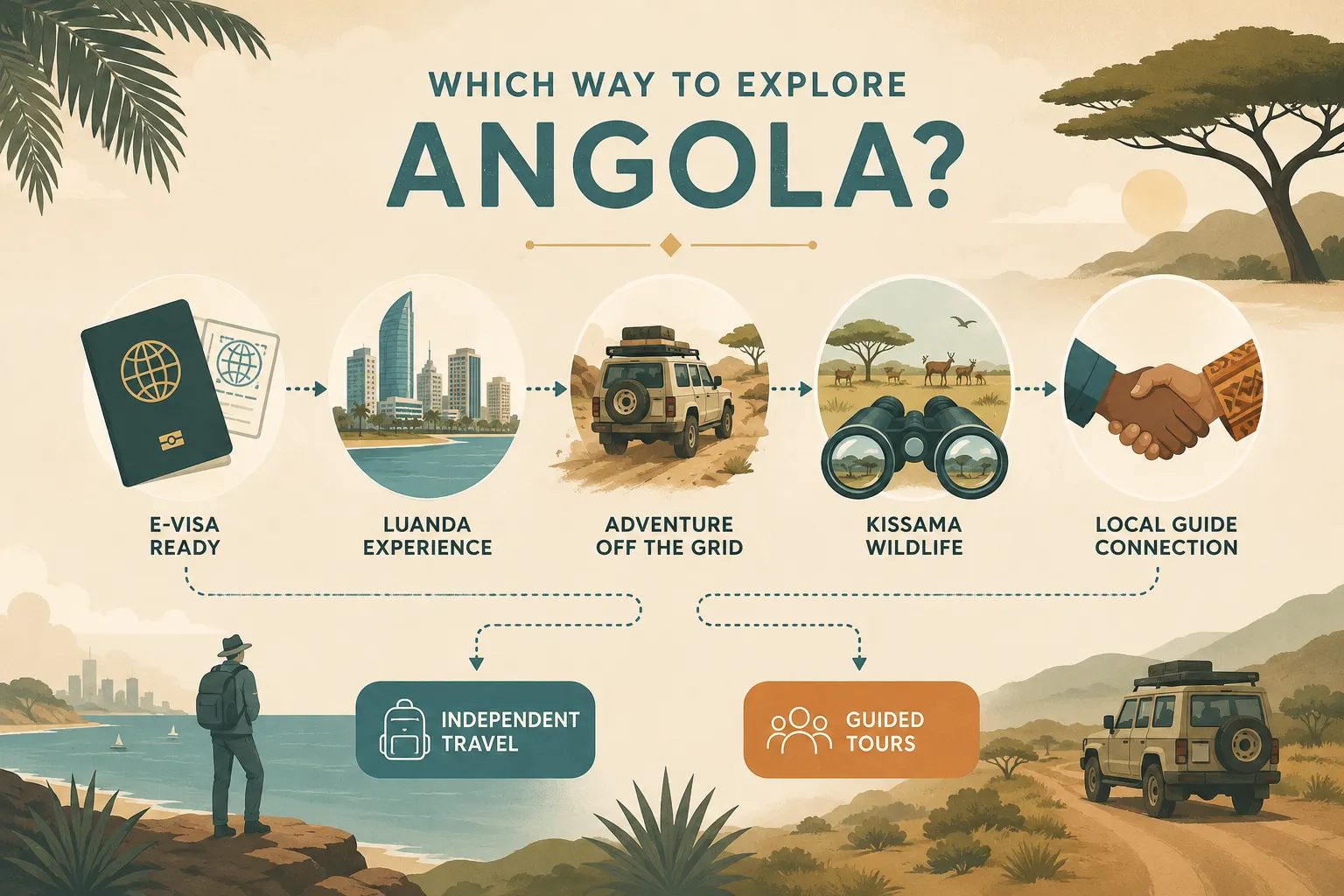
| Traveller type | Recommendation |
|---|---|
| First-timer, no Portuguese | Small-group tour or private driver-guide for interior; DIY only in Luanda |
| Experienced Africa traveller | DIY coast + hire driver-guide for 4-5 days in the south |
| Solo woman | Group tour or private guide; safer and more social |
| Family with kids | Private driver-guide, custom pacing, kid-friendly stops |
| Photographer | Private guide who knows light, timing, permissions |
| Business + 2-3 leisure days | DIY city + a single booked day tour |
| Fluent Portuguese speaker | Mostly DIY; hire a guide only for parks and Cangandala |
How long should an Angola trip be?
For a first visit, 10 to 14 days hits the sweet spot: enough for Luanda, one interior loop (Kalandula) and either the coast (Benguela) or the south (Lubango). Under a week and you’re basically doing Luanda plus day trips. Longer than two weeks and you’ll want to add Iona or Cabinda. See our 7-day Angola itinerary and 10-day grand itinerary for planning.
Best time to visit Angola
The dry season, roughly May to October (locally called cacimbo in the cooler months), is the best time for road trips, parks and photography. Roads are passable, humidity drops, and wildlife concentrates near water. November to April brings the rains, dramatic waterfalls (Kalandula is at peak flow), but also flooded rural tracks and travel delays. Deep dive: best time to visit Angola.
Common mistakes tourists make in Angola
- Underestimating driving times outside Luanda (double what the map says).
- Assuming credit cards work everywhere: carry kwanza cash outside big hotels.
- Booking a tour without verifying yellow fever and malaria prep first.
- Trying to see the whole country in 7 days.
- Ignoring the Portuguese barrier: even a phrasebook helps enormously.
- Skipping travel insurance because “it’s a short trip”.
Conclusion: the honest verdict
For most international travellers heading to Angola in 2026, the best answer isn’t “always take a tour” or “always go independent”. It’s a hybrid: explore Luanda and the coastal cities on your own, and book a private driver-guide or a reputable small-group operator for the interior, the south, and any national park. That combo gives you the freedom and lower cost of DIY where the country is easy, and the safety net and cultural access of a guide where it isn’t.
Next steps:
- Pick a rough route length (see our Angola itinerary options).
- Check your visa route and vaccinations 6-8 weeks out.
- Decide which segments need a guide using the decision table above.
- Shortlist 2-3 operators and vet them with the questions in this article.
- Book flights and the interior segment first; leave city days flexible.
Free help from our team in Angola
Looking for a guide in Angola?
Our guides are our own team, not a marketplace. Tell us where and when you travel and we suggest the guide who fits your trip.
- Local team in Angola
- No obligation, nothing to pay
- Reply by email or WhatsApp
Want to keep this guide? We email you the key points with a link to every section.
Frequently asked questions
Are Angola tours safe?
Yes, when booked with a reputable operator. Angola's main risks are petty crime and road conditions, not organised tourist-targeting. Major 2026 advisories urge caution but don't warn against tourism.
Can I book Angola tours on arrival?
Some Luanda day tours yes; multi-day interior tours no. Book those at least 4-8 weeks ahead, especially in dry season.
Do Angola tour guides speak English?
Guides working with international operators do. Guides hired locally through Portuguese-only agencies often don't. Confirm in writing.
Is Angola cheaper as an independent traveller?
Sometimes, but not by as much as you'd think. Luanda hotels and domestic TAAG flights are expensive either way. Guided tours save time and reduce logistics costs (fuel, permits, translation).
Can I combine independent travel and a tour?
Absolutely, and it's what I recommend for most readers: DIY in Luanda and the coast, private driver-guide for the interior or south.
What's the single biggest reason to hire a guide in Angola?
Portuguese. If you don't speak it, you'll spend half your holiday miming at petrol pumps and hotel reception.