Quick Answer
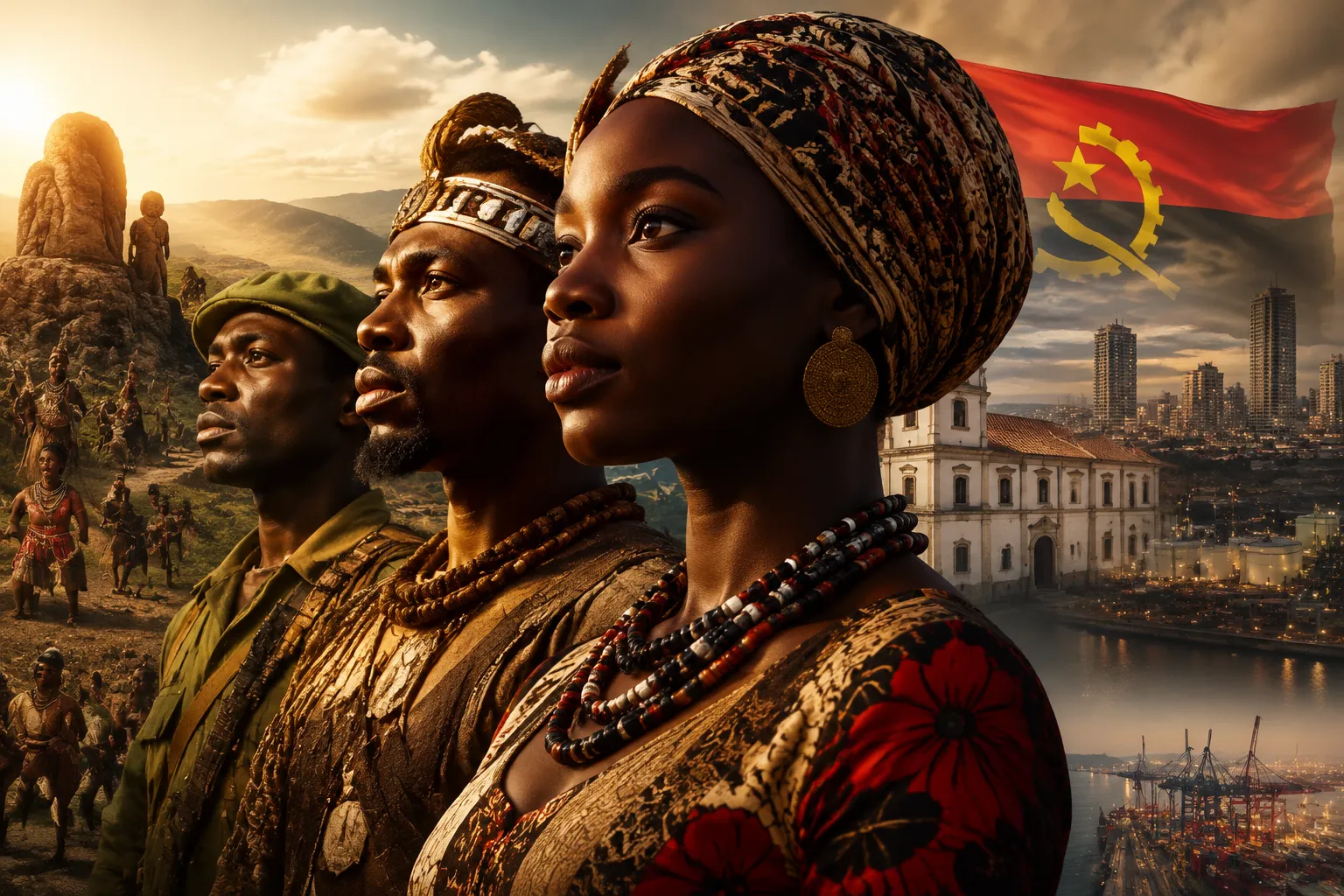
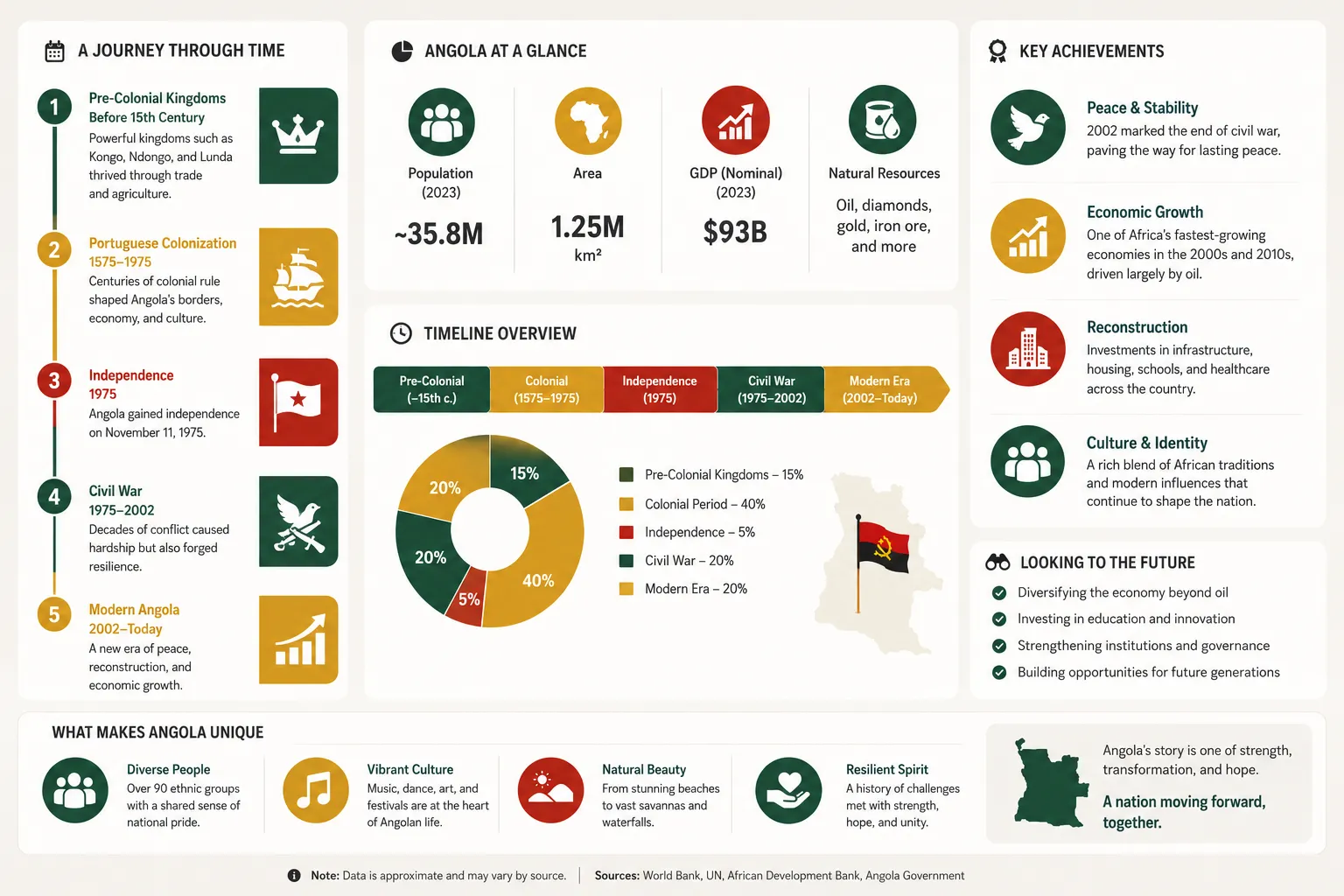
Angola’s history stretches from powerful pre-colonial kingdoms like Kongo, Ndongo and Matamba, through nearly 500 years of Portuguese contact and colonization, a bitter independence war ending on 11 November 1975, and a 27-year civil war that closed in 2002. Today Angola is a peaceful, oil-rich republic still visibly shaped by that past, from the UNESCO ruins of Mbanza Kongo to Luanda’s pastel colonial facades and towering independence-era monuments.
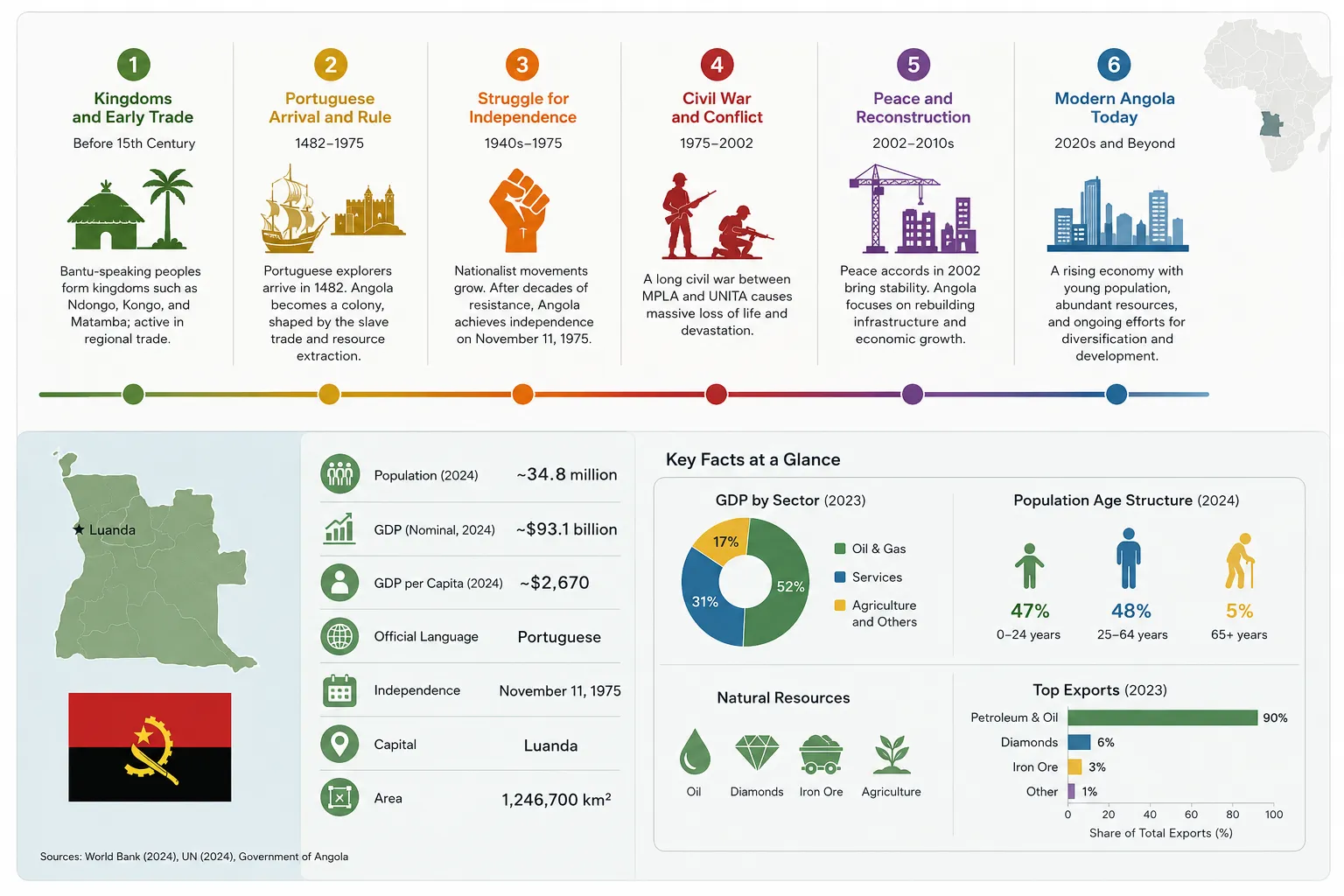
Key Takeaways
- Three major African kingdoms shaped pre-colonial Angola: Kongo, Ndongo and Matamba.
- Portuguese sailors arrived in 1483 under Diogo Cão; formal colonization deepened over the next four centuries.
- Angola was one of the largest sources of enslaved Africans shipped across the Atlantic, mostly to Brazil.
- The armed independence struggle ran from 1961 to 1975, led by three rival movements: MPLA, FNLA and UNITA.
- Independence came on 11 November 1975, immediately followed by civil war that lasted until 2002.
- Cold War superpowers, Cuba and apartheid South Africa all intervened militarily.
- Since 2002 Angola has rebuilt, driven largely by oil, and reopened to international tourism.
- Travellers can still see this history at Mbanza Kongo, Fortaleza de São Miguel in Luanda, and monuments like the Agostinho Neto Mausoleum.
What were the major kingdoms in Angola before colonization?
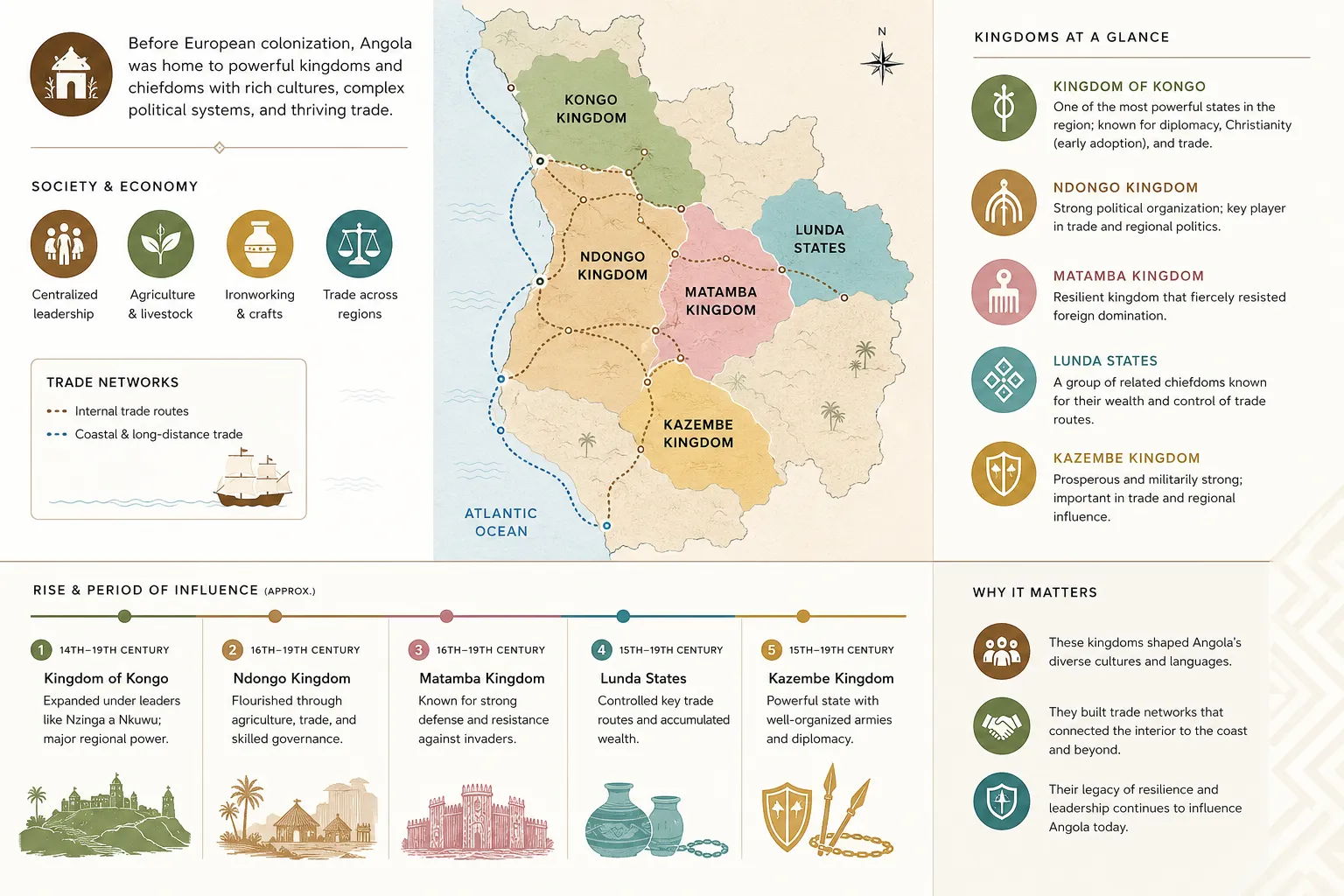
Before Europeans arrived, the land we now call Angola was home to several well-organized Bantu kingdoms, most notably Kongo, Ndongo and Matamba. These were not scattered villages but centralized states with kings, courts, taxation, long-distance trade routes and standing armies.
- Kingdom of Kongo (roughly 14th to 19th century): capital at Mbanza Kongo in the far north. It stretched across parts of today’s Angola, DR Congo and Gabon.
- Kingdom of Ndongo: south of Kongo, ruled by a king titled the ngola, from which the country takes its name. Its heartland was around modern Malanje and Kwanza Norte.
- Kingdom of Matamba: east of Ndongo, famous for Queen Njinga (Nzinga Mbandi), who ruled both Ndongo and Matamba in the 17th century and resisted the Portuguese for decades.
- Further south and east: the Ovimbundu kingdoms of the central highlands (Bié, Bailundo, Huambo) and the Lunda and Chokwe states.
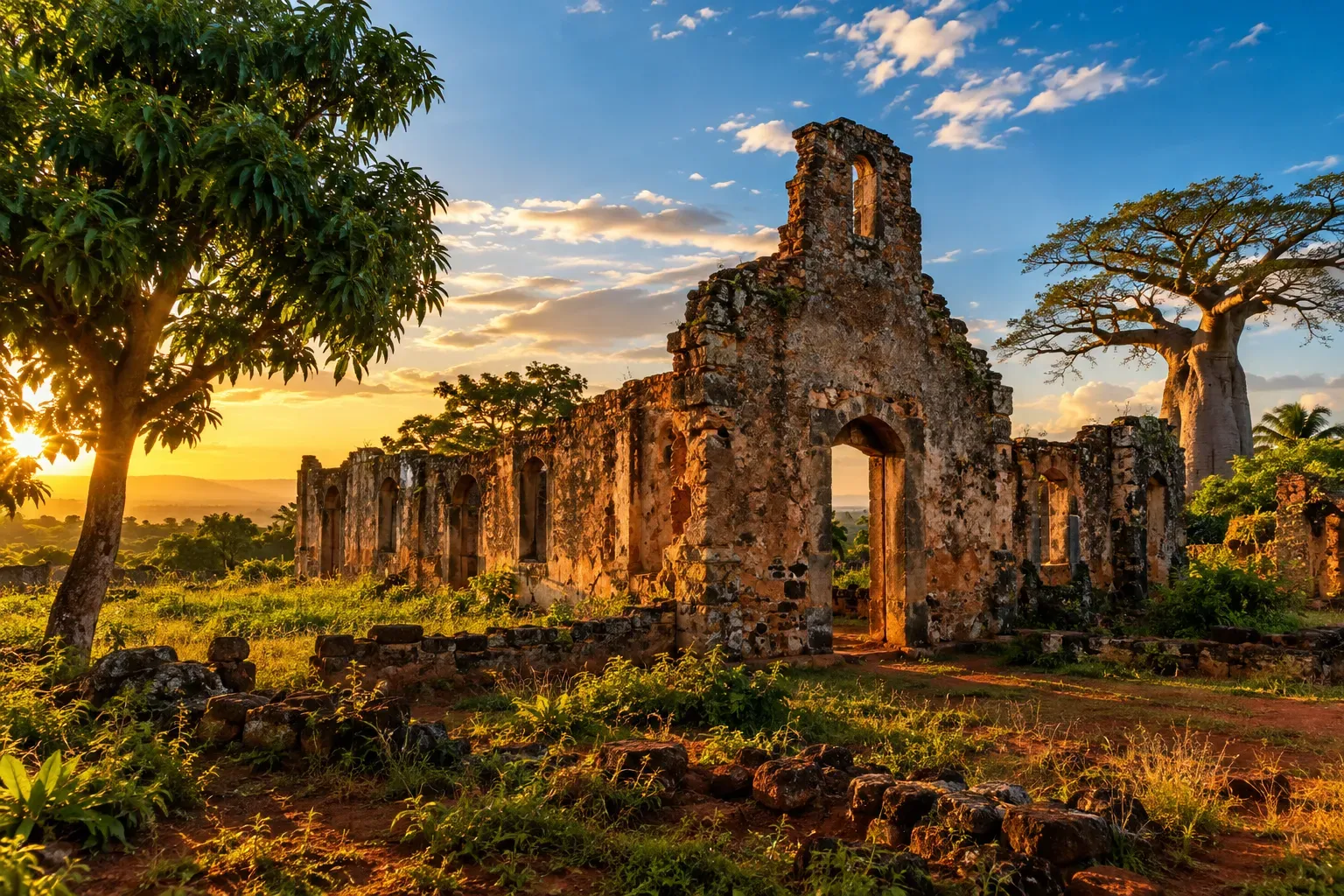
Travellers curious about this era should visit Mbanza Kongo, a UNESCO World Heritage Site since 2017, where royal palace foundations, a colonial cathedral and sacred trees survive.
How did the slave trade impact Angola’s history?
The transatlantic slave trade is the single most devastating chapter of angola history. From the late 1500s to the mid-1800s, an estimated 5 to 6 million people were forcibly shipped from ports like Luanda and Benguela, mostly to Brazil. This figure makes Angola the largest single source region in the entire Atlantic slave trade (source: SlaveVoyages database, Emory University).
The trade hollowed out communities, fueled internal wars (kingdoms raided each other to supply captives) and shaped the demography of the Americas. It also explains the deep cultural link between Angola and Brazil, still audible today in Angolan Portuguese, in semba (an ancestor of samba) and in dishes like funge and muamba.
What was life like under Portuguese colonial rule in Angola?
Portuguese rule was harsh, racially stratified and economically extractive, especially in the 20th century. For most of the colonial period Portugal controlled only coastal enclaves; effective occupation of the interior only happened after the 1885 Berlin Conference and military “pacification” campaigns that lasted into the 1920s.
Under the Salazar dictatorship (1933-1974):
- Angola was declared an “overseas province” of Portugal, not a colony.
- A system called the indigenato divided the population into assimilados (a small minority with Portuguese citizenship) and indígenas (the vast majority, subject to forced labour and travel passes).
- Forced-labour laws sent Angolans to work on coffee plantations, in diamond mines and on public works.
- Education and healthcare for Black Angolans were minimal; by 1960 illiteracy exceeded 90% among the African population.
- Portuguese settlement grew rapidly after WWII, reaching around 330,000 settlers by the early 1970s.
You can still read this history in the architecture. Luanda, Benguela, Lobito and Namibe are full of pastel colonial facades, wrought-iron balconies and old churches. For a deeper look at the capital, see our guide on Luanda.
How did Portuguese colonization affect Angola?
Portuguese colonization reshaped Angola’s borders, language, religion and economy, and its effects are still visible everywhere. Portuguese is the official language; Catholicism is the largest religion; the borders drawn in Berlin still stand, awkwardly including the Cabinda exclave.
Colonization also created a dual economy: modern ports, railways (the Benguela Railway) and plantations for export, alongside an impoverished rural majority. That imbalance directly fed the independence movements of the 1950s and 1960s.
Who were key figures in Angolan independence movements?
Three movements led the fight, each with its own leader, ethnic base and foreign backers:
| Movement | Founded | Key leader | Main base | Cold War ally |
|---|---|---|---|---|
| MPLA | 1956 | Agostinho Neto | Luanda, Mbundu, mestiços | USSR, Cuba |
| FNLA | 1962 | Holden Roberto | North, Bakongo | USA, Zaire, China (early) |
| UNITA | 1966 | Jonas Savimbi | Central highlands, Ovimbundu | USA, apartheid South Africa |
Agostinho Neto, a poet and doctor, became Angola’s first president. His mausoleum in Luanda, the striking silver rocket-shaped tower, is one of the city’s landmarks.
When did Angola gain independence from Portugal, and what role did the MPLA play?
Angola became independent on 11 November 1975. Independence was triggered by Portugal’s Carnation Revolution of 25 April 1974, which overthrew the Lisbon dictatorship and ended Portugal’s willingness to fight colonial wars.
The MPLA (Popular Movement for the Liberation of Angola) had waged guerrilla warfare since 4 February 1961, a date still celebrated as the start of the armed struggle. When Portugal withdrew, the MPLA seized Luanda and declared the People’s Republic of Angola, with Agostinho Neto as president. FNLA and UNITA declared their own rival government in Huambo. The country was at war with itself before the Portuguese flag was even folded.
Neto’s MPLA won that opening round with decisive help from Cuban troops and Soviet weapons, and has governed Angola continuously ever since.
How did Cold War superpowers get involved in Angola?
Angola became one of the hottest proxy battlefields of the Cold War. Within weeks of independence:
- The Soviet Union shipped weapons, advisors and aircraft to the MPLA.
- Cuba sent up to 50,000 troops (Operation Carlota) that were decisive in defending Luanda in late 1975.
- The United States funded FNLA and UNITA via the CIA.
- Apartheid South Africa invaded from Namibia in 1975 to support UNITA and block a Marxist state on its border.
- Zaire (Mobutu) backed the FNLA from the north.
The 1988 Battle of Cuito Cuanavale in southeastern Angola, one of the largest conventional battles in Africa since WWII, is widely credited with pushing South Africa to negotiate Namibian independence and, eventually, the end of apartheid.
How long did the Angolan Civil War last, and why did it happen?
The Angolan Civil War lasted 27 years, from 1975 to 2002, with brief pauses. Its roots were a toxic mix of:
- Unfinished decolonization: three armed movements, no shared transition.
- Ethnic and regional rivalries: MPLA’s urban/Mbundu base vs UNITA’s rural Ovimbundu base.
- Cold War funding that let both sides keep fighting long after they would have run out of resources alone.
- Diamonds and oil: UNITA financed itself with “blood diamonds” from the interior; the MPLA government used offshore oil revenues.
Peace attempts in 1991 (Bicesse) and 1994 (Lusaka) collapsed. The war finally ended in February 2002, weeks after UNITA leader Jonas Savimbi was killed in combat in Moxico province. A ceasefire was signed on 4 April 2002.
The human cost: roughly 500,000 dead, millions displaced, and one of the world’s worst landmine problems. Demining continues today, which is why travellers should stick to marked paths in rural areas. Check current advice on is Angola safe before planning off-the-beaten-track trips.
What happened to Angola after independence in 1975, and how has the economy changed?
After 1975 Angola was formally a one-party Marxist-Leninist state under the MPLA, at war for most of its first quarter century. Economic life was dominated by state enterprises and, quietly, by offshore oil pumped by Western companies whose royalties funded the government’s war effort.
Key turning points since:
- 1991-1992: transition to multi-party democracy on paper; first elections held.
- 2002: end of civil war, start of massive reconstruction (roads, railways, housing).
- 2002-2014: oil boom. GDP grew at double digits; Luanda became famous as one of the world’s most expensive cities for expats.
- 2014-2016: oil price crash exposed how little the economy had diversified.
- 2017: José Eduardo dos Santos steps down after 38 years; João Lourenço becomes president and launches an anti-corruption drive.
- 2020s: continued push to diversify into agriculture, mining, fisheries and, notably, tourism, helped by visa liberalization for many nationalities including EU citizens (verify current rules on the official e-visa portal).
“Angola went from being a Cold War battlefield to an oil state to, slowly, an emerging travel destination. All within one lifetime.”
What is Angola’s relationship with Portugal today?
Relations are close, pragmatic and sometimes tense. Portuguese is still the working language, Portuguese companies are major investors, and hundreds of thousands of Angolans and Portuguese live in each other’s countries. During Portugal’s 2011-2014 economic crisis, Angolan capital even flowed into Lisbon real estate, reversing centuries of one-way traffic.
Recent friction has focused on anti-corruption investigations in Portuguese courts involving Angolan elites, but on the whole, ties through language, family, football and business remain strong.
What cultural traditions in Angola come from its historical kingdoms?
A surprising amount of daily culture in Angola traces directly to the pre-colonial kingdoms and their fusion with Portuguese influence:
- Languages: Umbundu, Kimbundu, Kikongo and Chokwe are still spoken by millions alongside Portuguese. See our overview of the language of Angola.
- Music and dance: semba (from the Kimbundu word massemba), kizomba and kuduro all grow from Bantu rhythmic traditions.
- Food: national dishes like muamba de galinha, funge, calulu and kizaca use ingredients and techniques that predate Portuguese contact, though cassava itself came via the Atlantic exchange. More in our Angolan cuisine guide.
- Spiritual life: Catholicism is dominant but often blends with older beliefs in ancestors and nature spirits.
- Symbols: the palanca negra gigante (giant sable antelope), endemic to Angola, is the national symbol and appears on the national football team’s nickname.
Where can travellers still see Angolan history today?
You can trace the whole arc in a two-week trip:
- Mbanza Kongo (Zaire province): UNESCO site of the Kongo Kingdom’s capital.
- Luanda: Fortaleza de São Miguel (1576), the National Museum of Slavery in Belas, the Iron Palace, the Agostinho Neto Mausoleum, and the pastel Marginal.
- Massangano and Kwanza River forts: 16th and 17th-century Portuguese outposts inland.
- Benguela and Lobito: colonial coastal architecture and the historic Benguela Railway to the Congolese border.
- Huambo and Kuito: cities heavily damaged in the civil war, now rebuilt.
- Cuito Cuanavale (Cuando Cubango): battlefield of the war’s turning point.
For a full itinerary framework, start with our pillar guide on travel to Angola and browse Angola attractions.
Planning a trip: practical note
If this history has you curious, most European travellers now qualify for simplified e-visa or visa-free tourist entry (verify current rules for 2026 on the official Angolan e-visa portal and your national travel advisory before booking). Flights from Europe usually route via Lisbon on TAAG Angola Airlines or via Brussels and Paris. For a broader planning checklist, see our guide on travel to Angola.
For up-to-date, official safety information, always cross-check your government’s travel advisory before you go.
Conclusion
Angola’s story is one of remarkable resilience: powerful African kingdoms, centuries of Portuguese contact and forced labour, a bitter Cold War proxy conflict, and a 21st-century rebuild that is only now opening its doors to international travellers. Understanding this arc turns a trip to Luanda, Mbanza Kongo or Cuito Cuanavale from sightseeing into something much richer.
Next steps:
- Read our practical planning pillar on travel to Angola.
- Check current entry rules on the official Angolan e-visa portal and your government’s travel advisory.
- Build an itinerary around the historical sites listed above and pair them with nature stops like Kissama National Park and the Kalandula Falls.
Want to keep this guide? We email you the key points with a link to every section.
Frequently asked questions
When did Angola become independent?
On 11 November 1975, from Portugal, after a 14-year armed struggle led mainly by the MPLA, FNLA and UNITA.
Who colonized Angola?
Portugal, starting with coastal contact in 1483 and full colonial control after the late 19th century, ending in 1975.
How long was the Angolan Civil War?
27 years, from 1975 to 2002, with short-lived ceasefires in 1991 and 1994.
What is Mbanza Kongo?
The former capital of the Kingdom of Kongo in northern Angola, a UNESCO World Heritage Site since 2017 and a key destination for anyone interested in Angolan history.
Why did Cuba send troops to Angola?
Cuba backed the Marxist MPLA against South African and US-supported forces from 1975. Cuban troops stayed until 1991 and played a decisive role at Cuito Cuanavale in 1988.
Is Angola safe to visit today?
The country has been at peace since 2002 and tourism is growing. Petty crime in Luanda and residual landmine risk in some rural areas remain concerns. Always check your national travel advisory and our [is Angola safe](/is-angola-safe/) guide before travelling.