Angola has a plant that can live longer than most civilizations, a national animal so rare it was thought extinct for decades, and a capital city that once topped global rankings as the most expensive place on Earth for expats. If you thought southern Africa’s best trivia lived in Namibia or South Africa, these fun facts about Angola will change your mind fast.
Below are 25 short, verifiable, genuinely surprising facts about a country most travellers still overlook. Grab a coffee (or a bica, as the locals say) and enjoy.
Quick Answer
Angola is a huge Portuguese-speaking country on the Atlantic coast of southern Africa, home to roughly 37 million people, one of Africa’s largest waterfalls (Kalandula), the endemic giant sable antelope, and a 1.600 km coastline. Its highlights range from the ancient Welwitschia plant that can live over 1.000 years to Luanda’s booming skyline and the mysterious Iona desert.
Key Takeaways
- Angola is the 7th largest country in Africa by area, bigger than France, Germany and Spain combined.
- Portuguese is the official language, making Angola one of the largest Lusophone nations in the world.
- The Welwitschia mirabilis, found in Iona National Park, can live more than 1.000 years.
- Kalandula Falls in Malanje is one of the largest waterfalls in Africa by volume.
- The giant sable antelope (palanca negra) is endemic and Angola’s national symbol.
- Angola gained independence from Portugal on 11 November 1975.
- The Angolan kwanza (AOA) is the local currency; cash is still king outside big hotels.
- Since 2023 Angola offers visa-free or e-visa access to many nationalities for short tourism (always verify).
What is Angola known for?
Angola is best known for its Atlantic coastline, oil wealth, Portuguese colonial heritage, and dramatic natural landscapes like the Kalandula Falls and the Namib-Iona desert. It’s also the birthplace of kizomba and semba, two dance styles that took over dance floors from Lisbon to Los Angeles.
Fun Fact #1: Angola gave the world kizomba. That slow, sensual dance you may have tried on holiday? It was born here in the 1980s, evolving from semba.
Fun Fact #2: The country has produced more than 1 million barrels of oil per day on average over the past decade, briefly dipping below that mark in July 2025 before rebounding above it again by August.[3][5]
Fun Fact #3: Luanda has repeatedly appeared at the top of Mercer’s list of the world’s most expensive cities for expats, thanks to imported goods and a small luxury market.
Where is Angola located in Africa?
Angola sits on the southwest Atlantic coast of Africa, bordered by Namibia to the south, Zambia to the east, and the Democratic Republic of Congo to the north and east. Its small exclave, Cabinda, lies north of the Congo River, separated from the mainland by a narrow strip of the DRC.
Fun Fact #4: Angola has one of Africa’s longest coastlines, stretching roughly 1.600 km along the Atlantic Ocean.
Fun Fact #5: The country is crossed by the Tropic of Capricorn in the far south, which means the sun sits directly overhead there twice a year.
Fun Fact #6: Cabinda is geographically detached from the rest of Angola, a quirk of 19th-century colonial treaties. It’s also where most of Angola’s offshore oil is pumped.
For a full orientation before you go, our guide to travel to Angola covers regions, routes and logistics.
What language do people speak in Angola?
Portuguese is the sole official language and the everyday language of most Angolans, especially in cities. Alongside it, Bantu languages such as Umbundu, Kimbundu, Kikongo and Chokwe are widely spoken at home.
Fun Fact #7: Angola is the second-largest Portuguese-speaking country in the world by population, after Brazil.
Fun Fact #8: English is rarely spoken outside high-end hotels and the oil industry. A few phrases of Portuguese go a very long way. See our overview of language of Angola for a starter kit.
How many people live in Angola?
Angola’s population is estimated at around 35 to 37 million people (verify with INE Angola for the latest census update). It’s one of the fastest-growing populations in Africa, with a median age under 17.
Fun Fact #9: More than 60% of Angolans are under 25, making it one of the youngest countries on Earth.
Fun Fact #10: Roughly one in three Angolans lives in Luanda or its metropolitan area.
What is the capital of Angola?
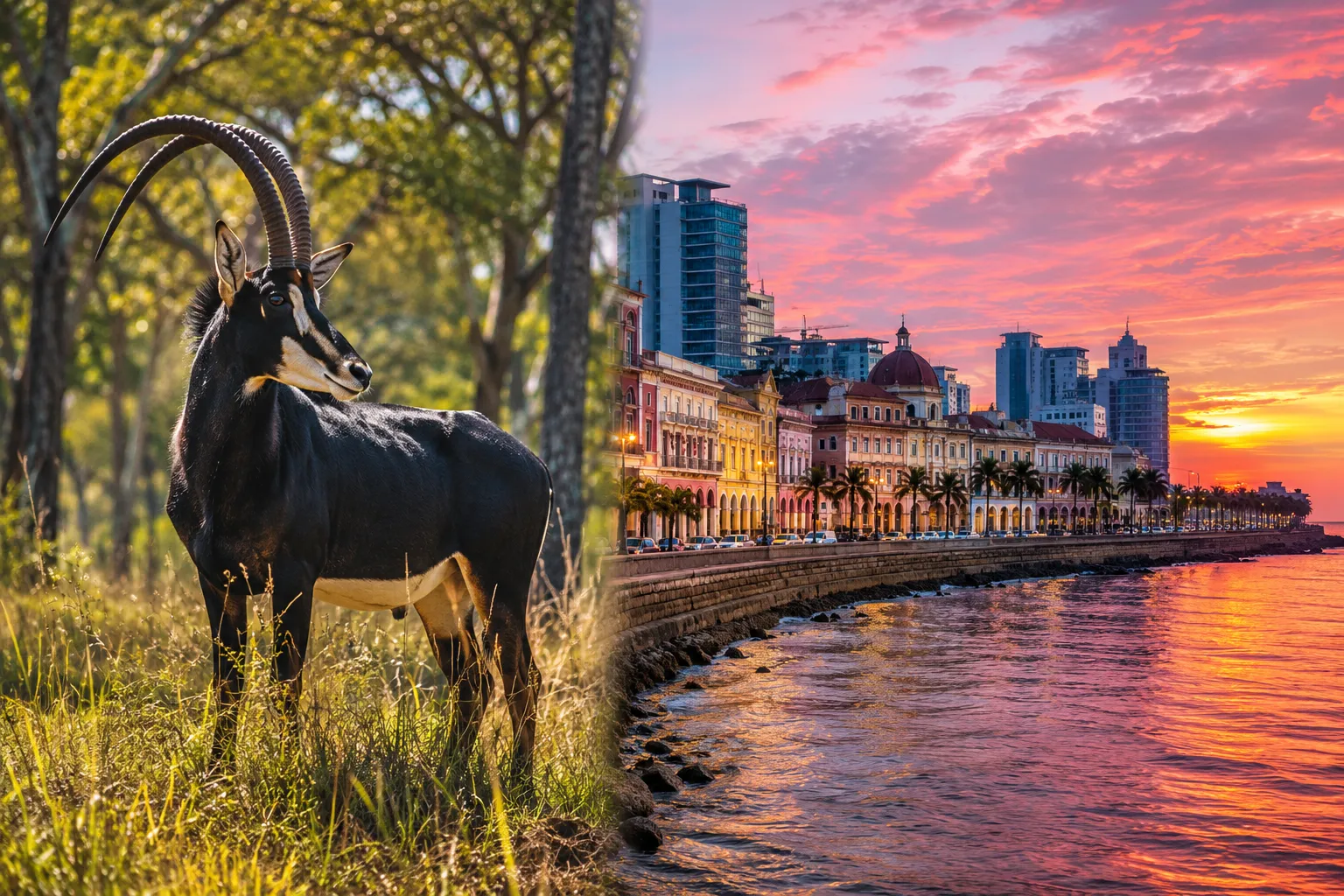
The capital is Luanda, a coastal megacity of an estimated 8 to 9 million people. It’s Angola’s political, economic and cultural centre, perched on a wide Atlantic bay.
Fun Fact #11: Luanda was founded by the Portuguese in 1576, making it one of the oldest continuously inhabited European-founded cities in sub-Saharan Africa.
Fun Fact #12: The Fortaleza de São Miguel, overlooking Luanda Bay, dates from the same era and now houses a national museum. More landmarks in our Luanda.
What currency does Angola use?
The official currency is the Angolan kwanza (AOA). Card payments work in Luanda hotels and upmarket restaurants, but cash is essential elsewhere.
Fun Fact #13: The kwanza is named after the Kwanza River, Angola’s longest river entirely within its borders.
Fun Fact #14: Inflation has been a wild ride. Annual inflation fell to 10,11% in June 2026 from 19,73% a year earlier, and the National Bank of Angola cut its policy rate to 15,75% in July 2026 as the outlook improved.[2][4]
What animals live in Angola?
Angola hosts elephants, lions, cheetahs, hippos, crocodiles, whales, hundreds of bird species, and rare endemics like the giant sable antelope. Wildlife populations were hit hard by the civil war but are recovering.
Fun Fact #15: The giant sable antelope (Palanca Negra Gigante) is found nowhere else on Earth. It was feared extinct after the war, then rediscovered in 2004 via camera traps in Cangandala National Park.
Fun Fact #16: In the early 2000s, Operação Arca de Noé (“Operation Noah’s Ark”) airlifted elephants, giraffes and zebras from South Africa and Botswana to repopulate Kissama National Park near Luanda.
Fun Fact #17: Humpback whales migrate along Angola’s coast between July and October, and can be spotted from Luanda beaches on lucky days.
Explore more in our overview of Angola’s national parks and the Kissama National Park.
Weird plants and wild records: more fun facts about Angola
Angola’s plant life alone deserves its own listicle. From desert survivors to giant cacti-like euphorbias, the flora is as unusual as the fauna.
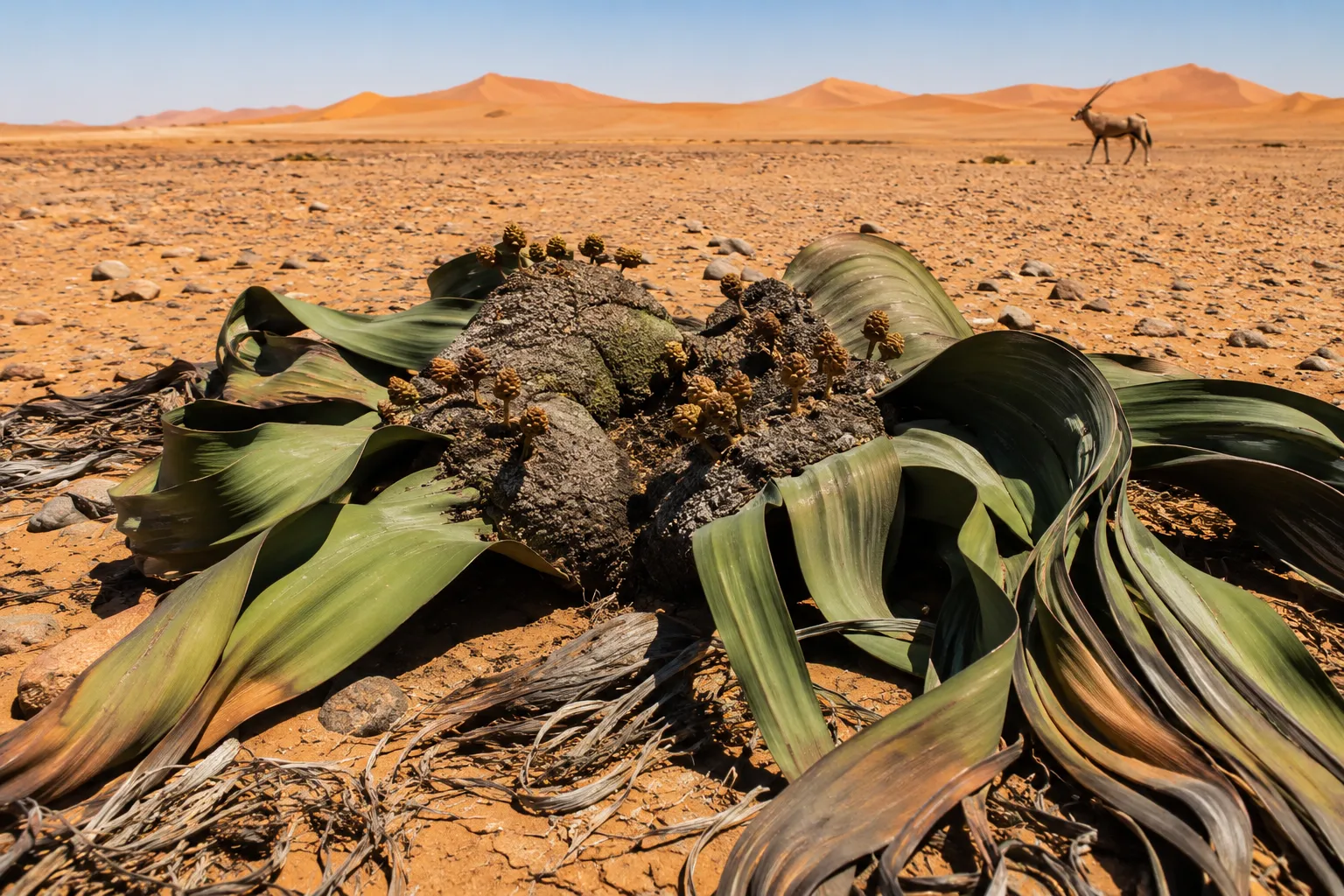
Fun Fact #18: The Welwitschia mirabilis, found in Iona National Park, has just two leaves that grow continuously for the plant’s entire life. Some specimens are estimated at over 1.000 years old, with a few possibly reaching 2.000.
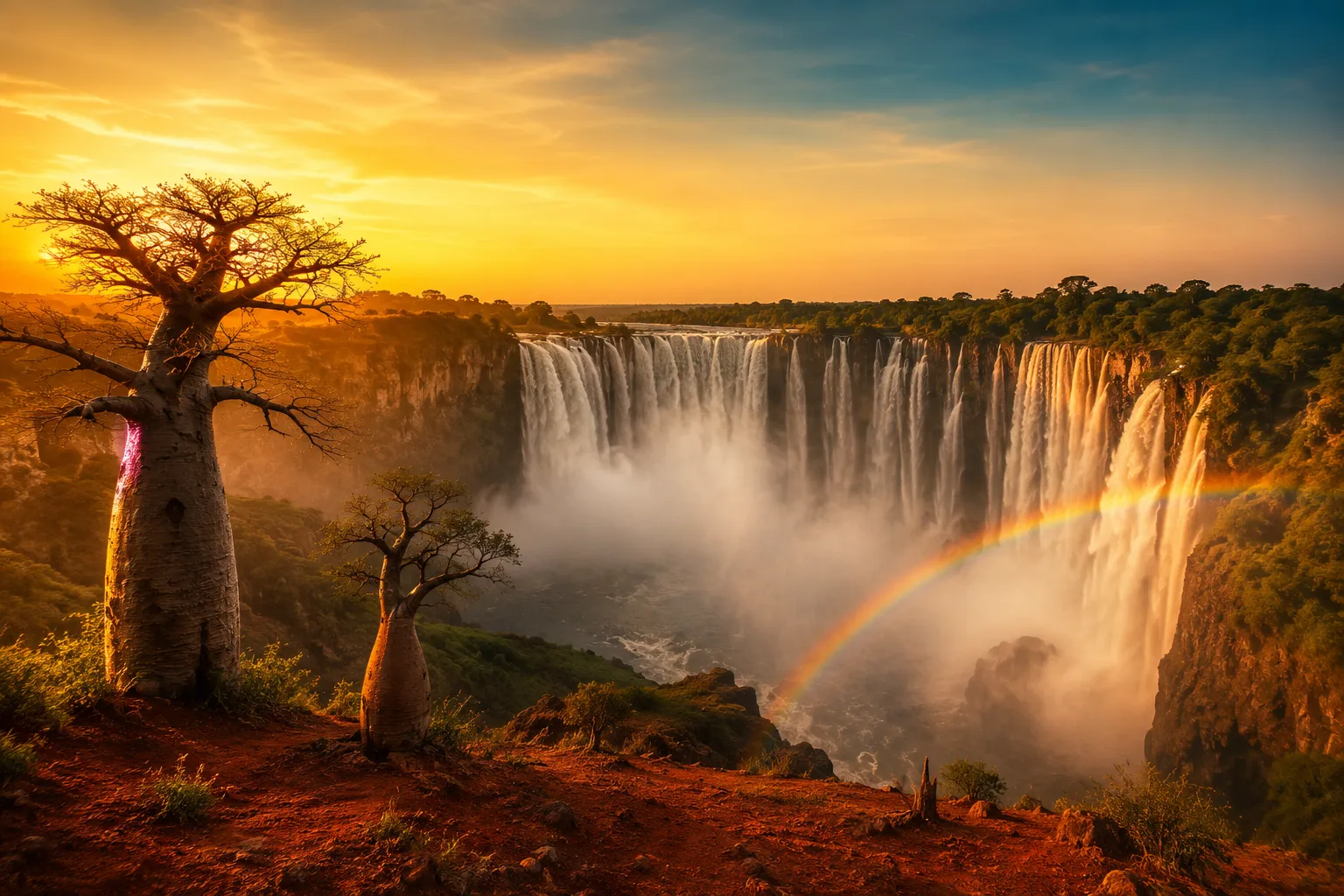
Fun Fact #19: Kalandula Falls in Malanje province plunges roughly 105 metres and stretches about 400 metres wide in the rainy season, ranking among the largest waterfalls in Africa by volume. Details in our Kalandula Falls.
Fun Fact #20: Angola contains part of the Miombo woodland, one of the largest tropical woodland ecosystems on the continent.
Fun Fact #21: The Miradouro da Lua (“Viewpoint of the Moon”) south of Luanda looks so otherworldly it’s often compared to a lunar landscape, sculpted by wind and rain over millennia.
Is Angola safe to visit?
Angola is generally safe for tourists who take normal urban precautions, especially in Luanda, Benguela and Lubango. Petty crime is the main risk, and stricter travel advice usually applies to the Cabinda exclave and some remote border areas.
Fun Fact #22: Landmines left over from the civil war have been largely cleared from tourist areas, thanks to organisations like the HALO Trust. Princess Diana famously walked through a partly cleared minefield in Huambo in 1997.
As of mid-2026, Angola is assessed as a moderate-risk security environment, mostly due to crime and infrastructure gaps rather than active conflict.[13] Always check your government’s current travel advice before you travel. In July 2025, a diesel price hike triggered large protests with reported casualties, a useful reminder to monitor news before booking.[1][6]
More detail in our dedicated guide: is Angola safe.
What is the best time to visit Angola?
The best time to visit is the dry, cooler season from May to October, when roads are passable, humidity drops, and wildlife is easier to spot. The rainy season (November to April) brings dramatic waterfalls but tough travel conditions.
Fun Fact #23: Kalandula Falls looks radically different depending on the season, a thundering wall in March or April, a photogenic curtain in July.
For a month-by-month breakdown, see best time to visit Angola.
How did Angola get its independence?
Angola gained independence from Portugal on 11 November 1975, after a 14-year armed liberation struggle led by the MPLA, FNLA and UNITA movements. Independence was quickly followed by a civil war that lasted until 2002.
Fun Fact #24: Angola’s Independence Day (11 November) is the country’s biggest national holiday, celebrated with parades, concerts and family gatherings.
What is Angola’s economy based on?
Angola’s economy is built on oil and gas, with growing contributions from diamonds, agriculture, fisheries and construction. The country is diversifying, but crude still dominates exports.
Angola’s economy grew 5,3% year-on-year in Q1 2026, with the non-oil sector expanding 6,2% while oil contracted slightly by 0,2%.[2] Consensus forecasts expect oil production to remain below the 2015-2024 average of 1,39 million bpd until at least 2030.[7]
Fun Fact #25: Angola is the second-largest oil producer in sub-Saharan Africa after Nigeria, and it left OPEC in early 2024 to pursue its own production strategy.
What are the most famous landmarks in Angola?
Angola’s most famous landmarks include Kalandula Falls, Fortaleza de São Miguel in Luanda, the Serra da Leba mountain pass, Cristo Rei of Lubango, and the Miradouro da Lua. Add Tundavala Gap and Pungo Andongo’s black rocks for the full postcard set.
Quick landmark cheat sheet:
| Landmark | Region | Why it’s worth it |
|---|---|---|
| Kalandula Falls | Malanje | One of Africa’s largest waterfalls |
| Fortaleza de São Miguel | Luanda | 16th-century fortress, city views |
| Serra da Leba | Huíla | Iconic hairpin mountain pass |
| Cristo Rei | Lubango | Christ statue overlooking the city |
| Miradouro da Lua | South of Luanda | Lunar-like eroded cliffs |
| Tundavala Gap | Huíla | Vertigo-inducing 1.000 m escarpment |
More ideas in our roundup of Angola attractions.
What is unique about Angolan culture?
Angolan culture blends Bantu traditions with Portuguese influence, expressed through music, food, language and religion. Semba, kizomba and kuduro are the soundtrack; Catholicism and indigenous beliefs share the spiritual space.
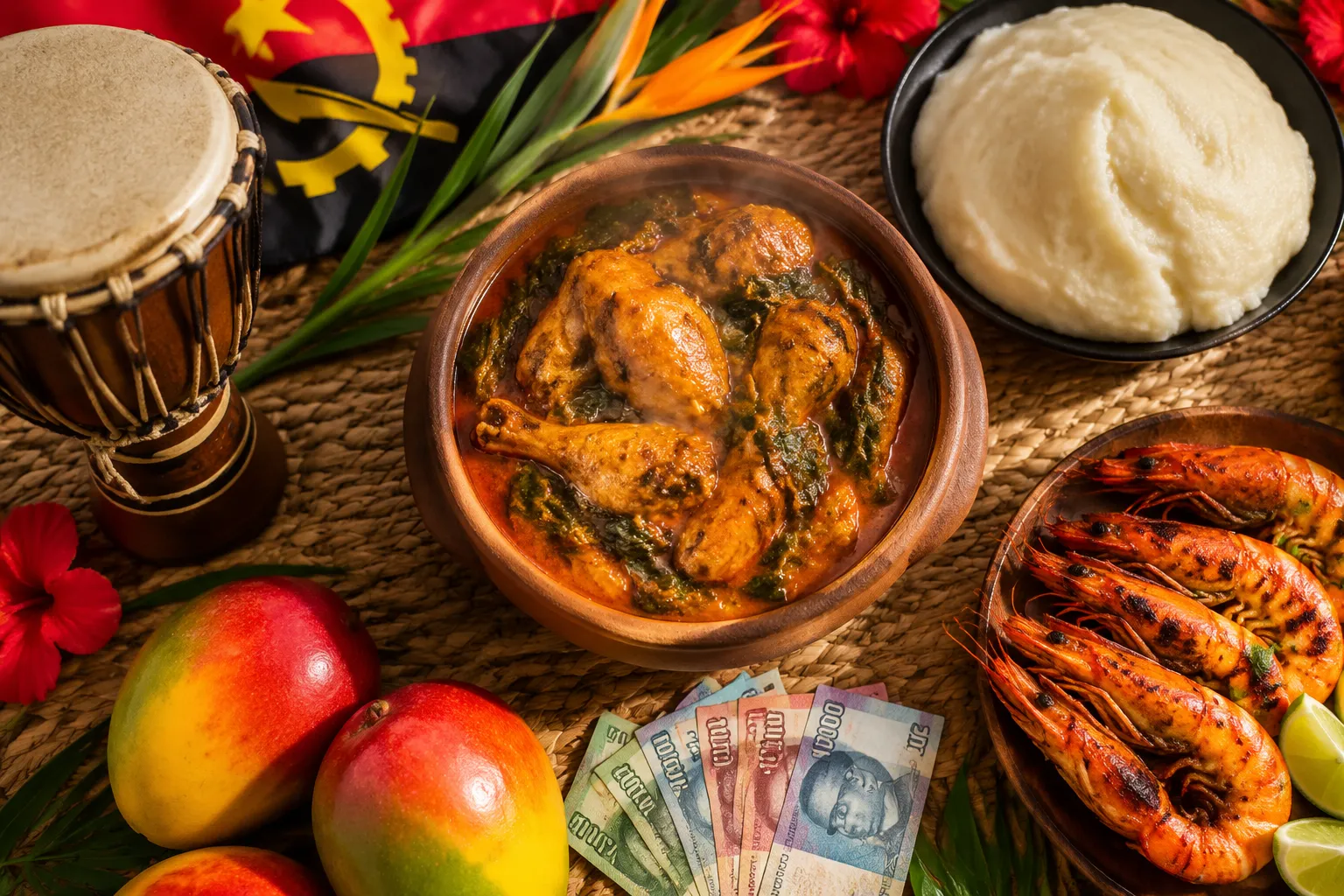
The national dish is muamba de galinha, a rich chicken stew with palm oil, okra and chilli, usually served with funge (a cassava or corn porridge). Coastal cuisine is heavy on fresh fish and prawns. Try our deeper dive into Angolan cuisine.
Can you visit Angola as a tourist?
Yes, and it’s easier than it used to be. Since 2023, Angola has significantly loosened its visa rules, offering visa-free short-stay access for many EU nationalities and an e-visa portal for others. Rules change, so always verify with the official Serviço de Migração e Estrangeiros before booking.
Practical checklist:
- Passport valid at least 6 months
- Yellow fever vaccination certificate (usually required)
- Return ticket and proof of accommodation
- Malaria prophylaxis (consult a travel clinic)
- Some cash in USD or EUR for exchange
More on documents and shots in Angola visa and Angola vaccinations.
Ready to plan your trip?
If these fun facts about Angola made you curious, the next step is easy. Start with our overview of why visit Angola ideas, then check visa and vaccination rules on the official portals before booking. For flights, TAAG Angola Airlines is the main carrier, and international connections run through Lisbon, Addis Ababa and Johannesburg.
Whatever you do: pack your curiosity, brush up on ten words of Portuguese, and go before the rest of the world catches on.
Time difference with Angola
Angola uses West Africa Time (UTC+1), all year round and with no daylight saving.
Angola stays on UTC+1 all year (no daylight saving). The UK matches Angola in summer and is 1 hour behind in winter; most of Western Europe matches Angola in winter and is 1 hour ahead in summer. More practical travel tips inour travel tips for Angola.
Want to keep this guide? We email you the key points with a link to every section.
Frequently asked questions
Is Angola bigger than Texas?
Yes. Angola covers about 1,25 million km², roughly twice the size of Texas.
Do Angolans speak Spanish?
No. Portuguese is the official language, alongside several Bantu languages such as Umbundu and Kimbundu.
Can I use euros or dollars in Angola?
Not for daily purchases. You'll need to exchange to Angolan kwanza. USD and EUR are the easiest to change at banks.
What is Angola's national animal?
The giant sable antelope (Palanca Negra Gigante), an endemic species that survived the civil war against long odds.
Is Angola good for a first-time Africa trip?
It's better as a second or third African destination. Infrastructure is improving fast but Portuguese-language skills and a flexible mindset help a lot.
What's the weirdest fact about Angola?
Probably the Welwitschia, a desert plant with two leaves that keep growing for over a thousand years. Nowhere else on Earth grows quite like it.
References
- [1] Angola - Human Rights Watch World Report 2026
- [2] Trading Economics, Angola Interest Rate News
- [3] Angola Production Dips Below Million Barrel Level For First Time Po...
- [4] Aman Alliance content brief
- [5] Angola's Oil Production Rebounds Above 1 Million Bpd
- [6] BBC News Angola protests
- [7] Angola Petroleum Production Dashboard